


1. Symptoms of sigmoid cancer |
2. Diagnosis of sigmoid cancer |
3. Sigmoid cancer treatment by stage |
4. Prognosis of patients with sigmoid cancer |
5. Where to go for treatment for sigmoid cancer? |
Colorectal cancer, which includes cancer of the sigmoid colon, is one of the most common malignant diseases of the GI. According to European statistics, it occurs in one in 20 cancer patients and has a high mortality rate. The incidence of sigmoid colon cancer peaks between the ages of 40 and 60. Men are a more vulnerable group.
Read our article to learn how the disease is diagnosed and treated abroad.

Listen to the article:
Types and symptoms of sigmoid cancer
Sigmoid cancer develops in the lower part of the colon, which is directly adjacent to the rectum. When the cells begin to grow uncontrollably, they form tumours that cause discomfort to the patient and can spread throughout the body.

There are different types of tumours of the sigmoid colon. They differ in cell structure, development, treatment methods and prognosis. The most common are:
 Adenocarcinomas of the sigmoid colon. They make up the majority of cases of this disease. The tumours form from the secreting cells of the inner walls of the organ. In the initial stages of the disease, they take the form of adenomatous polyps, which can later grow to become malignant.
Gastrointestinal stromal tumours/sarcomas are less common and form in the muscle tissues of the intestine. These tumours can be benign in their early stages but develop into malignant tumours over time.
Carcinoids are tumours that arise in the hormone-producing cells of the intestine. This type of disease is often asymptomatic.
In rare cases, lymphoma, a cancer of the lymphatic tract, starts in the bowel.
Patients usually come to doctors with the following complaints:
Intestinal disturbances;
Diarrhoea, constipation or feeling that the bowels are not emptying;
Blood in the stool;
Abdominal bloating and cramps;
Vomiting;
Sudden weight loss for no apparent reason;
Fatigue.
In stage 4 sigmoid cancer, metastases to distant organs can also cause painful symptoms. The disease most often metastasizes to the liver, but it can also affect the peritoneum, lungs, brain and distant lymph nodes. Patients may complain of pain in the affected areas of the body or organ dysfunction.
Factors that increase the risk of developing sigmoid cancer include:
Having close relatives who have had bowel cancer;
The presence of intestinal polyps;
Chronic ulcerative colitis;
Crohn’s disease;
Genetic predisposition to diseases such as Lynch syndrome or familial adenomatous polyposis;
Alcohol abuse;
Smoking;
Obesity.
The main problem in treating sigmoid cancer is that in 20% of cases it is diagnosed already at the final stage. For these patients, palliative treatment is the main option.
APPOINTMENT WITH AN ONCOLOGIST
Experienced oncologists in Germany, Spain, Israel and other countries can advise you on the treatment of sigmoid cancer, answer all your questions and draw up a treatment plan. To book an online consultation, please leave a request on our website by clicking on the button below.
Diagnosis of sigmoid cancer
When symptoms are consistent with sigmoid cancer, doctors prescribe several diagnostic procedures. They aim to make an accurate diagnosis. If the cancer is confirmed, they run tests to determine the stage of the disease and plan the treatment.
Colonoscopy | Colonoscopy is the leading method of diagnosing all bowel diseases. It involves inserting a thin tube with a camera through the anus. This allows the doctor to look at the organ from the inside. In this way, any suspicious lump can be seen. If a tumour is found, a sample can be taken straight away to test for the presence of cancer cells. |
Blood tests | When diagnosing bowel problems, doctors usually prescribe panel tests of liver and kidney functions. In addition, they may measure levels of cancer markers such as CEA. It is not the main method of confirming the diagnosis, but it is a good marker for the effectiveness of treatment. |
Imaging tests | If sigmoid cancer has been confirmed, doctors usually prescribe imaging tests to check the spread of cancer and the presence of metastases. For this purpose, a CT scan of the abdomen and chest is most often prescribed; however, an MRI or PET scan may sometimes be used as well. |
Medical organisations recommend regular bowel screening from the age of 45 onwards. Detecting the disease at an early stage increases the chance of full recovery and allows milder treatments to be used.
Treatment of sigmoid cancer by stage
Treatment for stage 0 sigmoid colon cancer
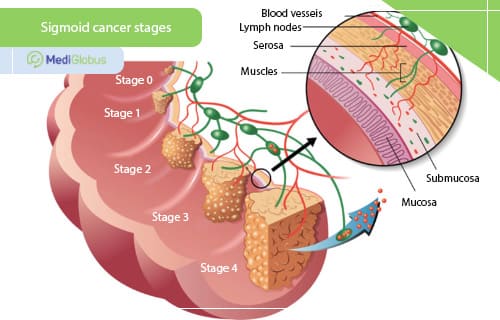
Tumours of the sigmoid colon at stage 0 are confined to the inner intestinal tissue layer. Resection, which can be done during a colonoscopy, is usually sufficient to treat them. Subsequent treatment afterwards will not be necessary.
Larger tumours may require a partial colectomy – the removal of a segment of the bowel. This is an invasive operation in which a small amount of surrounding tissue is removed in addition to the tumour. The remaining sections of the bowel are then stitched together and the organ continues to function normally.
Treatment of stage 1 sigmoid cancer
The mainstay of treatment for stage 1 sigmoid cancer is surgery – a partial colectomy. The specifics depend on the size and location of the tumour. The surrounding tissue and neighbouring lymph nodes can be removed along with the tumour. Due to the low risk of metastases, chemotherapy or other systemic therapies are usually not necessary at this stage.
Treatment of stage 2 sigmoid cancer
In stage 2 sigmoid cancer, chemotherapy may be prescribed in addition to colectomy. The specific protocol is chosen individually by the oncologist depending on the characteristics of the tumour and the patient’s general well-being. Chemotherapy is not administered in all cases, and its main purpose is to prevent a possible relapse. The doctor may test for the presence of MSI and MMR gene mutations before prescribing therapy, which will influence the choice of drugs.
Common indications for adjuvant (post-operative) chemotherapy for stage 2 sigmoid cancer are:
High grade of malignancy of the tumour;
The surgeon has not achieved clean margins;
Spread of the tumour into the blood or lymphatic vessels;
Incomplete lymphadenectomy;
Intestinal obstruction;
Intestinal perforation.
Treatment for stage 3 sigmoid cancer
Stage 3 sigmoid cancer is characterised by local metastasis of the tumour. The standard of care for all patients is the surgical removal of the tumour along with part of the intestine, nearby lymph nodes, and chemotherapy.
Radiotherapy may also be prescribed at this stage. It is used in cases if:
The tumour cannot be completely surgically removed. In these cases, chemoradiotherapy is given to reduce it. If the disease responds well to treatment, it will be possible to remove the tumour later;
Malignant cells have been found in nearby tissues or organs;
If the surgeon has not been able to achieve clean margins;
If the surgery cannot be performed due to the patient’s poor health.
Stage 4 sigmoid cancer

Stage 4 sigmoid cancer has spread to distant organs and tissues – liver, lungs, brain, peritoneum, and lymph nodes.
Chemotherapy is the main treatment for stage 4 sigmoid cancer. It can be given before surgery (neoadjuvant) or after surgery (adjuvant). Both approaches are used if the patient’s health allows it.
In most cases, a complete resection of the tumour is not possible due to the extent of cancer. More often than not, doctors will consider palliative treatment. During it, the surgeon will remove the parts of the organ that are causing the disease symptoms, but this does not lead to a complete cure. Surgery is often needed to relieve bowel obstruction. Doctors may carry out a colectomy – removing part of the bowel – or a colostomy – removing part of the bowel and diverting the end of the organ out through the peritoneum.
Radiotherapy is also used in the treatment of stage 4 cancer, especially for metastases. It is also effective in shrinking primary bowel tumours to relieve the patient of pain.
Metastases that have formed in the liver can be treated by ablation or embolisation. Ablation is a procedure in which the tumour is destroyed by ultralow temperatures, radiofrequency, microwave radiation, or chemicals. During embolisation, the flow of blood to the tumour is cut off. Both operations are minimally invasive and can therefore be performed if open surgery is generally contraindicated.
Targeted therapy can also be used for stage 4 sigmoid cancer. These are drugs that have a selective effect on cancer cells and cause fewer side effects than chemotherapy. Before a targeted therapy is prescribed, genetic tests are carried out to check whether the drug will be effective for a particular patient. The FDA has approved more than 18 different drugs for the treatment of intestinal malignancies.
Treatment of recurrent sigmoid cancer
Sigmoid cancer can return after reaching remission if malignant cells remain in the body. In the later stages of the disease, this is more likely to happen. Recurrence can occur in the intestine as well as in other organs. In the first case, the main treatment protocol is surgery with adjuvant and/or neoadjuvant chemotherapy. Treatment can be palliative or with recovery as the goal. The treatment of relapse with a focus on distant organs depends on the location of the tumour – surgery, chemotherapy, radiation therapy, targeted therapy, ablation, embolisation, etc.
CANCER TREATMENT
Mediglobus coordinating doctors will help you with choosing a clinic for treatment abroad and making travel arrangements. For a free consultation, please click the button below and wait for our call.
Prognosis of patients with sigmoid cancer
The prognosis for patients depends on many factors, the most important of which are the type and stage of the tumour.
| Disease stage | Five-year survival rate | Percentage of patients diagnosed at this stage |
|---|---|---|
| Localised sigmoid tumour (stage 0-1) | 91% | 37% |
| Sigmoid tumour spread to adjacent tissues and lymph nodes (stage 2-3) | 72% | 36% |
| Sigmoid tumour with distant metastases | 15% | 22% |
Recurrence of sigmoid cancer occurs in 25-30% of patients at stage 2, and 60% at stage 3.
Among the factors that have a positive effect on the prognosis of treatment for sigmoid cancer:
The early stage at the time of diagnosis;
No bowel obstruction or perforation;
A low number of metastases at stage 4 of the disease;
Ability to achieve a clean margin;
Low CEA at the start of treatment;
General good health of the patient.
 Читать:
 Where to go for treatment for sigmoid cancer?








Summary
Sigmoid cancer develops in the lower part of the colon, which is directly adjacent to the rectum. There are different types of tumours, the most common being adenocarcinomas, sarcomas, carcinoids and lymphomas. The main symptoms are bowel dysfunction, pain, weakness and weight loss.
Colonoscopy, blood tests and imaging tests (CT, MRI, etc.) are used to diagnose the disease.
At stage 0, sigmoid colon cancer (polyp) can be removed during a colonoscopy. In later stages, surgery, chemotherapy, radiation therapy, targeted therapy, embolisation and ablation are used.
The prognosis for treatment of sigmoid cancer depends on the type and stage of the tumour, as well as other factors, and ranges between 15% and 91%.
Patients choose clinics in Turkey, Israel, Spain, Germany, Azerbaijan and South Korea for treatment of sigmoid cancer abroad.
TREATMENT APPOINTMENT
To book an appointment for cancer treatment abroad, click on the button below and fill in the form. Our coordinators will call you back within 30 minutes. They will provide you with all the necessary information and help with travel arrangements.