


Nephroblastoma (Wilms’ tumour) is a highly malignant kidney cancer. The disease develops in childhood. More than 75% of cases occur in children under the age of 5. Boys and girls are affected equally. The incidence rate in patients under 15 years of age is 1:10,000. The disease accounts for 6% of all childhood cancers (from the book ‘Wilms Tumour’ by Marry M. van den Heuvel-Eibrink). The main method of treating the disease is surgical intervention. Read our article to find out how Wilms’ tumours are removed abroad and what the chances of complete recovery are for patients at foreign clinics.
Preparation for surgery
Before surgery, doctors perform a thorough preoperative examination using appropriate imaging methods.
This is necessary to determine the characteristics of the tumour, its location, damage to adjacent tissues and vascular involvement. The specialists also determine whether one kidney or both are affected.
If renal vein and cavity dilation is detected during diagnosis, the operation should be postponed, and chemotherapy should be started. An abdominal Doppler ultrasound is also recommended to check for a clot in the renal vein. If the clot has spread to the thoracic vena cava, the patient will need echocardiography. It is important to note that some patients may require emergency cardiac surgery. Therefore, a paediatric surgeon specialising in oncology and a cardiac surgeon are required to operate, and appropriate equipment, including a heart-lung bypass machine, is also necessary.
In the case of an unresectable tumour, a biopsy is performed first. Surgery is indicated after a course of chemotherapy, after which most tumours shrink significantly in size.
If the diagnosis reveals bilateral Wilms’ tumour, the doctors first perform a surgical examination and take tissue samples via a biopsy. The patient is then prescribed chemotherapy, which usually lasts 6 weeks. Such preoperative treatment is followed by surgery. The used technique depends on the stage, size and location of the tumour and other factors. This approach to treating bilateral nephrectomy reduces the risk of developing renal failure. The overall 2-year survival rate in such cases exceeds 80%.
The International Society of Paediatric Oncology (SIOP) recommends chemotherapy before surgery for children under 6 months of age with nephroblastoma. This reduces the risk of complications during and after nephrectomy.
You can find out about diagnosis and the possibility of surgery in one of the clinics abroad by contacting a MediGlobus specialist. You will receive comprehensive information about the disease and treatment methods. We will also help you choose a hospital, make an appointment with a doctor and prepare for your trip.
 Read:
Read: Surgery for nephroblastoma
The main goal of surgery is to remove the entire Wilms tumour in a single procedure. This is necessary to prevent the spread of cancer cells to the abdominal cavity. If the tumour is too large and has metastasised, the patient undergoes chemotherapy and/or radiation therapy to reduce the tumour before surgical resection.
Nephrectomy is the key treatment option for nephroblastoma. This procedure involves the partial or complete removal of the affected kidney.
The surgical technique is selected individually for each specific case. Abroad, most nephrectomies are performed using a minimally invasive approach, with the help of a Da Vinci robotic assistant, or laparoscopically.
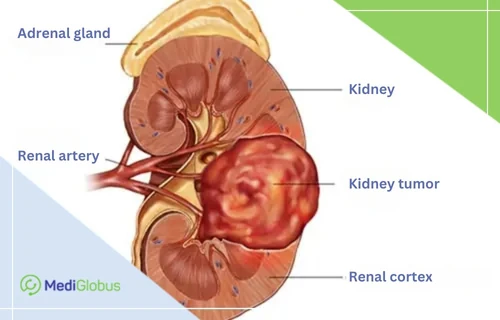
Radical nephrectomy is the most common surgery for Wilms’ tumour.
It is performed under general anaesthesia. The surgeon removes the malignant tumour along with the entire kidney, ureter and fatty tissue surrounding the organ. The doctor also resects the affected lymph nodes. Then they check the liver and the other kidney for cancer cells. Tissue from any suspicious areas is taken for examination under a microscope — a biopsy.
Radical nephrectomy is performed via classic extraperitoneal or transperitoneal access. In oncological practice, preference is given to median laparotomy. This is due to the physiological position of the patient on the operating table, the low trauma of the operation, and the speed of its performance.

In 15% of children with cancer, nephroblastoma affects the lungs. This is diagnosed using X-ray or CT scanning of the chest. In this case, the surgeon takes a sample of the affected tissue or completely removes the node through a separate incision in the chest wall. Knowing whether the nephroblastoma has spread to the lymph nodes, liver, or other kidney is necessary to accurately determine the stage of the disease and develop a further treatment plan.
After radical nephrectomy, the remaining kidney increases in size and completely takes over the function of filtering the blood. With adequate treatment of nephroblastoma, recurrence of the disease is rare. The child develops and grows at the same rate as healthy children. However, to monitor the situation, they must undergo regular examinations by an oncologist and diagnostic tests.
Partial nephrectomy involves removing part of the kidney. This operation is performed in the early stages of nephroblastoma or if the child has only one functioning kidney left.
For children with Wilms’ tumours in both kidneys, it is important to preserve as much normal kidney tissue as possible. First, the surgeon performs a radical nephrectomy. They remove the kidney that is more affected by cancer. Then the doctor performs a partial nephrectomy on the other kidney. A partial nephrectomy on both kidneys is also possible.
Minimally invasive surgery for Wilms’ tumour
Robotic surgery
This is the preferred option for nephroblastoma surgery. It is less traumatic, bloodless and easier for children to tolerate. The Da Vinci robot is used to perform the procedure. The tumour is removed through incisions no larger than 1,5 cm. For comparison, in classic open surgery, the incision reaches 30 cm. The surgeon’s precision is enhanced by a 3D video camera and robotic microsurgical instruments. Postoperative sutures heal within a month and are removed 5-7 days after surgery.
Laparoscopic removal of nephroblastoma
Laparoscopic nephrectomy is used to remove small kidney tumours while preserving healthy kidney tissue. This is a minimally invasive technique that causes less trauma to patients and allows for a quick recovery. The doctor removes the tumour using a laparoscopic technique, inserted through three punctures in the kidney area.
The Journal of Translational Andrology and Urology lists the following advantages of minimally invasive interventions in nephrectomy:
- intraoperative visualisation ensures more accurate removal of affected tissues;
- smaller incisions and less trauma result in less pain after surgery;
- patients start eating sooner after surgery, which speeds up the recovery process;
- shorter hospital stay;
- patients return to normal activity faster;
- the use of a small incision leads to better aesthetic results compared to a large incision in open surgery.
Kidney transplant after removal of Wilms’ tumour
More than 10% of children with nephroblastoma have bilateral kidney damage. If a child is diagnosed with this disease, total removal of both kidneys is indicated. After such an operation, the child will need dialysis several times a week. During this procedure, a special machine performs the function of the kidneys — filtering the blood. As soon as the child recovers from surgery and a donor kidney becomes available, they will need to undergo organ transplantation.
Children with stage 5 nephroblastoma undergo kidney transplantation no earlier than 1-2 years after surgery. This is because the risk of recurrence is highest during this period. If there are no signs of cancer after a year or two, the cancer patient can have a donor kidney transplant.
Donors can be first-degree relatives (mainly a sister or brother) or people with maximum genetic compatibility. If a person does not have a suitable related donor, they can contact a clinic to participate in a cross-organ transplant programme. As part of this programme, several families facing similar problems are selected. If donors and recipients from different families are compatible, they can undergo organ exchange, giving patients a chance for a successful recovery.
Stay with MediGlobus and keep up to date with the latest news about achievements in foreign medicine. If you need the help of a neurologist abroad, leave a request. Our coordinators will help you find a clinic that offers a helpful treatment programme.

Complications during and after nephrectomy
According to a study by the National Wilms Tumour Study Group (NWTSG), which involved 3,335 children who underwent primary nephrectomy due to malignant kidney tumours, surgical complications occurred in 12,7% of patients. The complications identified included intestinal obstruction (5,1%), excessive bleeding (1,9%), infection at the surgical site (1,9%) and damage to large vessels (1,5%). A significant increase in the risk of complications was observed when the tumour size exceeded 10 cm.
Studies also indicate a varying risk of tumour rupture depending on preoperative treatment. Complications were identified in 15% of patients who underwent surgery without prior chemotherapy. Only 3% of children who underwent chemotherapy experienced such undesirable consequences.
Prognosis for the treatment of nephroblastoma abroad
‘The combination of surgery, chemotherapy before and after surgery, and radiation therapy after surgery makes patient survival very high,’ says Dr José Manuel Moreno Villares, paediatric specialist, medical director of the University of Navarra Clinic in Madrid, co-director of the paediatrics department.
According to data from the American Society of Clinical Oncology, the relative 5-year survival rate for patients with Wilms’ tumour is 93%. The cancer stage, the patient’s age and general health, and other factors influence the prognosis:
- For stage 1, 2, and 3 nephroblastoma with favourable histology, the relative 4-year survival rate is 95-100%.
- For stage 4 and 5 tumours with favourable histology, the relative 4-year survival rate is 85-100%.
- Survival rate for neoplasms with focal anaplastic histology is 70-100%.
- Survival rate for Wilms tumours with diffuse anaplastic histology is 30%-85%.

According to the Children’s Oncology Group (COG), nephroblastoma recurrence occurs in approximately 10-15% of cases. It is more common after unilateral nephrectomy and is associated with right-sided tumour location and larger tumour size. The COG study showed that recurrence in the flank or abdomen is observed in 7,4% and 9,5% of patients with stage II nephroblastoma after intraoperative surgical spill (tumour rupture during surgical removal). In patients without spill, these rates decrease to 2,5% and 3%, respectively.
When chemotherapy is used, the survival rate after recurrence is approximately 50-60%. The prognosis also depends on the initial stage of the disease, the initial treatment, the extent of the cancer spread, and the duration of the recurrence. Complete resection of the recurrent lesion is also a favourable prognostic factor.
Where can patients with Wilms’ tumour be treated abroad?
The treatment of patients with nephroblastoma requires a multidisciplinary approach. A team of doctors, led by a paediatric oncologist and urologist, selects the optimal surgical option. Cancer treatment for this category of patients is carried out at specialised and general clinics.
The leading countries in this field are Turkey, Spain, Austria, China, Israel, Korea, and India. These countries have leading medical institutions for the treatment of cancer in children, in particular, Wilms’ tumour. Among them are:
Liv Hospital network in Turkey

SoonChunHyang Hospital in South Korea

Fuda Cancer Centre in China

Navarra University Clinic in Madrid

Memorial Hospital Network in Turkey

Sourasky Medical Centre (Ichilov) in Israel

Fortis Clinic in India

Vienna Private Clinic in Austria

Summary
- Nephroblastoma is the most common primary kidney tumour in children. It has an aggressive course. Most cases of oncological pathology occur between the ages of 2 and 5. Boys and girls are affected with equal frequency.
- Before a nephrectomy, the patient needs to undergo a preoperative examination to determine the characteristics of the tumour. In some cases, the best option is to postpone surgery and undergo chemotherapy first. A comprehensive approach that takes into account the stage of the tumour influences the choice of surgical technique and ensures higher survival rates.
- Nephrectomy is the key treatment option for nephroblastoma. This procedure involves partial or complete removal of the affected kidney. The surgical technique is selected for each specific case. Abroad, most nephrectomies are performed using minimally invasive techniques, with the help of the Da Vinci robotic assistant or laparoscopically.
- After radical nephrectomy, the remaining kidney increases in size and takes over the function of filtering blood. With adequate treatment of nephroblastoma, recurrence of the disease is rare. The child develops and grows at the same rate as healthy children. However, they must undergo regular examinations by an oncologist and diagnostic tests to monitor the situation.
- Kidney transplantation is indicated in cases of bilateral nephrectomy. Donors may be first-degree relatives (primarily a sister or brother) or unrelated individuals with maximum genetic compatibility. The best results are achieved with kidney transplants from living donors.
- Complications occur in 12,7% of patients. These include intestinal obstruction, profuse bleeding, infection at the surgical site, damage to large vessels, and tumour rupture. The risk of complications is reduced after chemotherapy prior to surgery.
- Combined treatment, including surgery, chemotherapy before and after surgery, and radiation therapy after surgery, improves the survival prognosis for patients with Wilms’ tumour.
- The relative 5-year survival rate for Wilms’ tumour is 93%. The prognosis depends on the stage of the cancer, the patient’s age, overall health, and other factors.
- Recurrence of nephroblastoma occurs in 10-15% of cases, especially after unilateral nephrectomy. The use of chemotherapy after recurrence provides a survival rate of approximately 50-60%. Complete resection of the recurrent lesion also has a favourable effect on the prognosis.
- Nephrectomy for nephroblastoma is performed in Turkey, Spain, Austria, China, Israel, Korea, and India. These countries have leading medical institutions for the treatment of cancer in children.
Specialists at the MediGlobus International Patient Support Centre will advise you on all matters related to choosing a clinic and organising treatment. Leave your contact details and we will get in touch with you!