


Increasingly, international medical protocols recommend the use of monoclonal antibodies for the treatment of various diseases, especially cancer. Many patients have questions – what are these drugs? How do they differ from others? How and how much to use them? What is their effectiveness? What are the risks? MediGlobus experts will answer these and other questions in our article.
What are monoclonal antibodies?
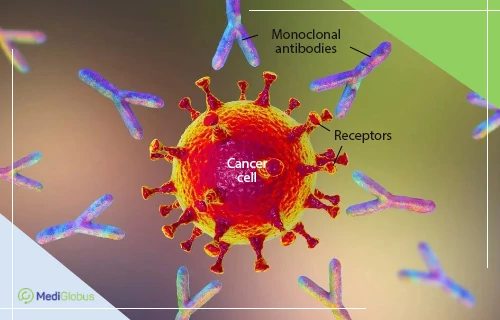
Monoclonal antibodies are a group of medicines that are laboratory-grown copies of immune cells called antibodies. This is part of the body’s defence system that fights pathogenic agents such as infections or cancerous tumours. The unique ability of antibodies is to recognise specific receptor proteins on the cells to which they can attach. When doctors find that, for example, cancer cells have large numbers of receptors such as HER2, they can create monoclonal antibodies that will “hunt” them.
Monoclonal antibodies have a wide range of effects and can be used for various diseases including malignant tumours, graft rejection after organ transplantation, and autoimmune and infectious diseases. New drugs are being developed annually and new applications for existing drugs are being discovered.
Each monoclonal antibody can recognise only one protein receptor. Therefore, to fight the disease effectively, it is necessary to individualise the drugs for each patient. Often in foreign clinics, cancer patients are prescribed such a procedure as immunohistochemistry. This is a laboratory study, which is carried out after a biopsy on the collected tissues, allowing identification of the presence of specific receptors, under which it will be possible to select monoclonal antibodies.
According to the World Health Organisation, as of 2024, there are more than 800 drugs of the monoclonal antibody group registered in the world. They can be easily distinguished by the ending “mab”: pembrolizumab, adalimumab, bevacizumab, etc.

What diseases are monoclonal antibodies used for?
The use of monoclonal antibodies for the treatment of various diseases is approved by international organisations after long and thorough studies. The efficacy of this group of drugs has been proven in application to the following diagnoses:
Cancer
Most often monoclonal antibodies are used for the treatment of cancer. Tumours curable in this way include chronic lymphocytic leukaemia, breast cancer, stomach cancer, and many other diagnoses. The drugs are particularly commonly used to treat stage 3-4 disease and have increased efficacy when combined with chemotherapy and/or radiation therapy.
Organ rejection syndrome
Overseas, doctors have begun to increasingly use monoclonal antibodies to prevent or treat organ rejection following transplantation. The drugs can be administered after kidney, liver, lung, heart, etc. transplants. This treatment approach has dramatically prolonged short and long-term organ survival, but also carries with it the risk of infectious complications.
Autoimmune and inflammatory diseases, including allergies
Monoclonal antibodies can treat autoimmune diseases (e.g. systemic lupus erythematosus), inflammatory processes (various forms of arthritis, etc.), and allergies, including seasonal allergies. The drugs help by directly targeting the disturbed immune mechanisms, thus addressing the problem at its root.
Infections including COVID-19
Monoclonal antibody therapy can be used as an alternative to vaccination for certain infections such as hepatitis B, malaria, diphtheria, tetanus, rabies, etc. In the case of coronavirus, reputable medical organisations, including the Pasteur Institute, recommend monoclonal antibodies specifically for immunocompromised patients to protect them from more severe strains of the disease.
Osteoporosis
Two medications from the monoclonal antibody group have been approved to treat osteoporosis. They make bones stronger by stopping cells from working to destroy them. This treatment approach is more effective than standard vitamin therapy. Monoclonal antibodies help prevent fractures, which can be particularly dangerous in old age.
Migraine
Monoclonal antibodies work by blocking CGRP receptors, which can cause inflammation and pain in the head area in people who suffer from migraine attacks. These drugs also have a vasodilatory effect. Thus, their effects are twofold: they both eliminate the cause of pain and reduce the sensitivity to it.
Elevated cholesterol
Controlling cholesterol levels is an important component of preventing cardiovascular disease, especially in older age. Monoclonal antibody therapy helps lower its levels by improving liver function. The medication attaches to the PCSK9 protein, which has a damaging effect on the liver’s LDL receptors that help break down “bad” cholesterol. Taking the drug increases the number of LDL receptors.
Certain eye diseases
Monoclonal antibodies can treat a wide range of angiogenic and inflammatory ophthalmic diseases, such as giant cell arteritis, Graves’ disease, non-infectious uveitis, and age-related macular degeneration.
Certain diseases of the nervous system
The use of monoclonal antibodies is also possible in the treatment of many neurological diseases, among which multiple sclerosis, optic neuritis and various forms of peripheral demyelinating neuropathy are the most common.
 Read:
Read: How do the drugs work and how effective are they?
Monoclonal antibodies can have many different mechanisms of action on disease. It all depends on which proteins they target and what type of drug they belong to. Often the drugs prescribed to patients fight the disease using multiple pathways at once.
The synergistic effect of targeted therapies, including monoclonal antibody treatment, is also important. Its essence is that the simultaneous use of several methods of cancer treatment (for example, monoclonal antibodies and chemotherapy) mutually reinforces each other, and the result is better than the sum of the percentages of effectiveness.
When it comes to cancer treatment with monoclonal antibodies, the main effects of the drugs include:

 Direct destruction of cancer cells;
“Marking” cancer cells, making them “visible” to the immune system;
Blocking tumour growth;
Disrupting the blood supply to the tumour;
Triggering the self-destruct mechanisms of cancer cells;
Blocking immune system inhibitors that make the immune system unable to fight cancer;
“Training” the immune system to recognise and destroy cancer cells;
Targeting delivery of chemotherapy or radiation therapy.
The effectiveness of monoclonal antibody treatment depends on many factors, and it is important to remember that not all patients may be indicated for this therapy. In foreign cancer centres, drugs are only prescribed after doctors are sure they will be effective enough for a particular patient and the therapeutic effect will be greater than the potential risks of side effects.
Speaking of specific diagnoses, studies show the following indications of the effectiveness of cancer treatment with monoclonal antibodies:
| Diagnosis | Drug example | Efficacy |
|---|---|---|
| Chronic lymphocytic leukaemia | Rituximab | 83,3% of patients have a positive response to therapy, while the conventional protocol has only 60,2% efficacy rate |
| Acute lymphoblastic leukaemia | Alemtuzumab | 91% of patients respond to treatment, among whom 81% succeed in completely eradicating signs of cancer |
| HER2-positive breast cancer | Trastuzumab | Reduces mortality and recurrence rates by one-third |
| Gastric cancer (adenocarcinoma) | Ramucirumab | Average patient survival is 75% longer |
| Multiple myeloma | Bortezomib | 68% of patients over 65 cross the 5-year survival threshold |
| Small cell lung cancer | Pembrolizumab | When monoclonal antibodies are used, the efficacy of the treatment protocol increases 2,52-fold. |
What are the different types of drugs?
There are several groups of monoclonal antibodies, differing in structure and mechanism of action. These include naked monoclonal antibodies, conjugated monoclonal antibodies, and bispecific monoclonal antibodies.
Bare monoclonal antibodies
These are the group of drugs that are most commonly used in the treatment of cancer. They are just synthesised antibodies, without any additional attached structures. The drugs work by attaching to the cancer cells or proteins floating in the blood. Such substances can have a variety of therapeutic effects:

Depending on the type of effect of the drug, it can be classified as “targeted therapy” or “immunotherapy“. Targeted therapy refers to drugs that can have a targeted effect on specific cells, depending on the expression of a particular protein on their surface. Immunotherapy refers to drugs that affect the activity or focus of the patient’s immune system – usually by activating it to fight the disease on its own.
Slow or stop tumour growth by attaching to cancer cells and blocking proteins that help them multiply;
Boost the cancer patient’s immune response by attaching to cancer cells and acting as a marker for the body’s immune system to destroy them;
Enhance the cancer patient’s immune response by targeting immune system checkpoints.
Conjugated monoclonal antibodies
In conjugated monoclonal antibodies, additional anti-tumour components – usually a chemotherapy drug or a radiation-emitting particle – are attached to the basic structure of the drug. In tandem, such drugs effectively destroy cancerous tumours from within – the antibody finds malignant cells, attaches to them and delivers the drug inside. Such drugs have a mechanism of action similar to that of standard chemotherapy or radiation therapy, but with a significant improvement: the presence of a monoclonal antibody avoids the drugs’ impact on healthy tissue, which reduces the number and severity of side effects.
Bispecific monoclonal antibodies
Such drugs consist of parts of two different monoclonal antibodies and can attach to two different proteins at the same time. So-called BiTE drugs are most commonly used in the treatment of cancer. In these drugs, one part attaches to a protein on cancer cells and the other part attaches to a protein on immune T-cells. This brings the immune system into contact with the cancer process, which helps to teach it to recognise tumours and ‘switch on’ the body to fight the cancer. Such a group of drugs is used in the treatment of, for example, acute lymphoblastic leukaemia, multiple myeloma, lymphoma and small-cell lung cancer.
Side effects and what to do about them

Compared to chemotherapy and radiation therapy, side effects from monoclonal antibodies do not have such a burdensome impact on patients. The targeted effects of the drugs avoid most of the negative effects on healthy tissues.
However, the risk of some complications do exist, and cancer patients are always warned about them before starting treatment. In most cases, drugs are administered in the form of intravenous drips, so treatment is carried out under the supervision of medical staff. Depending on what side effects the patient is dealing with, different methods are chosen to control and minimise them.
In general, the most common side effects caused by monoclonal antibody drugs are:
Fever, chills, weakness, muscle pain;
Rash, itching, and hives;
Nausea, vomiting, diarrhoea;
Low blood pressure.
In rare cases, patients develop more dangerous complications. The medical staff treating cancer patients are always aware of the risk of complications and are trained to provide emergency care. In foreign clinics with which MediGlobus co-operates, the reaction time of the medical team in emergencies is less than a minute.
Severe side effects of monoclonal antibodies include:
Severe allergic reactions;
Internal bleeding;
Skin ulcers and rashes;
Congestive heart failure and heart attacks;
Increased risk of certain infections;
Inflammatory lung disease.
Where to go for treatment?
The price of monoclonal antibody therapy will vary significantly depending on the diagnosis, the drug, the duration of the course and other factors. A good way to save money on treatment abroad can be to compare the cost of oncotherapy in different countries. The international platform MediGlobus can help you in this matter. Leave a request on our website and we will give you a free consultation and estimate for your treatment.







Summary
Monoclonal antibodies are advanced medical drugs used in the treatment of cancer, infections, transplant rejection, immune, neurological, ophthalmological and other diseases.
Monoclonal antibodies are copies of immune cells that have the unique ability to attach to receptor proteins on the surface of pathogenic cells. Through this mechanism, it is possible to trigger the self-destruction of cancerous tumours, slow their growth, target drug/radiation delivery, etc.
The use of monoclonal antibodies can significantly improve the prognosis of the disease and the effectiveness of other therapies.
Monoclonal antibodies have fewer side effects than standard cancer treatment protocols.
The drugs are usually administered intravenously over an extended course. The drugs are available at specialist cancer centres, for example, Hisar Intercontinental (Turkey), Uniclinica Navarra (Spain), Uniclinica Cologne (Germany), Vienna Private Clinic (Austria), Ichilov (Israel), Fuda Clinic (China), and SoonChunHyang Clinic (South Korea).
Stay with MediGlobus and keep up to date with the latest news on the latest developments in foreign medicine. If you need help from a neurologist abroad – leave an appointment. Our coordinators will help you find a clinic that offers a treatment program that will help you.

Sources:
- 1. American Cancer Society
- 2. National Library of Medicine
- 3. Nature: The safety and side effects of monoclonal antibodies
- 4. UpTpDate: Overview of therapeutic monoclonal antibodies
- 5. MAbs: Antibody immunosuppressive therapy in solid-organ transplant
- 6. World Health Organisation
- 7. Institut Pasteur
- 8. Drugs Today: Monoclonal antibodies for treatment of osteoporosis
- 9. National Migraine Centre
- 10. Heart UK
- 11. Progress in Retinal and Eye Research: Therapeutic monoclonal antibodies in ophthalmology
- 12. ACTA Academiae Medicinae Sinicae: Efficacy of Rituximab for Patients with Chronic Lymphocytic Leukemia
- 13. Blood: Alemtuzumab therapy in T-cell prolymphocytic leukemia: comparing efficacy in a series treated intravenously and a study piloting the subcutaneous route
- 14. Lancet Oncology: Trastuzumab for early-stage, HER2-positive breast cancer: a meta-analysis of 13 864 women in seven randomised trials
- 15. Journal of Clinical Oncology: Efficacy of ramucirumab combination chemotherapy as second-line treatment in patients with advanced adenocarcinoma of the stomach or gastroesophageal junction after exposure to checkpoint inhibitors and chemotherapy as first-line therapy within the prospective phase II IKF-S628/AIO-STO-0417 (MOONLIGHT) trial.
- 16. Frontiers in Oncology: Effectiveness and safety of pembrolizumab for patients with advanced non-small cell lung cancer in real-world studies and randomized controlled trials: A systematic review and meta-analysis