


Facial neuritis (Bell’s palsy) is a disease of the peripheral nervous system that affects 1 million people worldwide, according to WHO statistics. Every year, doctors diagnose 20-30 cases of the disease per 100,000 population. Children account for 30% of the total number of patients.
In most hospitals in developing countries, doctors use traditional methods of treatment – drug therapy and physiotherapy. In some cases, this approach is ineffective and leads to the development of complications. In European, Turkish, Israeli, and South Korean clinics, doctors can accurately determine the cause of neuritis and prescribe the correct treatment using modern diagnostics. The use of the latest medical developments offers a high chance of a quick and complete recovery. In foreign clinics, 80-90% of patients with facial nerve neuritis of any complexity are completely cured of the pathology.
What is facial neuritis?
Facial neuritis is a disease that causes inflammation, loss of sensation and paralysis of the facial nerves. As a result, a person’s facial expressions become expressionless or disappear completely, and the face becomes asymmetrical.

The main causes of disease are:
- inflammatory processes of the hearing organs, sinuses and brain;
- viral and infectious diseases (chickenpox, measles, mumps, Lyme disease, sarcoidosis, etc.);
- traumatic brain injury;
- vascular pathologies;
- cancer.
The risk of developing the disease increases in cases of acute respiratory infections, after hypothermia, in pregnant women, as well as in patients with diabetes mellitus, atherosclerosis and multiple sclerosis. The disease is mainly diagnosed in people aged 25-45.
Interesting fact
Inflammation of the facial nerve can be caused by the herpes virus. This virus causes small rashes on the lips or shingles.
Among the main forms of the pathology, one-sided Bell’s palsy is more common. In 2% of cases, bilateral nerve damage develops.
Symptoms of facial nerve neuritis
The facial nerves control the muscles of the middle ear, as well as the facial muscles responsible for blinking and facial expressions. In addition, the facial nerves regulate the salivary and lacrimal glands and transmit information from the taste receptors on the tongue to the brain. Therefore, when the facial nerves are affected, patients experience a wide variety of symptoms.
Symptoms of the disease:
- impaired sensitivity in the face;
- pain in the ear or jaw;
- impaired hearing and taste;
- changes in the amount of saliva or tears produced;
- facial asymmetry.
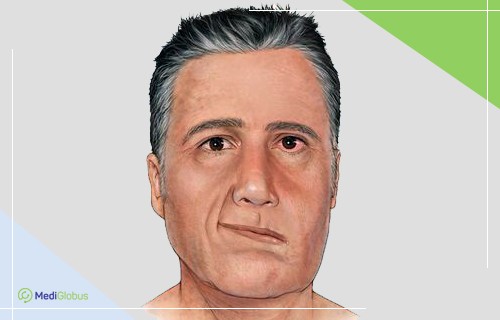
With unilateral nerve inflammation, wrinkles and folds on the skin on one side of the face are smoothed out, the shape of the eye changes, and the corner of the mouth droops. If you ask the patient to wrinkle their forehead, there will be no wrinkles on the affected area of the face. The patient is also unable to completely close one eye, which leads to irritation and dryness of the mucous membrane of the eye.

Diagnosis of facial neuritis
When diagnosing inflammatory diseases of the facial nerves, the doctor must determine whether the neuritis is an independent disease or has developed as a result of other diseases. It is also important to find out where the inflammatory process is developing and what form the pathology takes – is it acute or chronic.
Often, doctors from general clinics limit themselves to only an external examination of patients with suspected facial neuritis. In contrast, in specialised foreign clinics, patients undergo comprehensive diagnostics, which helps the neurologist see the full picture of the disease’s development. In addition, other specialists, such as an otolaryngologist, neurosurgeon or plastic surgeon, are often consulted to make an accurate diagnosis. Treatment is selected on an individual basis, taking into account the characteristics of the pathology.
Dr Babak Azizade, founder and president of the Facial Paralysis and Bell’s Palsy Foundation (FPBPF):
“It is necessary to identify the underlying cause of facial paralysis. In my practice, I have seen many patients who were misdiagnosed with Bell’s palsy, but it turned out that they had other, more serious conditions, such as acoustic neuroma or parotid gland tumours. Imaging studies should be performed to rule out tumours or neoplasms, and electroneuromyography should be performed to assess the nerves and muscles. This will help determine the appropriate surgery for the patient.”
The main diagnostic methods are:
- MRI – to determine the location of tumours, vascular abnormalities, inflammatory processes and other pathologies in the body;
- Chest X-ray or CT scan – to rule out sarcoidosis;
- Electroneurography – determining the speed of nerve impulses;
- Electromyography – assessing the sensitivity of nerves and muscles.
Treatment of facial nerve inflammation abroad
Neurologists in Turkey, Israel, Germany, and South Korea are considered to be the most successful in treating neurological diseases. Thanks to individualised therapy and a comprehensive approach, recovery occurs as quickly as possible. Treatment of facial nerve neuritis in foreign clinics lasts up to 7-10 days, depending on the complexity of the disease. Then, if necessary, the patient continues treatment at home. Full recovery occurs in 2-3 weeks. In complex cases, restoration of normal facial expressions takes up to six months.
In the first stage of treatment, doctors prescribe a complex of medications to relieve inflammation, swelling and pain. Depending on the characteristics of the disease, the neurologist selects medications:
- corticosteroids – to help reduce swelling;
- anticonvulsants – to reduce the sensitivity of nerves to irritants, which leads to a reduction in pain;
- neuroprotectors – to protect nerve cells;
- antispasmodics – to effectively eliminate muscle spasms;
- antiviral drugs.
Treatment of facial nerve neuritis necessarily includes a set of physiotherapy methods aimed at strengthening the immune system, restoring and stimulating muscles and nerves to prevent the development of atrophy and other complications.
The following methods are used to treat facial nerve neuritis:
- electrostimulation – treatment of muscles and nerves using electric current;
- electrophoresis – administration of drugs under the influence of a weak magnetic field;
- acupuncture – effectively eliminates pain and improves blood circulation;
- magnetic therapy – quickly relieves swelling and inflammation, normalises metabolic processes;
- laser treatment – helps to relieve inflammation, eliminates pain, and improves blood circulation in the affected tissues.
 Read:
Read: Surgical treatment of facial nerve neuritis
If physiotherapy and drug therapy remain ineffective and the patient is at risk of developing irreversible disorders due to facial muscle paralysis, the doctor may decide to perform surgery.
In modern medicine, two types of surgical intervention are used to treat facial neuritis:
- Dynamic – restoration of the integrity of the nerves, resulting in the correction of facial movements.
- Static – correction of the external manifestations of facial paralysis.
The main surgical methods for treating facial nerve neuritis are:
| Nerve decompression | During the operation, the neurosurgeon widens the bone canal to relieve pressure on the nerve. |
| Neurolysis | Removal of scars, adhesions, and bone calluses that compress the nerve and interfere with its normal conduction of neural impulses. |
| Direct neurorrhaphy | The section of the nerve with impaired conduction is excised, and then the nerve ends are sutured. The operation is performed if the affected area does not exceed 2 cm. |
| Replacement of nerve defects with autografts | If the affected area of the nerve reaches a size of 2-7 cm, the defect is replaced with a graft. The patient’s nerves (the great auricular or gastrocnemius) are used as donor material. |
| Transposition (displacement) of facial nerve branches | During the operation, the neurosurgeon redirects a healthy nerve branch to the area of the damaged nerve. |
| Neurovascular functional muscle transplantation | Restoration of symmetrical facial expressions by replacing paralysed muscles with healthy ones. Muscles are taken from another part of the patient’s body along with nerves and blood vessels. |
In clinics in Turkey, Germany, Spain and South Korea, facial nerve neuritis operations are performed using safe methods. Neurosurgeons prefer to use microsurgical techniques. The operation is performed using a neuromicroscope, which magnifies the image of the surgical field several times and allows the surgeon to see the smallest details. In addition, special microsurgical instruments and ultra-thin suture material are used. With their help, the neurosurgeon is able to work with the smallest anatomical structures. During and after microsurgical operations, the risk of complications is minimal, and patients recover much faster.
Which clinic should you contact for the treatment of facial neuritis?
The most successful clinics in terms of treating neurological diseases are:
Israel
Sourasky Medical Centre
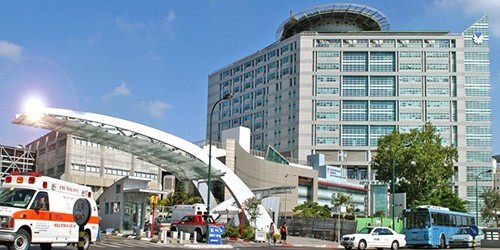
The Sourasky Medical Centre is considered one of the largest in the country. Every year, doctors perform about 1,000 neurosurgical procedures to treat diseases of the brain, spinal cord, and peripheral nervous system. During operations, doctors use modern neuronavigators, intraoperative MRI, and equipment for neurophysiological monitoring of the nervous system, which help to fully control the surgical process and significantly reduce the risk of dangerous complications.
| Procedure | Cost |
| Neurologist consultation | from $550 |
| CT scan | from $700 |
| Procedure | Cost |
| MRI scan | from $1,000 |
| Nerve decompression | from $17,000 |
Turkey
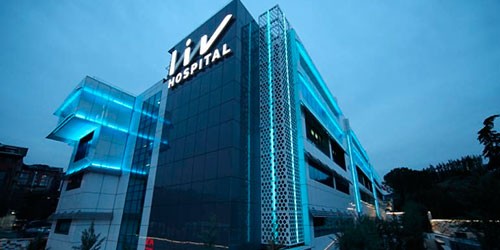
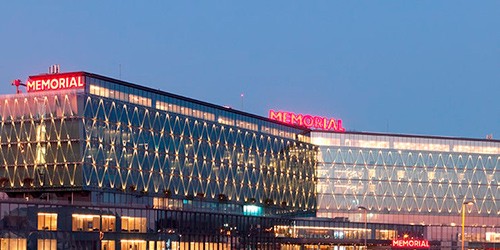
Patients with neurological diseases of varying complexity seek treatment in Turkey: Alzheimer’s disease, multiple sclerosis, epilepsy, paresis, paralysis, neuritis, etc. The Liv and Memorial clinics are particularly popular. Diseases of the nervous system are treated here according to European protocols. Doctors guarantee each patient treatment according to an individual programme, a comprehensive and interdisciplinary approach, as well as maximum safety. A big advantage of treatment in Turkey is the affordable prices in hospitals.
Liv Clinic
Memorial Clinic
| Procedure | Cost |
| Consultation with a neurologist | from $150 |
| CT scan | from $400 |
| Procedure | Cost |
| MRI | from $600 |
| Nerve decompression | from $9,000 |
Spain
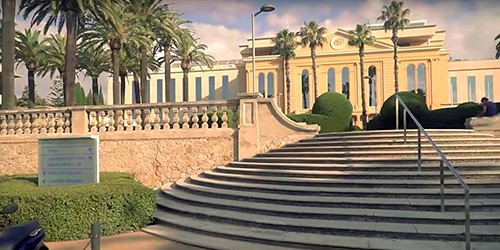
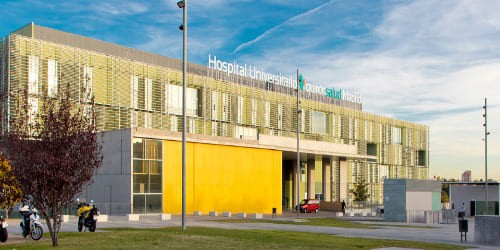
Neurologists in Spain use modern methods and technologies to provide patients with effective and safe treatment. Among the most sought-after clinics for the treatment of neurological diseases are the Teknon and Quirón Madrid medical centres. About 95% of patients suffering from epilepsy achieve significant improvement or complete relief from seizures thanks to a comprehensive approach to treatment. The use of a wide range of medications allows up to 70% of patients to recover without the need for surgery. Deep brain stimulation is successfully used to reduce tremors in 90% of patients.
Tecnon Medical Centre
Quirón Madrid Clinic
| Procedure | Cost |
| Consultation with a neurologist | from €350 |
| CT scan | from €700 |
| Procedure | Cost |
| MRI scan | from €1,000 |
| Nerve decompression | from €19,000 |
South Korea
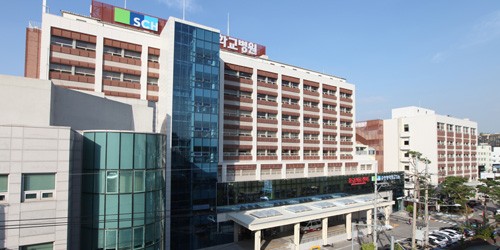
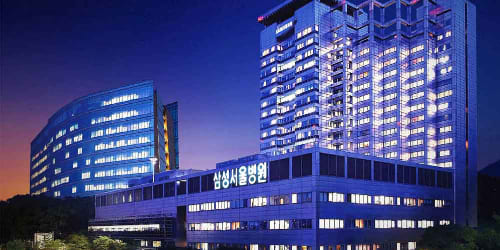
Patients with facial nerve neuritis who want to receive high-quality and relatively inexpensive treatment using modern methods turn to clinics in South Korea. The neurology departments at Soonchunhyang and Samsung clinics have all the necessary diagnostic, surgical, and physiotherapy equipment to make an accurate diagnosis and effectively treat the disease. Several specialists work with patients with nervous system diseases, and treatment is carried out following international medical standards.
SoonChunHyang Hospital
Samsung Clinic
| Procedure | Cost |
| Consultation with a neurologist | from $50 |
| CT scan | from $600 |
| Procedure | Cost |
| MRI | from $800 |
| Nerve decompression | from $15,000 |
Patient testimonials about facial neuritis treatment
At the age of 33, Maggie Whittum had achieved considerable success in the world of theatre, but a sudden illness thwarted all her plans for the future and threatened her life. Maggie developed a headache, double vision, and rapidly progressing paralysis. In the emergency room, she was put on a ventilator because she was having trouble breathing. The doctors diagnosed her with a stroke caused by a brain cavernoma and scheduled surgery. The operation was successful, and Maggie’s life was no longer in danger. However, the stroke damaged her facial nerve, leading to facial paralysis. Her attending physician then suggested surgery to restore her face and facial expressions.
Maggie’s situation was complicated. Usually, the fifth cranial nerve is used to restore the face in cases of paralysis. However, it had been completely destroyed by the haemorrhage. The doctors then decided to transplant the 12th cranial nerve. A weight was also placed in the eyelid to help close the eye completely.
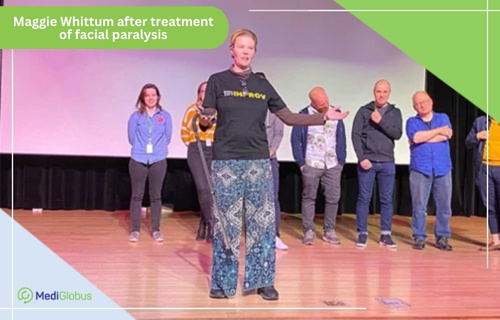
“The facial reanimation surgery went well, and I was so grateful to the surgeons,” – Maggie recalls.
But it took several months of rehabilitation to fully restore symmetry to her face and resume muscle and nerve function. However, her hard work paid off, and Maggie made a full recovery.
After treatment, Maggie returned to her creative activities. She contacted a theatre group that includes actors with various physical, cognitive and emotional problems and was accepted into the troupe. In addition, Maggie is actively involved in community life and educates people about issues related to stroke and facial paralysis.
Summary
- Facial nerve neuritis is a disease that affects the nerves of the face. The main symptoms are pain, hearing and taste disorders, and facial asymmetry.
- In clinics abroad, patients undergo comprehensive diagnostics, including MRI, CT, electroneurography, and electromyography.
- Inflammation of the facial nerve is treated with physiotherapy and medication.
- In complex cases, neurosurgeons perform surgery to decompress the nerve, replace the affected areas of the nerve with healthy ones, and perform muscle tissue transplantation in cases of facial muscle paralysis.
- Foreign neurosurgeons perform microsurgical operations using special equipment and instruments to correct facial expressions. As a result, 80-90% of patients make a full recovery.
- Patients prefer to undergo treatment in clinics in Israel, Spain, Korea, and Turkey.
If you are interested in how to treat facial nerve neuritis and where to seek help, contact MediGlobus. We will provide a free consultation on diagnosis and treatment abroad. Click on the button below, fill out the form and wait for a call from the coordinator.