


b
1. Causes of lymphoma relapse |
2. Methods of treatment |
3. Prognosis of treatment |
4. Hospital recommendations |
Lymphoma relapse is the return of the disease after a period of remission. It occurs in about 37% of all patients with this cancer. It is impossible to predict the recurrence of the disease, but it must be treated as soon as possible. Lead about available treatment methods and their effectiveness from this article.

Listen to the article:
How do the relapses of Hodgkin’s lymphoma and non-Hodgkin’s lymphoma occur?

Lymphomas are malignant tumours that affect the human lymphatic system. They are divided into 2 types: Hodgkin’s and non-Hodgkin’s. The share of these pathologies accounts for about 5% of all cases of cancer.
The lymphomas are treated by a team of doctors, including oncologists and haematologists. They develop the most effective methods of oncotherapy, which will help prevent the relapse of the disease.
The recurrence of this cancer after remission is most often observed in the first 2 years after treatment. This happens when cancer cells remain in the patient’s body. Up to a certain point, the immune system fights them and does not allow them to divide.
With a decrease in protective immune forces and exposure to unfavourable factors, cancer cells begin to multiply uncontrollably again. This process triggers the reappearance of lymphoma.
In 1/3 of patients with lymphoma, the disease recurs. It can occur early or late. Early relapse appears during the first year after the end of therapy, and late relapse – later.
To diagnose the recurrence of lymphoma in time, comprehensive examinations are carried out abroad. They help to detect the slightest abnormalities and quickly start treatment.
Risk factors for developing lymphoma
 Age. Hodgkin’s lymphoma has 2 age peaks for development and recurrence – at 15-30 years and after 55. Non-Hodgkin’s tumours can occur at any age, but the highest risks are seen in children and the elderly.
Gender. Male patients have a more unfavourable prognosis of oncotherapy. Disease recurrence is more common in them than in women.
Presence of lymphoma recurrences in the family history.>
Congenital or acquired immunodeficiencies. In the presence of pathologies that affect the immune system, lymphoma patients have an increased likelihood of disease recurrence after oncotherapy.
The volume of the lesion. Patients with the initial stage of the disease successfully overcome the threshold of relapse-free 5-year survival in 93% of cases. For later stages of oncopathology, the figures are less optimistic.
Smoking and unhealthy lifestyle..
 Read:
Read: Symptoms of relapse of Hodgkin and non-Hodgkin lymphomas
Signs of disease recurrence are similar to the first manifestations of this pathology. Among the most frequent symptoms stand out:
enlargement and discomfort in the area of lymph nodes,
rapid fatigue and weakness,
night sweats,
fever,
nausea and vomiting,
unexplained weight loss.
Treatment of relapsed lymphoma
Abroad, a multidisciplinary team of doctors develops an individual oncotherapy programme for each patient. At the same time, the choice of treatment option for recurrent pathology depends on several factors, in particular:
the type of oncopathology,
symptoms and test results,
the response to previous treatment,
clinical trials,
the duration of previous therapy,
the general physical condition of the patient.
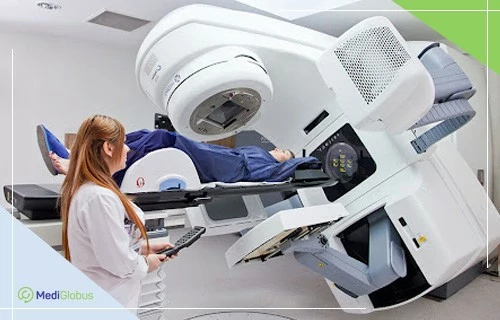
Most people with recurrent Hodgkin’s or non-Hodgkin’s lymphoma require more intensive and longer treatment. The main treatment option is chemotherapy. For this purpose, other drugs are used, stronger than the previous ones.
Several cycles are needed to achieve the maximum effect. Such treatment is also called “second-line therapy” or “salvage therapy”.
Radiation therapy is indicated for some patients. It is performed together with chemotherapy or alone. Radiation is given at low doses to control symptoms at any stage or as a palliative treatment. It is especially recommended before bone marrow transplantation. In this case, radiotherapy helps to reduce the number of cancer cells.
If second-line chemotherapy and radiation therapy have failed, patients are given higher doses of chemotherapy followed by autologous bone marrow transplantation. Material for implantation is taken from the patient before high-dose chemotherapy. If necessary, donor haematopoietic cells are used for BMT.
Allogeneic bone marrow transplantation is given to adolescents and children with recurrent Hodgkin’s lymphoma that has not responded to other cancer therapies. This type of transplant has a lower chance of the disease coming back.
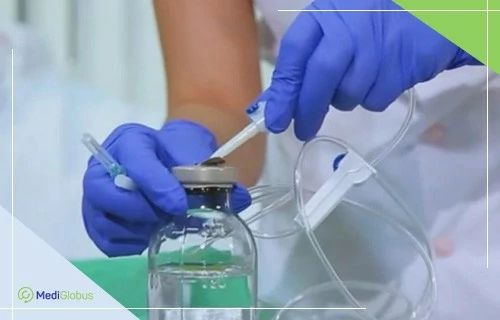
Targeted and immune drugs are used abroad to fight tumours with a high degree of malignancy. These drugs include Keytruda and Pembrolizumab.
Keytruda is a monoclonal antibody that helps rebuild the body’s immune system to actively fight cancer. It blocks a specific protein produced by the tumour and prevents it from growing.
The drug is given intravenously every three weeks. The duration of treatment with this targeted drug is 24 months.
For children and adults with Hodgkin’s tumours who have had more than 3 lines of chemo, the US Food and Drug Administration has approved Keytruda.
Prognosis in relapsed lymphoma
Treatment of relapsed lymphoma with several cycles of “salvage” chemotherapy results in the complete disappearance of the disease or remission of cancer in 30-40% of patients. The overall prognosis for 5-year relapse-free survival after such therapy is 60%.
According to the results of a study at the Royal Marsden Hospital in London (Royal Marsden), when transplanting one’s stem cells, the overall 5-year and 10-year survival rates of cancer patients are 55% and 49%, respectively.
According to the European Group for Blood and Marrow Transplantation, more than 66% of patients overcome the 5-year survival prognosis with donor BMT.
Targeted drugs help to achieve complete remission in 22% of cases. Partial remission is achieved in about 47% of patients with relapsed lymphoma.
Clinics for the treatment of relapsed Hodgkin’s and non-Hodgkin’s lymphoma


Summary
Patients with relapsed lymphoma can be divided into 2 categories. The first are patients who fail to achieve complete disappearance or remission of their cancer after a prolonged course of chemotherapy treatment. The other group is patients who achieved complete remission during the initial phase of oncotherapy and then experienced a relapse.
The recurrence of a malignant lesion in the lymphatic system can occur after several months or years. This most commonly occurs within 2 years of treatment initiation.
To combat recurrent oncopathology, chemotherapy and/or radiation are first administered. If this oncotherapy option does not work, then the doctors resort to bone marrow transplantation. Patients with certain types of these tumours, in particular classical Hodgkin’s lymphoma, are prescribed immune therapy and targeted drugs.
With comprehensive treatment, the disease can be controlled. The average 5-year survival rate of patients with this type of cancer is 50%.
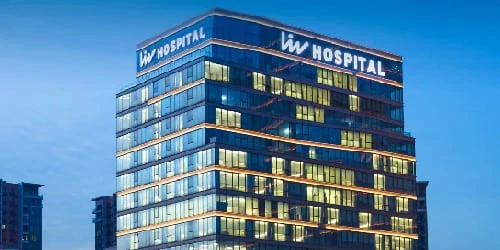
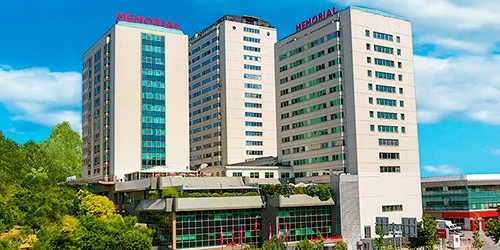
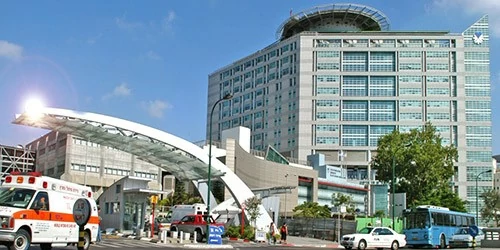
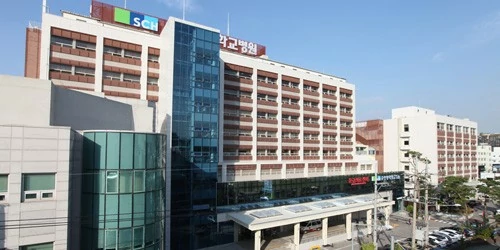
Medical tourists mainly choose such centres as Liv, Memorial, Ichilov, SoonChunHyang, and university hospitals in Navarre and Cologne.
To organise the treatment of lymphoma relapse abroad, please leave your contacts. Our coordinators will call you back as soon as possible and help you choose the best oncology centre for your medical problem.