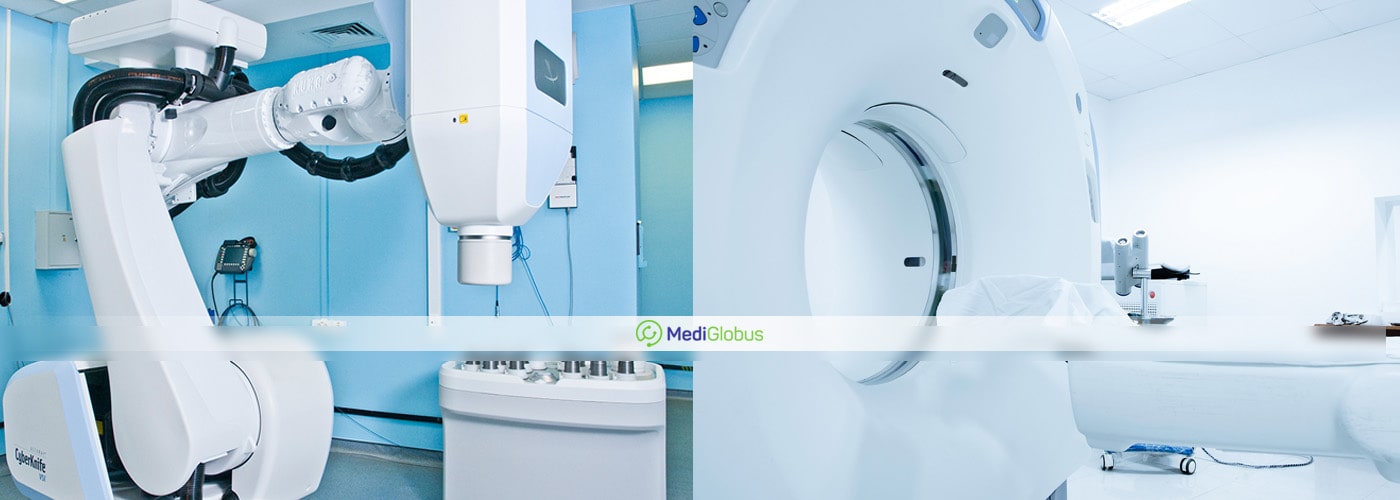



What are the differences between Gamma Knife and CyberKnife? This question is often asked by patients who are about to undergo radiosurgical intervention. Abroad, these devices are actively used to treat malignant or benign tumours, among other things. To understand when and which system is best to use, read the article.
What is a Gamma Knife?
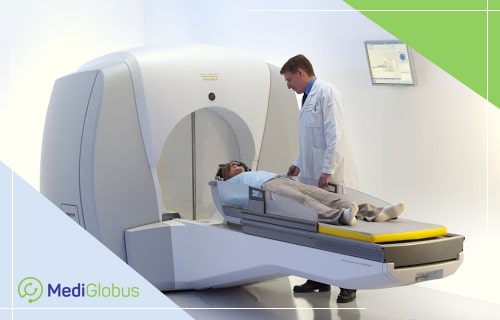
GammaKnife appeared in the late 1980s. This device was created to treat intracranial neoplasms, as well as vascular and functional disorders in the brain. The radiation source is radioactive cobalt.
Contrary to the name of this method, no knives are used during the procedure. Instead, up to two hundred precisely focused beams of radiation intersect at a single point with an accuracy of less than a tenth of a millimetre.
After the procedure, patients remain in the hospital for several hours. After 24 hours, they return to their normal lives. Gamma Knife radiosurgery is used instead of or in combination with traditional surgery or radiotherapy, depending on the patient’s diagnosis.
More than 1,5 million people have been treated using this technique. Every year, around 80,000 patients use the Gamma Knife to combat various diseases.
Gamma Knife Procedure
MRI or CT imaging is used to accurately determine the location of the tumour. Based on the data obtained, a team of doctors consisting of a neurosurgeon, radiation oncologist and physicist develops a treatment plan. This takes 30 to 90 minutes, depending on the size and location of the target.
On the day of radiosurgery, the patient is given local anaesthesia. It is needed to attach a fixation frame to the patient’s head. The patient lies down on the tomograph couch so that their head is positioned for precise irradiation of the tumour. They are then moved into the machine, and the session begins.
Treatment usually lasts from 20 minutes to 2 hours. During this time, the patient feels nothing. At the end of the procedure, the frame is removed from the patient’s head.

The patient usually goes home the same day. However, in some cases, they are kept in the hospital overnight for observation. As a rule, the existing disease can be eliminated in just one or two sessions at most. The mechanism of destruction of the pathological focus is triggered immediately during the procedure and continues to work for several months.
When is GammaKnife used?
GammaKnife is indicated for the treatment of certain neurological disorders (trigeminal neuralgia), brain metastases, vascular disorders, meningiomas, acoustic neuromas, gliomas, or pituitary tumours.
Advantages of Gamma Knife
Compared to traditional methods of treating complex brain tumours and other diseases, Gamma Knife surgery has several advantages. These include:
- a safe, minimally invasive procedure without incisions or opening the skull;
- minimal discomfort;
- no general anaesthesia, except for children;
- no infection, haemorrhage, cerebrospinal fluid leakage or adverse reactions to anaesthesia;
- the operation is performed on an outpatient basis;
- high accuracy and reliability;
- cheaper than conventional neurosurgery;
- no long postoperative hospital stay and no significant rehabilitation costs.
What is CyberKnife?
Cyberknife — is a robotic radiosurgical system used to treat benign and cancerous tumours in any location. It is based on the use of robotics, computer navigation and radiation surgery.
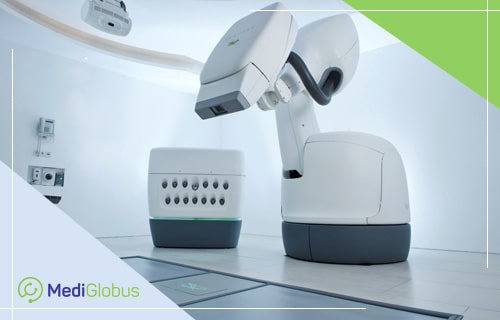
This device has been used in clinical practice since 2001. The therapeutic effect is achieved through the targeted delivery of high doses of radiation.
CyberKnife combines a compact linear accelerator mounted on a robotic arm and an integrated image guidance system. The imaging system captures stereoscopic images during treatment, allowing the movement of the tumour to be tracked and the robotic arm to be guided for precise delivery of the beam to the pathological site.
Thanks to real-time adaptive radiation delivery technology, CyberKnife minimises damage to healthy tissue and prevents the development of side effects. This device is ideal for treating moving tumours, such as lung cancer.

CyberKnife Procedure
CyberKnife delivers a high dose of radiation to the tumour with sub-millimetre precision. One to five sessions are sufficient to destroy the pathological focus.
During the procedure, the patient lies on the operating table while the machine’s ‘robotic arm’ moves around them and directs radiation beams at the affected area from different angles. The procedure lasts 30-90 minutes. As a rule, anaesthesia is not required.
To irradiate tumours of the liver or other internal organs, it is sometimes necessary to install special ‘beacons’ that determine the location of the neoplasm. In this case, the patient is given local anaesthesia.
Advantages of CyberKnife
CyberKnife is a conservative treatment option for patients with inoperable or surgically complex tumours. This technology has the following advantages:
- the maximum radiosurgery effect is achieved in 1-5 outpatient procedures;
- non-invasive, painless and does not require anaesthesia;
- minimal side effects;
- short recovery period;
- minimises radiation exposure to healthy tissue surrounding the tumour site;
- tumours previously treated with the maximum permissible doses of radiation can also be treated with this method.
Indications for use of CyberKnife
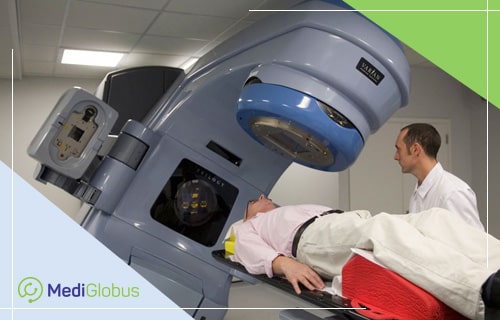
Since 2001, the CyberKnife radiosurgical system has been approved by the FDA for the treatment of benign tumours and various types of cancer, including tumours of the brain, breast, liver, lung, throat, pancreas, and prostate. More than 300,000 cancer patients have been treated with this device.
Main differences between Gamma Knife and CyberKnife
The effectiveness of treating intracranial tumours with the Gamma Knife and CyberKnife is the same. Both technologies can be used to treat adults and children. However, some differences should be considered when choosing between these devices. These include:
| Characteristics | CyberKnife | Gamma Knife |
| Irradiation areas | Brain, spine, body | Intracranial tumours |
| Irradiation effect | Photons | Gamma rays |
| Size of the pathologic focus | 3-6 cm | 3-4 cm |
| Patient immobilisation | No | Yes |
| Anesthesia | Local anesthesia | Not required |
Which foreign clinics offer Gamma Knife and CyberKnife treatments?
There are very few centres worldwide that specialise in the use of these technologies. Gamma Knife and CyberKnife are available at leading medical institutions in Turkey, Israel, Spain, Germany and other countries with developed healthcare systems.
Summary
- The Gamma Knife radiosurgical system appeared in the late 1980s. This device was created to treat intracranial neoplasms, as well as vascular and functional disorders in the brain. The radiation source is radioactive cobalt. More than 1,5 million people have been treated using this technique. Every year, about 80,000 patients use the Gamma Knife to combat various diseases.
- CyberKnife is a robotic radiosurgical system designed to treat cancerous and benign tumours of any location. It is based on the use of robotics, computer navigation and radiation surgery. More than 300,000 cancer patients have been treated with this device.
- The effectiveness of treating intracranial tumours using the Gamma Knife and CyberKnife is the same. Both technologies can be used to treat adults and children. CyberKnife can be used to treat tumours in various locations, in particular, neoplasms that move when the patient breathes. The Gamma Knife is used exclusively for the treatment of intracranial pathologies.
- Few centres specialise in the use of these technologies. Abroad, Gamma Knife and CyberKnife are available in leading medical institutions in Turkey, Israel, Spain, Germany and other countries with developed healthcare systems.
Contact the coordinating doctors of the MediGlobus international platform. We will help you choose the best solution for your medical problem. Together with us, more than 300 clinics assist foreign patients. Submit your application!