NEEDS SUPPORT?
Call me back

Leave your phone number and our Medical Coordinator will contact you

Leave your phone number and our Medical Coordinator will contact you

Munich Cyberknife Center
The specialists of the MEDIGLOBUS Support Team will help you to get an individual Treatment Plan with a Price Quote.

Munich Cyberknife Center

Germany, Munich

Clinic Review

Munich Cyberknife Center

The CyberKnife Centre Munich ranks among Europe’s top medical institutions for the radiosurgical treatment of benign and malignant tumours.

University Hospital of Munich (Grosshadern) on the initiative of two of Europe’s foremost radiosurgeons, Dr Berndt Wowra and Dr Alexander Muacevic.

The CyberKnife Clinic collaborates with the Charité University Hospital and other medical centres in Germany and around the world. The centre employs a team of professional doctors and specialists, who together achieve great success in the treatment of cancer.

The CyberKnife European Centre for Radiosurgery is certified as an Expert European Radiosurgical Centre by the company that developed the CyberKnife system, Accuray. The certificate confirms that the centre employs specialists with knowledge of radiosurgical systems, provides high-quality medical services, uses innovative, safe therapy methods and uses state-of-the-art quality equipment.

The CyberKnife 6 unit is the latest model with an integrated InCise 2 collimator. It is a piece of special equipment that improves the accuracy and intensity of the radiation, which further expands the capabilities of the CyberKnife. The unit is currently considered to be the most progressive and effective method of non-surgical treatment of cancer, even in its most advanced stages. The CyberKnife treatment has a success rate of up to 95% and is in a leading position compared to other methods of fighting cancer.

More than 11,000 CyberKnife operations have been carried out over the years at the Radiosurgical Centre, including for international patients – the highest number of operations in Europe among similar medical centres. Patients choose the CyberKnife Clinic in Munich because of the treatment devices, which only a few large hospitals in the world offer. In addition, experienced doctors who follow the most effective and modern treatment protocols work here.

Which Diseases are Treated at the CyberKnife Centre in Munich?

CyberKnife is an innovative, effective and safe method of incisionless cancer treatment. Its principle is to expose abnormal tissue to a narrow beam of radiation, which destroys the tumour cells at the genetic level. Healthy tissue remains untouched. The unit detects the location of the tumour on its own and directs the beam with an accuracy of 0,1 mm. There is no need to fix the patient’s head or body and no need for anaesthesia. The unit detects the slightest movement of the patient and redirects the radiation.

The CyberKnife Centre Munich treats all types of benign and malignant diseases, located in the brain (neurinoma, meningioma, arteriovenous malformations, metastases, etc.), spinal cord, prostate and pancreas, kidney, liver, lungs, breast, prostate, iris, etc. Thanks to the CyberKnife, it is now possible to treat the most difficult-to-reach neoplasms, e.g. in the brainstem, optic or auditory nerves, or the pancreas.

Cancer therapy at the CyberKnife Centre is carried out on a strictly individual basis and patients are admitted to the procedure after a thorough examination and approval by a multidisciplinary committee.

The average cost of CyberKnife treatment in Munich starts at €19,000,00.

Features of the Clinic

Treatment at the Cyberknife Centre Munich

The unique benefit of the procedure, especially for foreigners, lies in the short duration of treatment. Unless a complete diagnosis or additional examination is required, therapy at the CyberKnife clinic takes a few days.

Preparation for Cyberknife Treatment

The patient does not need any special preparation for the procedure. You can eat and take medication as usual. An MRI, CT or PET-CT scan must be carried out before the tumour can be located. The centre uses state-of-the-art, high-resolution diagnostic equipment. The examination may also be carried out in other clinics, but the images must meet certain requirements – they must be no more than 3 months old and the images must be legible. For tumours in the liver or kidneys, a radiologist first injects markers to visualise the neoplasm. The diagnostic results are transferred to the planning module of the operating robot by the specialist. It can take up to 24 hours to prepare the machine.

Scalpel-free Surgery using Cyberknife

Generally, a CyberKnife cancer treatment requires one session of 40-90 minutes. If necessary, the procedure can be divided into several short sessions. CyberKnife surgery is painless and the patient is conscious. Immediately after the procedure, the patient can return to normal life. No hospitalization is necessary, so free time can be devoted to leisure activities, e.g. sightseeing in Munich. After 3 months, the patient should be examined again to check the effectiveness of the treatment. You do not need to come back to the clinic. It is sufficient to have an examination and to send the results to your doctor, who will then make a recommendation.

Features of the Cyberknife Centre in Munich:

  • The latest CyberKnife M6 and InCise2 collimator;
  • One of the best cancer therapy efficiency rates in the world – 95%;
  • Excellent treatment results for cancer patients in the last stages;
  • Treatment of the most advanced cancer cases;
  • Minimal risk of complications after treatment;
  • A rapid patient care, with virtually no waiting times;
  • Emergency hospitalisation if necessary;
  • The possibility of providing medical documentation without translation.

A great advantage of the centre is its cooperation with leading medical institutions around the world. In this way, doctors share their valuable experience and develop and implement new methods of diagnosis and treatment of oncology. The CyberKnife Centre collaborates with the world’s leading centres for neuro-oncology, prostate pathology, kidney tumours, lung cancer, pancreatic cancer, breast cancer, neuroendocrine tumours and pediatric oncology. There is also a partnership with the University Hospital of Munich and the Clinic of the Technical University of Munich.

Effectiveness of Cyberknife M6 Therapy at the Munich Clinic

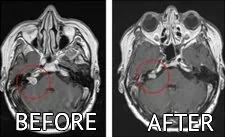
cyberknife brain treatment before after pictures

MRI images before and after the CyberKnife treatment demonstrate the effectiveness of the procedure. On the left is an acoustic neurinoma in the right cerebellum. On the right, 2.5 years later, the benign neoplasm has disappeared, with only a scar in the area of the internal auditory canal.

cyberknife brain treatment before after pictures

PET-CT images of the spinal column. On the left, metastasis in the spinal column is visualised. The right picture was taken six months after the CyberKnife treatment. The tumour has disappeared and bone marrow has formed in its place.

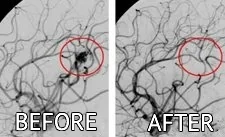
cyberknife brain treatment before after pictures

Images of a cerebral arteriovenous malformation in a 15-year-old patient. On the left is an image taken before treatment and on the right a positive result one year after treatment.

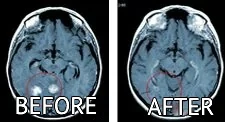
cyberknife brain treatment before after pictures

The MRI scan on the left shows two metastases in the brain as a result of lung cancer. Just one hour of CyberKnife therapy helped to get rid of the pathology, as the image on the right shows results 4 months after treatment.

Accomodation at the Cyberknife Clinic in Munich

If inpatient treatment is required, CyberKnife Centre provides comfortable single or double rooms. It is also possible to accommodate a patient with a companion. All rooms are best equipped with a television, WiFi, a separate toilet and a shower. There are three different menus to choose from, and you can also choose an individual menu.

Testimonials (1)

Average clinic rating
  • 5
Christian
Age: 50 years

My mother-in-law was diagnosed with cancer, and our oncologist recommended us to pursue Cyberknife treatment of her tumor. We contacted Munich Cyberknife center, and after reviewing her medical documents they agreed to receive us for tre... Read more

Doctors

Leading neurosurgeon and radiosurgeon at the European CyberKnife Centre in Munich.He was educated at the Georg-August Medical University in Göttingen. Dr Kufeld has undergone practical training at the University Hospital for Neurosurgery in Erlangen, and later at the Charité University Hospital. In 2007, he completed his doctorate in Medical Informatics at the Technical University of Berlin. Co-founder and director of the Charité CyberKnife Center in Berlin.Member of international scientific organizations:
  • German Scientific Society of Neurosurgery,
  • European Neurosurgical Society,
  • German Society for Medical Informatics,
  • Biometrics and Epidemiology,
  • Society of Radiosurgery.
He has authored 80 scientific papers at various international symposia and conferences, as well as more than 25 publications on the subject of CyberKnife and radiosurgery.
Doctor’s specialisation: CyberKnife.
Др. Маркус Куфельд
Markus Kufeld
Experience: over 24 years
Oncology
The leading specialist in radio-oncology at the CyberKnife Centre. He trained as a general practitioner at the Leopold-Franz University in Austria. He assisted in the Department of Radiation Therapy and Radio-oncology at the University Clinic of Innsbruck, Austria. He soon became a senior physician in the Department of Radiation Therapy and Radiation Oncology at the University Center of Innsbruck, Austria. He was then Head of the Department of Radiation Therapy and Radiation Oncology at the leading clinics in Austria. Since 2010, he has been Director of the 1st Medical Clinic at the Proton Therapy Center in Munich. Since 2012 he has worked in the Radiotherapy Clinic of Prof. Wilkowski in Agatharied, Germany. Since 2015 he has been working in the specialist team at the European CyberKnife Centre Munich-Grosshadern.Scientific and professional activities:
  • Developer of innovative methods of intensity-modulated radiotherapy and stereotaxy.
  • Holds a specialist certificate in proton therapy.
  • Member of the Board of Directors of the Austrian Society of Radiation Oncologists and Radiotherapists (ÖGRO).
  • Member of the Board of Directors of the Tyrolean Society for Experimental Oncology (TEXO).
  • President and member of the Board of Directors of the Scientific Society of Radiation Oncology (ZORO).
He is actively involved in research activities in the areas of oncology, neuro-oncology and lung cancer.
Doctor’s specialisation: radio-oncology.
Др. Альфред Хайденбергер
Alfred Heidenberger
Experience: over 21 years
Oncology
Founder and chief physician of the CyberKnife European Centre, professor and MD, leading neurosurgeon and radiosurgeon in Germany. Expert in CyberKnife radiosurgery and the treatment of central nervous system tumours.He completed his medical studies at Johannes Gutenberg University Mainz. Practised in the leading neurological and neurosurgical clinics in the UK and the US. Worked in the Clinic for Neurosurgery at the University of Munich. Defended his doctoral thesis at the University of Munich, where he was later awarded the title of Professor and Doctor of Medicine.Recipient of the "Excellence Award" of the European Society for Radiosurgery.
  • Professional and scientific activities:
  • Member of numerous international scientific societies;
  • President of the International Medical Association "Radiosurgery Society";
  • Has written over 100 scientific papers;
  • Founder of scientific internet portal.

Doctor’s specialisation: radiosurgery, neurosurgery.
Проф. Александр Муячевич
Alexander Muacevic
Experience: over 27 years
Neurosurgery

Location of the Clinic

Max-Lebsche-Platz 31, 81377 München, Germany
The European CyberKnife Centre is located at Max-Lebsche-Platz in Munich. Surrounded by a large car park, shops, supermarkets and cafes. There is also a large picturesque park next to the clinic.
Germany
Germany

FAQ

At the CyberKnife Centre Munich, doctors perform radiosurgical tumour removal using the ✓CyberKnife method.

Similar clinics

Medicana Ataköy Hospital

Ewha Medical Center

Seoul St. Mary's Hospital at Catholic University of Korea

Leave us a Review


    Successful
    This email already registered, please resend form

    Leave your request

    Благодарим за обращение.

    Наши координаторы обрабатывают
    вашу заявку.