


1. What is Gamma Knife? |
2. The process of treatment |
3. Efficacy of Gamma Knife |
4. Patient story |
5. Clinics recommendations |
6. Cost of Gamma Knife abroad |
For some brain diseases, surgery has long been the only method of treatment. However, it is not always possible to perform and is associated with considerable dangers and complications. Gamma Knife has made treatment of such pathologies safer and more effective. The method avoids a surgical procedure and still provides a precise impact on the affected areas. In this article, we will tell you more about the use of the therapy and its advantages over other treatment methods.

Listen to the article:
What is a Gamma Knife?
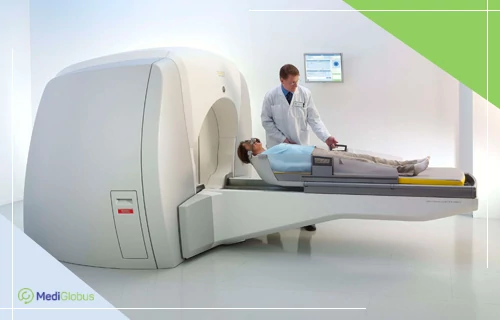
Gamma Knife technology is a stereotactic therapy technique used to treat diseases of the head and brain with ionising radiation without incisions. The radiosurgical knife works exactly like a laser, but instead of light, it emits high-energy rays that affect the area from different angles, following the shape of the pathology. This helps to get rid of the disease without resorting to surgery and without damaging healthy areas.
The device creates strong radiation, which is focused directly on the affected area. The rays are aimed at a specific point inside the head with an accuracy of 0,1 mm. Thanks to the high concentration of targeted energy, doctors achieve the desired results in just one session.
 malignant and benign tumours including gliomas, meningiomas, acoustic neurinomas, and metastases;
cerebral vascular diseases, such as arteriovenous malformations;
cysts and other pathologies;
neurological disorders, e.g. Parkinson’s disease, epilepsy.
Contact MediGlobus specialists to learn more about Gamma knife, how it works and if it can help in your case.
What are the advantages and disadvantages of GammaKnife?
Gamma Knife has many advantages over alternative treatments. Here are some of them:
Advantages:
Precision and high efficiency. During treatment, the device directs the beams to the tissue with millimetre precision, bypassing healthy areas.
Minimal invasiveness. Patients do not require surgery, reducing the risk of complications and infections.
One session. In most cases, a single session is sufficient to achieve the desired result.
Painlessness. Gamma Knife treatment is painless and does not require general anaesthesia, except for children.
Recovery. Patients return to daily life immediately after the procedure. In some cases, one may need to stay in the hospital for 24 hours for monitoring.
Cost. Gamma Knife is cheaper than neurosurgery.
Disadvantages:
Limited area of application. This therapy is not suitable for all types of tumours and diseases. In addition, Gamma Knife is not used if the size of the neoplasm is larger than 3-4 cm.
Delayed effect. Positive changes after radiosurgery appear after several months.
Side effects. Some side effects (fatigue, nausea or headache) are possible after the procedure. However, when compared to the risks of conventional neurosurgery, they are mild and disappear quickly.
Affordability. Gamma knife machines are not available globally. The equipment used for stereotactic radiosurgery is quite expensive and requires experienced and qualified specialists to work with it.
Comparison with alternative methods:
| Comparison criteria | Gamma knife | Traditional radiotherapy | Neurosurgery |
|---|---|---|---|
| Accuracy | Affects only the pathology, healthy areas are not traumatised | Irradiates the pathology and surrounding healthy tissue | Depends on the doctor’s experience and the complexity of the pathology |
| Invasiveness | Minimally invasive intervention | Non-invasive intervention | Invasive intervention |
| 1-2 | 1-2 | Several | Several may be required, depending on the complexity of the disease |
| Anaesthesia | Local anaesthesia | Not necessary | General anaesthesia |
| Side effects and complications | Rarely, in mild form | Possible nausea, hair loss, weakness, GI problems | Possible complications (infections, bleeding, neurological disorders, etc.) |
| Hospitalisation | Usually not required | Hospitalisation is possible, depending on the complexity of the pathology | Long hospitalisation is required |
| Effect | Gradual | Gradual | Usually rapid |
| Applications | Intracranial pathologies | Wide range of applications | Широкий спектр болезней и патологий головного и спинного мозгаWide range of diseases and pathologies of the brain and spinal cord |
 Read:
Read: Gamma Knife therapy process
Before therapy
Before starting Gamma Knife therapy, it is necessary to follow several recommendations to make sure the procedure will be successful. In most cases, no dietary restrictions are required, but it is important to eat a normal diet and drink enough fluids. Before the session, you should discuss with your doctor any medications you are taking and tell them if you have ever had an allergic reaction to anaesthesia.
Preparation for the procedure
There will be a consultation and preparation before the procedure itself. This usually takes between 30 minutes and 1,5 hours. The patient will be fitted with a special design on the head. This may require a local anaesthetic. This structure is used to fix the head during the radiation and to calculate and determine the direction of the radiation. Next, an MRI scan is performed. Using computer equipment, a three-dimensional model of the pathology is created and healthy areas are marked. The specialists then calculate the radiation dose.
Treatment process
The patient is laid on a couch and the head is fixed under the Gamma Knife apparatus. During the procedure, it is recommended to remain motionless to ensure the accuracy of the radiation exposure. The procedure itself is painless. It does not induce claustrophobia or cause discomfort. If you wish, you can ask for pleasant music to be played. The specialist will also monitor the process via a communication system and ask about the patient’s well-being. The duration of the session depends on the diagnosis – from 15-20 minutes to several hours.
Completion of the procedure
At the end, the structure is removed from the head and the marks left after fixation are treated. After the session, the patient may feel a little fatigue or discomfort, which usually subsides quickly. In most cases, hospitalisation is not required and the patient returns home the same day.
Gamma Knife brain tumour removal is an effective and safe method. Contact MediGlobus specialists to book an appointment without a waiting list and go for treatment as soon as possible.
Effectiveness of therapy
Gamma Knife stereotactic radiosurgery is highly effective in treating a variety of head and brain disorders. Below are some of the research findings published in Missouri Medicine, Epilepsy Research and Treatment, and Neurosurgical Focus:
Stereotactic radiosurgery has been successfully used as a primary treatment option for patients for whom surgery is not desirable due to various medical reasons and for intracranial tumours less than 3 cm in diameter.
The effectiveness of Gamma Knife radiosurgery for brain metastases is 84-97%. In addition, the therapy reduces brain oedema, leading to a reduction in steroid dosage. The results demonstrated that stereotactic radiosurgery performed after surgery reduces the risk of recurrence.
The result of Gamma Knife therapy for epilepsy is a marked improvement in patients’ condition. Studies show that the effect of radiosurgery is comparable to surgical treatment.
According to research data, the removal of meningiomas by Gamma Knife increases the life expectancy of patients. The five-year progression-free survival rate is 95,2% and the ten-year survival rate is 88,6%.
Radiosurgery has also been successfully used to treat non-functioning pituitary adenomas, where tumour control was 99%, 94% and 76% after 1, 5 and 10 years respectively.
Research on the use of Gamma Knife in glioblastoma is ongoing. Some evidence suggests that stereotactic therapy may be effective in combination with other modalities.
The story of Roy, who got rid of a brain tumour and kept his hearing intact thanks to Gamma Knife
Roy had been suffering from headaches for years, which he attributed to stress. However, when hearing loss and other symptoms appeared, the man sought medical attention. An MRI revealed a 2,5 cm diameter acoustic neurinoma, which is thought to have been developing for 10-15 years. He was offered neurosurgery or bloodless removal of the tumour with Gamma Knife. After discussing with his wife and weighing the pros and cons, Roy decided to agree to this treatment.
The man recalls that the procedure was as comfortable as possible: “Through the intercom, the technicians asked me if I wanted to listen to music. I chose classical music. Then they told me to relax and the session would start soon. The treatment was completely silent. It lasted 45 minutes and I had time for a good nap.”

Roy felt fine immediately after the procedure, but on returning home he felt some mild nausea and weakness. These symptoms gradually disappeared and the man was able to return to work a week later. Subsequent MRI scans showed that the tumour had shrunk in size and was continuing to shrink.
(Story from Brain Tumour Foundation of Canada)
Where is Gammaknife treatment available?





How much does Gamma Knife cost abroad?
In clinics where Gamma Knife stereotactic unit therapy is available, the price of the procedure will vary depending on the country and the status of the medical centre. For example, in Turkey, the treatment will cost 15-20% cheaper.
| Country | Cost |
|---|---|
| Turkey | from $7,000 |
| Israel | from $18,000 |
| Germany | from €15,000 |
| Spain | from €14,000 |
Resume
Gamma Knife is a modern method of treating brain tumours and other diseases using high-dose radiation therapy.
The therapy has the advantage of high precision and minimal damage to surrounding healthy tissue. This allows effective treatment of brain tumours and other diseases to be achieved with minimal side effects.
The procedure lasts from 15-20 minutes to several hours. The treatment does not require general anaesthesia or hospitalisation.
It is common to experience slight weakness or nausea after therapy, which disappears after a few days.
Gamma Knife treatment helps 84-97% of patients with brain metastases; for meningiomas, the 5-year survival rate after therapy is 95.2%; for pituitary adenomas, more than 94% of patients survive 5 years after treatment.
Gamma Knife stereotactic radiosurgery units are available in clinics in Turkey, Germany, Israel and Spain.
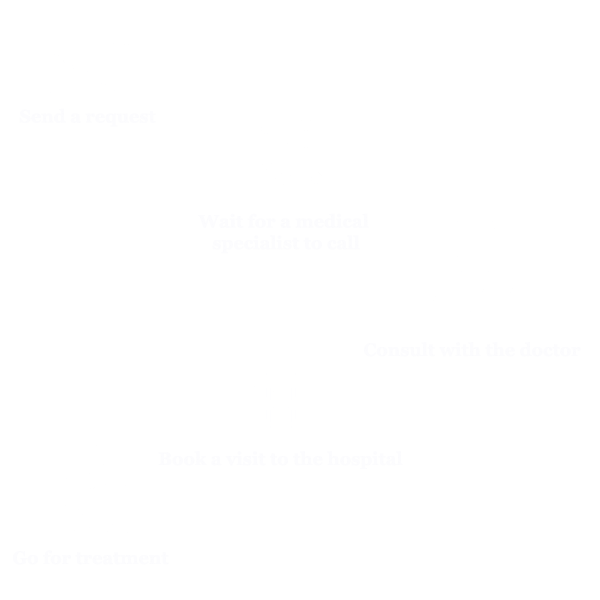
Removal of tumours and other brain pathologies is available in modern clinics in Turkey, Germany, Israel and Spain. Contact us, and we will help you select a medical centre and make an appointment with the doctor. To leave a request, click on the button below, fill in the form and wait for a callback.

Sources:
- 1. Healthline Media
- 2. MedlinePlus
- 3. Missouri Medicine
- 4. Brain Tumour Foundation of Canada
- 5. Epilepsy Research and Treatment
- 6. Neurosurgical Focus