


Today, there is no doubt that the development of cancer is linked to genetic factors. Doctors have identified more than 100 cancer-associated genes. Many people, even without any suspicious symptoms, begin to wonder whether they are carriers of the predisposing genes. This question becomes especially relevant for relatives of people recently diagnosed with oncology, or for couples who are starting to plan a family. So, how are genes and cancer interrelated, should everyone undergo genetic diagnosis, and can anything be done about it? These are the questions we’re going to help you understand today.
How are genetics related to cancer?
Genes encode how the body will be built. Each person has about 20,000 genes. Their functioning is a complex process in which breakdowns can occur. Some of them, in rare cases, lead to uncontrolled cell division, which forms cancerous tumours.

The genetic mechanisms of tumour formation can vary. DNA damage can affect the amount of proteins that promote cell growth or disrupt the natural self-destruction mechanisms of diseased cells. In general, scientists identify three groups of defective genes associated with cancer formation:
 Tumour suppressor genes – normally they stop the growth of tumours, which becomes disrupted if the genes are damaged.
Proto-oncogenes – contribute to increased growth and metabolism of cancer cells.
Genes, involved in genome stability – when they break, other DNA disorders accumulate, which can lead to cancer.
All cancers are linked to genetic factors; however, not all are genetically inherited. Thus, according to statistics, only 10-12% of cancers are passed from parents to children. In the remaining 90% of cases, genetic breakdowns that lead to the formation of tumours accumulate throughout life. That is why the risk of developing cancer increases with age, and all people over 50-55 years old are recommended to pay more attention to their health and consider cancer check-ups.
DNA changes that lead to cancer can occur at any age, even during embryonic development. However, certain factors increase the risk of genetic damage. These are called carcinogens. Among the most common carcinogens are chemicals in cigarettes or vapes, ultraviolet radiation (sun, tanning beds, gel polish lamps), and the human papillomavirus (HPV).
| CANCER CHECK-UP |
|---|
| Oncomarker blood test |
| Biopsy |
| CT/MRI/PET-CT |
| Consultation with an oncologist |
Spontaneous DNA changes that occur during life are not inherited.
Children with cancer may carry a genetic predisposition, but there is not always an increased incidence of cancer in their families. A 2015 study of more than 1,000 children with cancer found that 8,3% had predisposing gene mutations. However, among them, only 40% had relatives with cancer.
About hereditary cancer
Can cancer be inherited? Strictly speaking, no. Oncology cannot pass from parent to child through blood. What is inherited is a predisposition to cancer.
A person has 2 copies of each gene – 1 from their father and 1 from their mother. If one of these genes is defective, this will not be a problem for the body – the second gene will be sufficient to compensate for the work of the first. However, if the second gene is also ‘broken’, then a tumour may start to grow.
Therefore, it is important to understand that when doctors talk about predisposition to cancer, they do not mean its guaranteed development. Such a person is simply in the group of increased risk. The possibility that he or she will live a healthy life remains. But at the same time, the increased risk of developing cancer must be taken seriously.
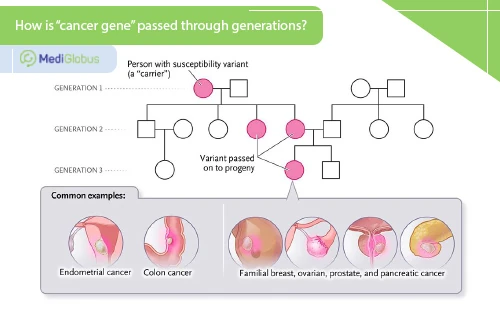
Patients ask, ‘If my relative is diagnosed with cancer, does that mean I am at risk of having it as well?’
Not necessarily. Having a relative diagnosed with cancer is a reason for your doctor to suspect a genetic predisposition, but it alone is not enough. Cancer remains a common problem, especially in older adults. Most families, especially if you have many relatives, have someone who has faced cancer. 90% of these cases are non-hereditary. When consulting, doctors take into account clarifying questions – who exactly among your relatives had cancer, how close were they to you, at what age the disease developed, the type of cancer, etc.
Some syndromes are referred to as ‘family cancer’. In these situations, it is common for several generations to suffer from the same disease. Doctors have compiled a list of signs that indicate that a predisposition to cancer is indeed hereditary. The more of these criteria are found, the stronger the family history is considered to be.
At least 3 relatives, including 2 close relatives (mother, father, brother, sister, child) have had cancer;
At least 2 relatives in 2 generations in the same line (maternal or paternal) who have had the same type of cancer (breast, bowel, cervical, etc.);
Having a relative who has had more than one cancer;
Having a relative with cancer at a younger age than the average age for a particular cancer (each cancer has its threshold, but most are diagnosed between the ages of 60-66);
Relatives with rare hereditary cancer syndromes (e.g. Cowden syndrome, familial adenomatous polyposis, Lynch syndrome);
A cluster of family history of cancers associated with BRCA gene mutation: breast cancer, ovarian cancer, pancreatic cancer;
Rare cancers in the family (e.g. retinoblastoma or breast cancer in men);
If genetic mutations have already been found in relatives who have had cancer;
Certain features of physiology (e.g. a large number of polyps in the bowel);
Belonging to an ethnic group in which cancer-predisposing genes are more common (e.g., Ashkenazi Jews);
If laboratory analyses of biopsy results show signs associated with an inherited gene mutationй.
The presence of one or more of these criteria can be considered a warning sign and a reason to seek genetic testing for increased cancer risk.
Also, medical guidelines used by reputable cancer centres recommend scheduling genetic testing for anyone diagnosed with the following cancers:
Triple-negative breast cancer;
Breast cancer in men;
Colorectal cancer under the age of 50;
Ovarian cancer;
Prostate cancer с with metastases.
For doctors, information on cancer susceptibility is of twofold benefit. Firstly, it allows them to detect people who require closer monitoring. Secondly, if a predisposition is detected in a cancer patient, data on specific affected genes may allow for more effective targeted therapy.

Some cancer-associated genes are more aggressive than others and are more likely to cause cancer. Others are the opposite. It always takes several factors to come together to start the oncological process. For this reason, in families where the propensity to tumours is inherited, it can sometimes be observed that cancer ‘skips’ a generation – occurs in grandparents and grandchildren, but not parents.
About genetic cancer risk testing
Genetic testing for cancer risk is carried out on a sample of tissue from which a sufficient amount of healthy DNA can be easily extracted – most commonly blood tests, but sometimes saliva, cells from the inside of the cheek or skin cells. These will allow doctors to analyse the patient’s DNA and see if genes that are associated with cancer risk are disrupted.
More often than not, patients make this request to doctors after facing a cancer diagnosis in their family. If a specific gene has been identified, it may be appropriate to have all immediate family members diagnosed.
Some of the most common cancer diagnoses for which an innate predisposition to cancer can be detected on the test are:
Breast cancer,
Ovarian cancer,
Intestinal cancer,
Pancreatic cancer,
Prostate cancer,
Thyroid cancer,
Gastric cancer,
Kidney cancer,
Sarcoma,
Melanoma.
The results of a genetic test usually take several weeks to come back, depending on the speed of the particular laboratory. The procedure is painless and carries no health risks.
A consultation with a genetic counsellor will help you consider the potential risks, advantages and disadvantages of genetic testing for your situation. After testing, the counsellor will help you understand what the test results mean for you and your family members.
If a patient knows of a particular gene that he or she may carry – for example, if it has already been found in a close relative – doctors will test for that particular piece of DNA. Otherwise, a cancer panel – a set of tests that check for susceptibility to several types of cancer – is ordered.
In 2023, the FDA approved the first in vitro cancer panel, which is one of the most common today – the Invitae Common Hereditary Cancers Panel. It allows simultaneous testing of 47 to 76 genes that are associated with a wide range of cancers.
‘Initae evaluates multiple genes in a single test using next-generation sequencing, which has proven useful for providing information about genetic variants with high sensitivity and speed,’ Dr Jeff Shuren, director of the FDA’s Center for Devices and Radiological Health.
Other countries may use different cancer panels that analyse more or fewer stretches of DNA. Specific details of the analysis should be clarified when choosing a clinic. MediGlobus coordinating physicians will help you compare offers from different medical centres and choose the most suitable one for you.
After the test, the patient will receive the results: positive, negative or undetermined.
A positive result in a cancer predisposition test indicates means that the patient is at increased risk of developing a particular cancer. The consultant doctor will be able to explain in more detail what this means for the individual patient and what measures they can take to protect themselves in the future.
The first and foremost recommendation is to start undergoing cancer checkups earlier or more frequently. Regular checkups that include imaging tests and cancer marker tests can detect a tumour before the first symptoms appear. This increases the chance of a successful cure.
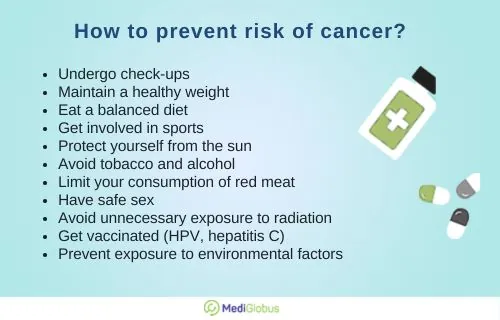
It is also possible to reduce the risk of developing cancer through your efforts: quitting bad habits such as smoking, eating a balanced diet, getting enough activity and having a healthy body weight can increase the chance of a healthy future for anyone.
Some cancers, such as breast cancer, can also be prevented by taking medication. NICE recommends tamoxifen, raloxifene and anastrozole for women who are at high risk of developing breast cancer.
In exceptional cases, patients take a radical step – preventive surgery. For example, in 2013, the world-famous actress Angelina Jolie had it done after she found out that she had inherited the BRCA gene from her mother. However, oncologists warn that such an intervention is recommended for a very small percentage of patients and that it is advisable to perform it after the onset of menopause.
Another issue that people who have learnt that they have a predisposition to cancer should discuss with their doctor is fertility. Chemotherapy is often used to treat cancer, which can lead to problems in getting pregnant or impregnating. If the patient plans to have children in the future, freezing sperm or eggs may be a viable solution. This will allow, in the case of a worst-case scenario, the use of in vitro fertilisation (IVF) to have a child.
Often enough, a positive result of genetic testing for cancer predisposition has a beneficial effect on the patient’s life. Such people are instructed to undergo cancer check-ups more frequently and more thoroughly. Thus, they are more likely to find cancer at stage 1 or even stage 0, when it can be cured by surgery alone – without the use of chemotherapy or radiation therapy. In contrast, people who don’t get check-ups 90% of the time go to the doctor well after the first symptoms appear, which is usually stage 2-3 disease, if not stage 4. They require much more aggressive, prolonged and expensive treatment.
A negative result in a cancer susceptibility test means that doctors have not found any gene known to science that is associated with cancer. If a person comes from a family with a history of cancer, it means that the gene has not been passed on. In such a case, the patient is said to have a standard average predisposition to cancer and he/she should follow the regulatory check-ups according to age.
If a person has relatives who have survived cancer, but none of them are found to have any harmful genetic changes, then a negative test result is categorised as a ‘non-informative negative’. This means that doctors suspect that a genetic component is present, but the current level of medical knowledge and technology is insufficient to detect it. It may be recommended that the patient undergo a second genetic test in a few years when science has reached a better understanding of the heredity of cancer.
Another variant of a cancer risk test result that a patient may receive is a variant of undetermined significance. This is how doctors refer to tests that detect changes in DNA but have no data to say whether the gene variant is linked to cancer. Usually, such results turn out benign and patients are not recommended to take additional measures to monitor their health. However, medical organisations recommend that patients should still stay in touch with a genetic counsellor so that they can react quickly if contrary information is discovered.


What cancers can be linked to a hereditary factor?
| Cancer type | Associated genes |
|---|---|
| Breast cancer in women | ATM, BARD1, BRCA1, BRCA2, CHEK2, CDH1, NF1, PALB2, PTEN, RAD51C, RAD51D, STK11, TP53 |
| Breast cancer in men | BRCA1, BRCA2, CHEK2, PALB2 |
| Colorectal cancer | APC, BMPR1A, EPCAM, MLH1, MSH2, MSH6, PMS2, CHEK2, POLE, PTEN, SMAD4, STK11, TP53, MUTYH |
| Endometrial cancer | BRCA1, EPCAM, MLH1, MSH2, MSH6, PMS2, PTEN, STK11 |
| Fallopian tube cancer, ovarian cancer, primary peritoneal cancer | ATM, BRCA1, BRCA2, BRIP1, EPCAM, MLH1, MSH2, MSH6, PALB2, PMS2, RAD51C, RAD51D |
| Gastric cancer | APC, CDH1, STK11, EPCAM, MLH1, MSH2, MSH6, PMS2 |
| Melanoma | BAP1, BRCA2, CDK4, CDKN2A, PTEN, TP53 |
| Pancreatic cancer | ATM, BRCA1, BRCA2, CDKN2A, EPCAM, MLH1, MSH2, MSH6, PALB2, STK11, TP53 |
| Prostate cancer | ATM, BRCA1, BRCA2, CHEK2, HOXB13, EPCAM, MLH1, MSH2, MSH6, PMS2 |
According to the Facing Hereditary Cancer Empowered FORCE charity
Biomarker test
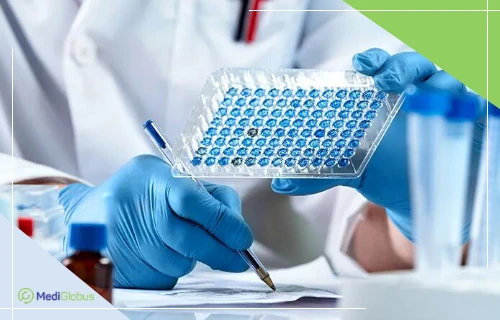
The biomarker test is also related to the genetic component of cancer. However, it differs from the cancer panel in that instead of testing the patient’s blood, it is done on tumour tissue obtained during a biopsy. This test can detect not only inherited genes that are associated with cancer but also spontaneous mutations. With this information, doctors can more accurately predict how a patient will respond to treatment – and therefore immediately select a more effective strategy. More importantly, the biomarker test makes it possible to prescribe a patient targeted therapy. This is a separate group of drugs that can distinguish cancer cells from healthy cells. Thanks to this, it makes it possible to treat oncology even at late stages, when chemotherapy is ineffective. In addition, targeted therapy is associated with fewer side effects. It works because the drugs ‘recognise’ specific proteins on the surface of cancer cells, so a biomarker test is mandatory before it is administered. Also, patients who have had a biomarker test can sometimes be invited to take part in clinical trials. This can be a chance of recovery for people with resistant tumours or stage 4 cancer.
Where can I get a cancer susceptibility test?




Some private companies offer at-home genetic testing services that, in addition to determining your ancestry, promise to identify susceptibility to a wide range of diseases, including cancer. However, we strongly discourage their use for medical purposes. Such panels test a smaller number of genes than clinics, so the results obtained when using them cannot be considered reliable.
Another important consideration is the issue of family planning. With IVF, it is possible to select the healthiest sperm and eggs so that the future child does not inherit pathogenic genes from the parents. However, in vitro fertilisation is strictly regulated by the laws of the countries where it is performed, and each has its legal nuances. Also, in most European countries it is forbidden to choose the sex of the future child. Therefore, future parents should carefully consider the choice of the clinic. In particular, the international medical tourism platform MediGlobus can recommend Invicta Clinic in Poland, IVI Fertility Clinic in Spain, and Cyprus IVF Hospital in Cyprus. For more detailed recommendations you can contact our coordinating doctors. We will give you a free consultation.
Summary
Genetic testing can detect increased susceptibility to cancer. People who carry these genes are advised to start cancer check-ups earlier and more often so that if a tumour forms, it can be detected as early as possible. Doctors know of more than 100 genes that increase the risk of developing cancer.
Only 10-12% of cancers are due to inherited factors. The remaining 90% are the result of spontaneous DNA mutations.
Genetic testing is recommended for people whose relatives have had cancer in at least 2 generations; those whose relatives have had cancer at a young age; and those whose relatives have had rare cancers or have a history of more than 1 cancer.
An effective method of cancer predisposition diagnostics is the cancer panel – when a large number of pathogenic genes are tested at the same time.
The biomarker test is performed on tumour tissue and allows the patient to be prescribed a more accurate and effective treatment, usually a targeted therapy.
Preimplantation genetic testing in IVF is available in some countries and allows the healthiest embryos to be selected before transfer.
Sources:
- 1. Cancer Research UK: Family history and ingerited cancer genes
- 2. Cancer Research UK: Genetic testing for cancer risk
- 3. National Cancer Institute: Cancer genetics
- 4. Acta Pharmacologica Sinica: Cancer predisposition genes: molecular mechanisms and clinical impact on personalized cancer care: examples of Lynch and HBOC syndromes
- 5. The New England Jounrnal of Medicine: Germline Mutations in Predisposition Genes in Pediatric Cancer
- 6. Anales de Pediatria: Genetic predisposition to childhood cancer
- 7. Nature: Realizing the promise of cancer predisposition genes
- 8. National Cancer Instite: Genetic testing fact sheet
- 9. FDA approval for Invitae Common Hereditary Cancers Panel
- 10. Nutrients: Healthy Lifestyle and Cancer Risk: Modifiable Risk Factors to Prevent Cancer
- 11. Facing Hereditary Cancer Empowered FORCE
- 12. Washington Unviersity
- 12. NEJM Illustrated Glossary