


1. About lung metastases |
2. Symptoms of the disease |
3. Treatment of lung metastases |
4. Prognosis of survival |
5. Leading clinics |
Lung metastases are quite common in advanced cancer. Usually, malignant tumours of the breast, intestines, kidneys, prostate, stomach, and thyroid spread to this organ. Other cancers may also metastasize here, but a little less often. Find out how to stop lung metastases and whether you can get rid of them at all in our article.

Listen to the article:
What are lung metastases and when do they appear?
Lung metastases are secondary malignancies that arise from the spread of a primary tumour to other organs and body systems. They get there through the blood or lymphatic tracts. About 30% of cancer patients have disease metastasis to the lungs.
Secondary tumours can affect any part of the lungs. In some cases, they appear only in one location, while in others there are multiple foci in one or both lobes of the organ.
Most of these cancer cells develop near the edges and lower parts of the lung. Metastases can also spread to the pleura or mediastinum.
 Read:
Read: 
What are the symptoms of lung metastases?
Singular lung lesions may remain undiagnosed for a long time. As the disease progresses and more and more metastases appear, patients develop lung tissue damage. This gives the following clinical picture:
 shortness of breath,
strangulated cough,
progressive shortness of breath,
hemoptysis,
chest and back pain,
pneumonia.
Pulmonary metastases are rarely diagnosed in their initial stages. Because of the lack of specific signs of pathology, they can be detected early by chance. Lung metastases can be seen on CT, MRI, X-ray, or PET scan. Bronchoscopy or fine needle biopsy confirms the disease. The accuracy of cancer diagnosis abroad exceeds 99%.
To make an appointment for a cancer diagnosis at one of the leading clinics abroad, click on the button below and fill out the feedback form. We will call you back as soon as possible.
What to do with lung metastases?
Treatment of lung metastases depends on the disease that caused them. The main goal is to control cancer or alleviate its symptoms. There are many different treatments for lung metastases. Among them are:
chemotherapy,
radiation therapy,
hormone therapy,
radiofrequency ablation (RFA),
laser therapy,
targeted therapy,
immunotherapy,
surgery.
Chemotherapy for lung metastases

The use of antitumor drugs is the preferred method of fighting the disease. It gives a good effect even when the cancer is in its late stages and spreads to distant organs.
For metastatic lung disease, chemotherapy is the most common treatment option. It helps to destroy the malignant cells and control their growth. The regimen, duration, and choice of chemotherapy drugs are individual for each patient.
Most patients require four to six cycles of treatment over three to six months. The drugs are given intravenously or used as tablets. Chemo is sometimes combined with other methods, such as surgery and targeted therapy.
Hormone therapy for lung metastases
Hormone therapy is indicated to control the growth of a malignant tumour and relieve the symptoms. It is prescribed for hormone-dependent neoplasms that have spread to the lungs. These include breast and thyroid cancer. These drugs block or remove certain hormones to slow or stop the development of the malignant process.
Immunotherapy for lung metastases
This is the use of drugs that help the patient’s immune system detect and attack cancer. This method is prescribed as a stand-alone treatment but is most often used in combination with other therapies such as chemo or radiation. The type of immunotherapy drug chosen depends on the primary tumour and its characteristics.
Radiation therapy for lung metastases
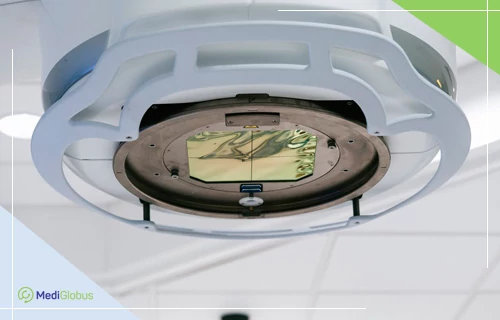
Radiation therapy for secondary tumours in the lungs is mostly prescribed as palliative care. It is used to treat symptoms such as breathing problems, coughing and bleeding. During external radiation therapy, the device directs a beam of radiation through the skin to the affected organ. The duration of therapy depends on:
treatment goals,
the number of cancer foci,
degree of lung damage,
the general condition of the patient.
Generally, radiation therapy for lung metastases is given once a day for 5 days a week.
One of the most popular options for irradiation of this pathology is stereotactic ablative radiotherapy. The method delivers higher doses of radiation precisely to the tumour. The impact on the surrounding healthy tissue is minimal.
Stereotactic radiotherapy involves fewer procedures than standard external radiation. The number and duration of the sessions depend on the size, location and number of metastases to be treated.
Radiofrequency ablation (RFA) of lung metastases
A minimally invasive method of treating lung metastases is radiofrequency ablation. It involves using electric current to create heat that destroys malignant cells. During the procedure, a special needle is inserted into the tumour under the control of imaging systems. An electric current passes through it, which causes the temperature in the metastatic cells to rise and destroys them.
Laser surgery for pulmonary metastases
This is the use of a laser that releases a high-intensity beam of light. This technology makes it possible to make bloodless tissue incisions. The surgeon uses a thoracoscopy to determine the location of the metastases. He then directs a laser beam to the pathological focus, which heats up and destroys the cancer cells. This method of treatment is recommended when a tumour blocks the trachea or airway.
Targeted therapy for lung metastases

Targeted therapy refers to the “biological” treatment of malignant diseases. It targets the tumour without affecting healthy organs. These drugs detect and attach themselves to certain proteins that are located on the surface or inside cancer cells. They stop the development of the tumour.
Targeted therapy is often combined with chemo. It is used to control lung metastases in some types of cancer, such as breast, prostate, kidney, stomach, etc. The type and regimen of the drug are determined by the primary tumour.
Surgery for metastatic lung lesions
Resection of pulmonary metastases is possible only if the primary malignancy is completely removed. Otherwise, the patient will not benefit significantly from surgery. It is usually recommended for patients with colon cancer, bone cancer, or soft tissue sarcoma that has spread to the lungs.
The surgical approach to lung metastases is determined by the localization and extent of the lesion. The surgery is usually done by an open incision of the sternum – a thoracotomy. The doctor then carefully removes the affected part of the lung along with the metastases.
In some cases, video-assisted lobectomy (VATS) or video-thoracoscopy can be performed. The procedure is minimally invasive. It involves a small incision in the chest. Recovery from the surgery takes 3 days.
Also, VATS has a smaller risk of bleeding or infection of the operating surface. Video thoracoscopy is recommended when there are one or more small metastases in the lung.

Life expectancy with lung metastases
The prognosis for metastatic lung disease depends on many factors. Key among them are the type and stage of primary cancer, as well as the methods of oncotherapy used to control the disease. The pathology is difficult to treat, and the 5-year survival rate for patients is usually about 7%. If the patient can have surgery to remove the primary tumour and metastases, then there is a chance for an improved prognosis. Also, if the body responds well to radiotherapy, chemotherapy, or other types of treatment, about 35% of patients can improve their chances of survival.
Where is the best place to treat lung metastases abroad?
Turkey – Atasehir Medicana Hospital, Koç University Hospital, Medipol Clinic.
South Korea– Seoul National University Hospital (SNUH) and SoonChunHyang Hospital.
Spain – Hospital Quiron Madrid, niversity Hospital of Navarra.
Israel – Sourasky Medical Center (Ichilov Clinic), Assuta Hospital Network.
Germany – University Hospital of Cologne.
Austria – Vienna Private Hospital, Central Vienna Clinical Hospital (AKH).
Resume
Lung metastases most commonly occur in breast, colon, kidney, stomach, prostate, ovarian, thyroid, bone, skin, head, and neck cancers. They can be detected by CT, MRI, and X-ray or PET-CT.
Symptoms of lung metastases include shortness of breath, difficulty breathing, cough with blood, and pneumonia. Signs of the disease are absent in the initial stages. They appear when the disease has progressed significantly.
Treatment of the disease involves the use of radiation, chemotherapy, radiofrequency ablation, laser surgery, hormonal, immune or targeted therapy, or a combination thereof. Surgery is indicated for singular metastases and a “controlled” primary tumour.
The prognosis for cancer metastasis to the lungs is conditionally unfavourable. Only 7% of patients manage to pass the 5-year survival threshold. In rare cases after successful complex treatment of a primary tumour and secondary malignant foci, patients state that lung metastases have disappeared.
To fight lung metastatic lesions patients usually choose clinics in Turkey, Spain, Israel, Korea, Germany, and Austria. Particularly popular are medical centres such as Medicana, Koç, Medipol, Ichilov, Assuta, Vienna Private Hospital, AKH, Quiron Madrid, Navarra, SNUH and SoonChunHyang.
To go for treatment of lung metastases abroad, you do not need to search for information on various forums and waste precious time. By contacting our coordinators, you can quickly arrange a medical trip. We can also help you find a suitable clinic and doctor.