


According to GLOBOCAN 2020, stomach cancer ranks fifth in terms of prevalence and fourth in terms of mortality among other cancers. High mortality rates are associated with the fact that most patients start treatment late. However, in the early stages of development, the disease is highly treatable, with approximately 90% of patients making a full recovery. Read on to learn more about this pathology, how it develops in the body, and methods of combating it at different stages.
What are malignant tumours of the stomach, and what causes them?
A malignant tumour develops when cells in the stomach lining begin to mutate and divide randomly. The tumour can be located in different parts of the organ: in the area where the stomach and oesophagus connect, in the body of the stomach, or the upper and lower parts. Men are affected more often than women. The average age of onset is 60-65 years. However, it is possible to develop the disease at a younger age.
One of the reasons why a tumour begins to develop in the stomach, according to doctors, is infection with the bacterium Helicobacter pylori. The activity of these microorganisms provokes the appearance of ulcers and gastritis. Therefore, people with stomach diseases have a high risk of developing this type of cancer.
Other factors that influence the development of malignant tumours include:
- smoking and excessive alcohol consumption;
- poor nutrition;
- exposure to toxic and harmful chemicals;
- medications that damage the stomach lining;
- for radioactive exposure;
- for chronic diseases of the digestive organs;
- for surgery on the digestive organs.
 Read:
Read: Get a quick gastroenterological check-up
The insidious nature of stomach cancer is that the disease may not manifest itself for a long time. That is why most patients see a doctor at a late stage. Regular stomach examinations allow medical specialists to monitor the health of this organ. Foreign clinics offer express diagnostic programmes. Their advantage is that the examination takes only 1-2 days and can even be done while on holiday abroad.
Stages of gastric cancer
Malignant neoplasms of the stomach are divided into stages and classified according to the TNM system. The size of the tumour and the extent of stomach damage (T value), lymph node damage (N value), and the presence of distant metastases in the body (M value) are taken into account. The treatment of stomach cancer at different stages differs in the degree of intervention.
Classification of stomach cancer according to the TNM system:
- stage 0 – TisN0M0
- stage IA -T1N0M0
- stage IB – T2N0M0, T1N1M0
- stage IIA – T3N0M0, T2N1M0, T1N2M0
- stage IIB – T4aN0M0, T3N1M0, T2N2M0, T1N3M0
- stage IIIA – T4aN1M0, T3N2M0, T2N3M0
- stage IIIB – T4bN0(N1)M0, T4aN2M0, T3N3M0
- stage IIIC – T4aN3M0, T4bN2(N3)M0
- stage IV – any T, any N, M1
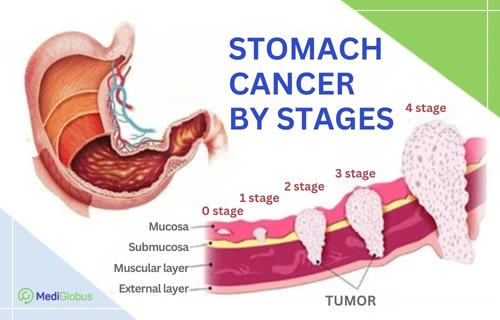
Description of the disease at different stages:
| Stage 0 | Accumulation of cancer cells without spreading to the deeper layers of the stomach lining. No metastasis. |
| Stage 1 | The tumour is no more than 2 cm in diameter. The pathology spreads to the muscle layer of the stomach. Single nearby lymph nodes may be affected. |
| Stage 2 | The tumour reaches a size of up to 5 cm. Malignant cells spread to the subserosal layer of the stomach wall. Local lymph nodes are affected. There are no metastases in other organs. |
| Stage 3 | The tumour is larger than 5 cm in diameter. All layers of the stomach wall are affected. The tumour spreads beyond the digestive tract. Malignant cells may be found in nearby organs. |
| Stage 4 | Distant lymph nodes and organs are affected. Metastases are most often found in the abdominal and retroperitoneal cavities, liver, spleen, kidneys, heart, and lungs. Sometimes the brain, spine, and bones are affected. |
Symptoms of gastric cancer at different stages
The manifestations of the disease vary depending on the size and location of the tumour, as well as the stage of the oncological process. Stage 1 stomach cancer usually has no symptoms. Mild discomfort in the abdomen and a decrease in appetite may occur.
As the cancer progresses and the deeper layers of the stomach wall are affected, the following symptoms are added to the general malaise:
- abdominal pain;
- nausea, vomiting;
- avspecific odour from the mouth;
- heartburn, bloating;
- rapid satiety after eating a small amount of food;
- indigestion;
- decreased or lack of appetite;
- anaemia;
- weakness, high fatigue;
- weight loss;
- stomach bleeding.
Stage 4 stomach cancer has the following symptoms:
- bloody stools;
- vomiting;
- unintentional weight loss;
- severe abdominal pain;
- yellowing of the eyes and/or skin;
- fluid accumulation in the abdominal cavity (ascites);
- difficulty swallowing and eating;
- other symptoms may appear depending on which organ is affected by metastases.
Tell your doctor about your symptoms
If you experience digestive problems and symptoms that may indicate stomach cancer, do not delay visiting your doctor. Timely treatment gives an 80-90% chance of a full recovery.
Removal of early-stage stomach tumours
Surgical removal
Early-stage stomach cancer is more often treated endoscopically. At this stage, the tumour is no larger than 2 centimetres in diameter and does not extend beyond the mucous membrane of the organ. Such patients undergo endoscopic mucosal resection (EMR) or endoscopic submucosal dissection (ESD).
The operation is performed without incisions. An endoscope is inserted through the throat and reaches the stomach. The instrument is equipped with a video camera, which allows the surgeon to see the area being operated on in detail. Through the endoscope, the surgeon inserts instruments to remove the tumour and surrounding tissue.
Treatment for stage I stomach cancer includes tumour resection or complete removal of the organ (gastrectomy), chemotherapy and radiation. At this stage of the disease, the neoplasm is often removed along with the affected tissues and lymph nodes, while preserving the organ.
Partial gastrectomy
Subtotal (partial) gastrectomy is an operation in which only part of the stomach is removed. Depending on the location of the tumour, a distal gastrectomy (neoplasm in the lower part of the stomach) or a proximal gastrectomy (tumour located in the upper part) is performed. Part of the stomach, oesophagus, small intestine, omentum and nearby lymph nodes are removed. If the cancer has spread to the spleen or other nearby organs, they are also removed. The remaining part of the stomach is then reattached. Eating becomes easier after such an operation, as it involves the removal of only part of the stomach, not the entire organ.
Total gastrectomy
Total removal of the stomach at stage 1 is less common when the cancer has affected most of the organ’s tissue or is close to the oesophagus. The surgeon removes the entire stomach, omentum and nearby lymph nodes, and may also remove the spleen, part of the oesophagus, intestine, pancreas or other neighbouring organs if they are affected by cancer. The end of the oesophagus is then connected to a section of the small intestine, allowing food to move through the intestinal tract.
Most subtotal and total gastrectomies are performed by open surgery, which requires a large incision in the skin of the abdomen.
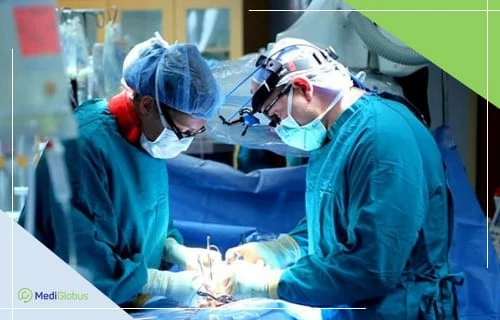
In foreign clinics, doctors prefer organ-preserving surgeries. Surgical intervention is performed using minimally invasive methods such as laparoscopy or robotic surgery. To access the affected organ, the surgeon makes small incisions into which special instruments are inserted. The process is visualised on a large-scale monitor. This allows the surgeon to see the smallest details, which simplifies the work and improves the quality of the operation. After such an operation, patients have far fewer complications, and recovery is easier and faster.
Chemotherapy
Chemotherapy for stage 1 stomach cancer is administered before and after surgery. In the first case, it is used to reduce the size of the tumour and simplify the process of its removal. After surgery, it is used to destroy residual cancer cells and prevent the risk of recurrence. The duration of the course and the drugs used are selected individually. Treatment is carried out in cycles with breaks in between so that the body can recover. A cycle usually lasts several weeks.
Currently, doctors have a large list of drugs available for the treatment of stomach cancer. Quite often, they are combined to achieve greater effectiveness. If one drug does not help, the doctor selects another, more effective drug.
Chemotherapy affects not only cancer cells, but also some types of healthy cells. Therefore, side effects are possible during treatment, such as nausea, vomiting, digestive problems, hair loss, and fatigue. Usually, after completing the course of treatment, these complications go away on their own.
HIPEC therapy
In modern medical centres in Germany, Turkey, Israel and Austria, doctors use the HIPEC (hyperthermic intraperitoneal chemotherapy) method to treat stomach cancer. After surgical removal of the tumour, a heated drug is injected into the abdominal cavity, which acts on the cancer cells for several hours. Compared to conventional chemotherapy, this method is considered more effective and safer, as it does not enter the bloodstream and does not harm healthy organs.
The combination of cytoreductive surgery with hyperthermic intraperitoneal chemotherapy is being actively researched in the treatment of abdominal and stomach cancer. The results of some studies provide the following information:
- Study by Yang et al. A study involving 68 patients with stomach cancer compared two treatment methods: surgical removal of the tumour and removal of the tumour followed by HIPEC therapy (cisplatin and mitomycin C). The group of patients who underwent HIPEC showed a survival rate of 11 months compared to 6,5 months in the group that underwent surgery alone.
- University of Pittsburgh. The study included 23 patients with gastric carcinomatosis. Patients underwent surgery to remove the tumour, followed by HIPEC chemotherapy (mitomycin C). Serious complications were identified in more than 50% of patients, but overall survival was 9,5 months. This indicates that despite complications, treatment prolongs the lives of cancer patients.
- Specialised Centre for Malignant Tumours of the Peritoneum in Japan. The study involved 194 patients who, in addition to intraperitoneal chemotherapy (HIPEC), underwent a course of conventional chemotherapy before surgery. After a loading dose of chemotherapy drugs, their survival increased to 15,8 months. Complications were observed in 23,6% of patients.
- Study by Rudloff et al. Two groups of patients participated in the study. One group underwent surgery with intraperitoneal chemotherapy (HIPEC) and conventional chemotherapy. The other group underwent only standard chemotherapy. The results showed that patients in the HIPEC group lived for 11,3 months without recurrence, while those who received only systemic chemotherapy lived for 4,3 months.
Radiotherapy
In conjunction with chemotherapy courses, patients undergo radiation therapy sessions. In the early stages, particularly good results are achieved when radiotherapy is combined with chemotherapy. Radiochemotherapy is performed before surgery to reduce the tumour. This method is also used after surgical removal of the neoplasm to destroy any cancer cells that may remain in the body.
Foreign clinics use intensity-modulated radiation therapy (IMRT) and three-dimensional conformal radiation therapy (3D-CRT) devices. They irradiate the tumour from different angles, which causes even greater damage to pathological tissues. Unlike conventional radiation therapy, which affects the entire body, IMRT and 3D-CRT only act within the cancerous area and cause virtually no harm to healthy tissue. This makes the therapy easier for the patient to tolerate and reduces the severity of side effects.
Treatment of Stage 2 Gastric Cancer
Treatment for stage 2 stomach cancer is not much different from treatment for stage 1. Gastrectomy remains the main method of treatment. The extent of the surgery and the decision on whether to remove part or all of the stomach are determined based on the extent of the organ damage and the number of affected lymph nodes.
Stage II stomach cancer is treated with chemotherapy or chemoradiation therapy. Sessions are scheduled before surgery to reduce the size of the tumour and increase the chance of preserving the organ. After surgery, chemotherapy and radiation are necessary to prevent recurrence of the disease.
Get effective treatment abroad
Medical centres in Turkey, Germany, and Austria employ oncologists with many years of experience. Foreign clinics use the latest methods and technologies to treat cancer, including safe surgery, high-quality medications, and powerful radiotherapy equipment. With their help, doctors successfully treat stomach cancer at all stages of development.
Treatment of patients with Stage 3 Gastric cancer
In the later stages of stomach cancer, the tumour reaches a large size. Complete surgical removal is practically impossible. In such cases, the tumour is partially removed to alleviate the patient’s condition. In some cases, a decision is made to perform a total gastrectomy.
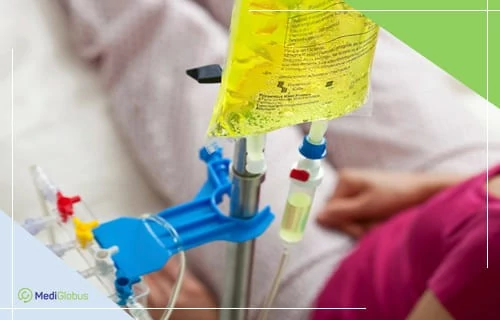
Stage III stomach cancer is also treated with chemotherapy. Medications help to reduce the size of the tumour and also treat the affected nearby organs.
In developed countries, new effective anti-cancer drugs are constantly being developed. The latest chemotherapy drugs are highly effective in treating cancer in its later stages. In addition, they have fewer side effects. Therefore, this therapy is easier to tolerate than domestically produced drugs.
Targeted therapy
Abroad, patients with stage 3 stomach cancer are offered targeted therapy. This is an effective method of fighting many types of cancer. It aims to block specific molecules responsible for the growth and survival of tumour cells. Such drugs have fewer side effects compared to chemotherapy. They are selected based on the unique characteristics of the patient’s tumour.
Currently, there are several targeted drugs available:
- Some cancer cells contain large amounts of the HER2 protein. Targeted drugs recognise this protein, attach to the cell and block its ability to divide. Drugs Trastuzumab and Fam-trastuzumab deruxtecan can be used for the treatment of gastric cancer. They help to increase life expectancy in advanced HER2-positive stomach cancer. They are particularly effective in combination with chemotherapy.
- Cancerous tumours create blood vessels to supply them with nutrients. The protein VEGF is responsible for this process. Drugs that target VEGF block this process. As a result, cancer cells lose their ability to feed properly and die. One such drug is the monoclonal antibody Ramucirumab (Cyramza). It is used to treat advanced stomach cancer after chemotherapy has failed.
- Some cancer cells that affect the stomach produce a protein called TRK, which promotes active tumour growth. The drugs Larotrectinib (Vitrakvi) and Entrectinib (Rozlytrek) recognise this protein and prevent further cancer development. These drugs help in advanced stages of stomach cancer when other methods have proven ineffective.
Immunotherapy
Immunotherapy is another effective treatment option for advanced stages of stomach cancer and recurrence of the disease. It aims to strengthen the body’s immune system to detect and more effectively destroy cancer cells. One of the features of the human immune system is its ability to distinguish between abnormal and healthy cells. However, cancer cells have learned to disguise themselves as normal cells. As a result, the immune system does not recognise them, which leads to the gradual growth of the tumour and the spread of the disease. Immunotherapy intervenes in this process by activating and strengthening immune cells so that they can more effectively recognise and attack cancer. This approach is particularly effective in the later stages of the disease and in cases of recurrence, when traditional treatments are ineffective.
The anti-cancer drug Keytruda for immunotherapy has become a real breakthrough in the treatment of malignant tumours of the gastrointestinal tract. Phase III trials were completed in 2023. The results showed that Keytruda, in combination with chemotherapy, reduces the risk of death by 22% in patients with HER2-negative gastric cancer.
“Most cases of gastric cancer remain undetected until an advanced stage, at which point the 5-year survival rate is only 6% — one of the lowest rates among all types of cancer. The positive overall survival results reported in this study are very encouraging and demonstrate the potential of KEYTRUDA in combination with chemotherapy to prolong the lives of patients with HER2-negative locally advanced unresectable or metastatic adenocarcinoma of the stomach or gastroesophageal junction,” said Dr. Sun Yang Ra, Director and Professor of Medical Oncology, Department of Internal Medicine, Songdan Cancer Research Institute, Yonsei University College of Medicine, Yonsei University Health System, Seoul, Korea.
Radiotherapy
Radiotherapy has proven to be highly effective in treating inoperable stomach cancer. Modern radiation systems determine the location and shape of the tumour and direct the rays directly at the affected tissues. As a result, the pathological formation decreases in size without damaging healthy tissues.
How do doctors help patients with terminal-stage gastric cancer?
To alleviate symptoms and prolong life, patients with terminal-stage cancer undergo palliative therapy. Surgery is indicated if it is necessary to eliminate obstruction of the oesophagus and stomach, in cases of bleeding or tumour rupture. Chemotherapy and radiation are prescribed to treat metastases. In some foreign clinics, patients with stage 4 stomach cancer are offered experimental treatment programmes with new anti-cancer drugs.
Surgical methods used to relieve symptoms in the later stages:
| Gastric bypass | This procedure is used to remove a blockage in the lower part of the stomach. The surgeon creates a bypass for food. To do this, part of the small intestine is connected to the upper part of the stomach. |
| Subtotal gastrectomy | Part of the stomach with the tumour is removed. This operation does not cure cancer, but it does relieve symptoms. In this case, it is not necessary to remove nearby lymph nodes or other organs. |
| Nutrition tube placement | This is a minor operation to place a nutrition tube through the skin of the abdomen into the lower part of the stomach or small intestine. The tube allows liquid nutrition to be administered directly. |
| Endoscopic tumour ablation | The procedure is performed using an endoscope, which is inserted through the mouth. The instrument is equipped with a laser, which is used to remove part of the tumour. The treatment is performed to stop bleeding or remove a blockage without the need for surgery. |
| Stent placement | This is a non-surgical method of preventing blockage of the opening in the stomach through which food passes. Using an endoscope, a metal tube is inserted into the stomach opening, which prevents the passage from closing, ensuring normal passage of food. For tumours in the upper part of the stomach, the stent is placed at the junction with the oesophagus, and for tumours in the lower part, it is placed at the junction with the small intestine. |
Which clinics are recommended for the treatment of stomach cancer?
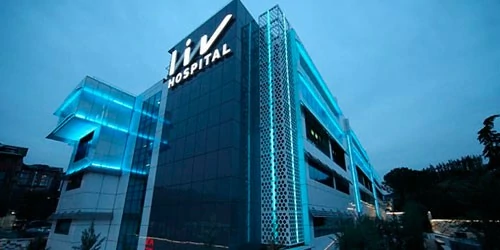
Liv Clinic
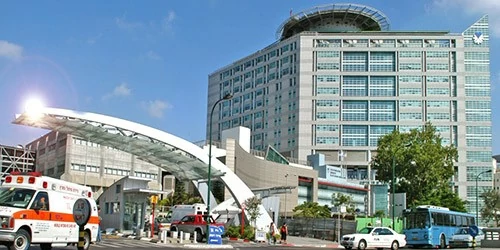
Ichilov Medical Centre
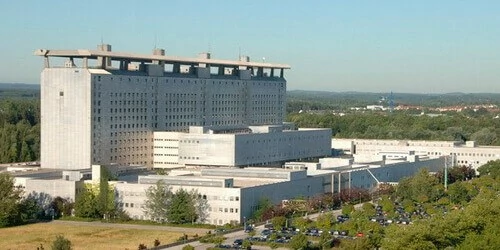
Ludwig Maximilian University Clinic
Vienna Private Clinic

Find a clinic for cancer diagnostics and treatment
Medical centres in Turkey, Europe and Israel demonstrate some of the best treatment outcomes for all types of cancer, including stomach cancer. They use effective and safe treatment methods, employ doctors of international standing, and use the latest medical technology.
Survival prognosis for gastric cancer
It is important to note that survival statistics do not predict specific outcomes for individual patients; each case is unique. The success of stomach cancer treatment depends primarily on the stage of the disease and timely therapy. The sooner a patient seeks medical help, the higher the chances of a full recovery. The outcome of treatment also largely depends on the age of the patient. Patients under 50 are more likely to recover than patients over 70.
According to Cancer Research UK statistics, the relative 5-year survival rate for stomach cancer patients is (the statistics do not take into account which methods of stomach cancer treatment were used):
- Stage 1 — 65%
- Stage 2 — 35%
- Stage 3 — 25%
- There are no 5-year survival statistics for stage 4 stomach cancer. Approximately 20% of patients survive for 1 year or more.
Overall statistics for all stages:
- More than 45% of patients live for more than 1 year
- More than 20% of patients live for more than 5 years
- More than 15% of patients live for more than 10 years
Summary
- Stomach cancer is a common oncological disease that affects the mucous membrane of the stomach.
- Stomach cancer is classified by stage depending on the size of the tumour, the extent of damage to the organ and lymph nodes, and the presence of metastases.
- Symptoms depend on the location of the tumour and the stage of the disease.
- The main method of treating stomach cancer in stages 1-3 is gastrectomy, the partial or complete removal of the stomach.
- Chemotherapy and radiation therapy are used as adjunctive treatments.
- The prognosis for survival depends on the stage of the cancer. In the early stages of stomach cancer, 80-95% of patients survive.
Leave a request
Stomach cancer is curable. This has been repeatedly proven by doctors from various medical centres around the world. Modern technologies and treatment approaches give patients a chance to recover and return to normal life. Contact a MediGlobus specialist if you are interested in treatment abroad. To do so, click on the button below.