


According to the American Cancer Society, the five-year relative survival rate for people diagnosed with gastric cancer is 70% if the cancer is at a localised stage, 32% if the cancer progresses to a regional stage, and drops to 6% if the cancer progresses to distant parts of the body. The low rate is due to patients seeking help in the later stages of the disease. But it is worth remembering that it is easier to cure cancer at the early stages than at 3 and 4. To do this, you need to undergo diagnosis and treatment of gastric cancer as soon as possible. In this article, we will explain how the disease is classified by stages, and consider methods of modern treatment of gastric cancer at each stage.
GASTRIC CANCER CLASSIFICATION
TNM classification. It is a comprehensive tumour staging system. T stands for the size of the tumour. N – presence of metastases in lymph nodes. M – distant metastases.
Division by stage. A simplified system that summarises the different TNM classes of the cancer process. In this case, there are 4 main stages of gastric cancer.
To diagnose gastric cancer in time and carry out the correct treatment, comprehensive oncological examinations are performed abroad. They allow you to accurately detect the tumour and quickly start fighting it.
GASTRIC CANCER STAGE 1 TREATMENT

Stage 1 gastric malignant tumour is divided into the following subtypes:
 Stage 1A T1NN0M0 – the tumour does not extend beyond the borders of its mucosa, there are no metastases.
Stage 1B T1N1M0 – the tumour is within the mucosa, and there are metastases to regional lymph nodes.
Stage 1B T2N0M0 – the tumour has sprouted into the muscular membrane, with no metastases.
Gastric cancer at the first stage is treated with a gastrectomy operation. It involves the removal of the affected part of the stomach. The intervention is done endoscopically, robotically or openly.
Robotic surgery is the most gentle. It is performed using the da Vinci Surgical Unit. The tumour is removed through 2-3 cm incisions. After that, the patient recovers within a week.
In some clinics, such as in Germany, Spain and Israel, doctors use hyperthermic intraperitoneal chemotherapy HIPEC. The procedure involves injecting hot chemo drugs into the abdomen during surgery. The drugs destroy cancer cells but do not enter the bloodstream or cause side effects like intravenous chemo.
Intensity Modulated Radiation Therapy (IMRT) is used to treat early-stage gastric cancer. It helps to fine-tune the dose of radiation to destroy the affected tissue without affecting healthy tissue. The prognosis for treating gastric cancer at these stages depends on the location of the tumour and the techniques used. Thus, while on average, according to Cancer Research UK, 65% of patients cross the threshold of five-year survival, some Japanese researchers have managed to achieve 89-95% survival rates at similar stages (World Journal of Gastroenterology).
 Read:
Read: THERAPY FOR STAGE 2 GASTRIC CANCER
Stage 2A T3N0M0 – the tumour has grown into the pseudoserosal shell (under the tissue that lines the stomach). There are no metastases.
Stage 2A T2N1M0 – the tumour has spread to the muscular sheath, and there are metastases in 1-2 lymph nodes.
Stage 2A T1N2M0 – the tumour is located within the mucosa, and metastasises to 3-6 lymph nodes.
Stage 2B T4aN0M0 – the tumour has grown into the serosa (the tissue lining the stomach), with no metastases.
Stage 2B T3N1M0 – the tumour has grown into the pseudoserous membrane, and there are metastases in 1-2 lymph nodes.
Stage 2B T2N2M0 – the tumour has spread to the stomach muscles and has grown into 3-6 lymph nodes.
Stage 2B T1N3M0 – the tumour is located within the mucosa, and there are metastases in 7 or more lymph nodes.
At this stage of gastric cancer development, as at the previous one, surgery is indicated. It involves resection of the maximum volume of the tumour. If the cancer has spread to the lymph nodes, the doctor removes them as well. In addition, chemotherapy and radiotherapy are prescribed. It is possible to carry out chemoradiation therapy.
In the treatment of gastric cancer, these two methods are used together. This helps to intensively affect the cancer cells and eliminate them.
The first course of oncotherapy is prescribed 4-6 weeks after surgery. In total, 4-6 courses are performed at intervals of 3 weeks. The duration of such treatment is about six months. The threshold of 5-year survival at this stage of gastric oncology in case of successfully performed oncotherapy, including hysterectomy, can reach 70%.

TUMOUR CONTROL OF STAGE 3 GASTRIC CANCER TUMOURS
Stage 3A T4aN1M0 – the tumour has spread to the serous membrane, and there are metastases in 1-2 lymph nodes.
Stage 3A T3N2M0 – the cancer has spread into the pseudoserous membrane, and 3 to 6 affected lymph nodes are observed.
Stage 3A T2N3M0 – the neoplasm sprouts into the muscle tissue, and cancer cells affect 7 or more lymph nodes.
Stage 3B (T4bN0M0, T4bN1M0) – the tumour has grown into the structures adjacent to the stomach, there are no metastases or they have affected 1-2 lymph nodes.
Stage 3B T4aN2M0 – the cancer has grown into the serosa and 3-6 regional lymph nodes.
Stage 3C (T4bN2M0, T4bN3M0) – cancer grows into the tissues neighbouring the stomach, and there are metastases in 3-7 lymph nodes.
Stage 3B T3N3M0 – the tumour is within the pseudogastric shell, and there are metastases to 7 or more lymph nodes.
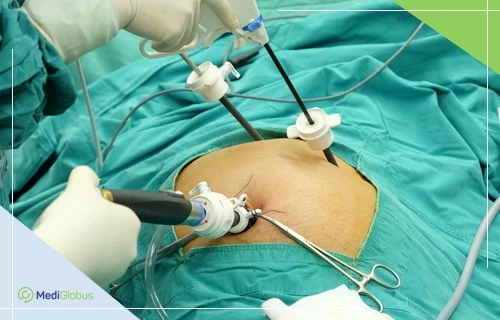
Surgical treatment of gastric cancer at stage 3 is rarely prescribed because the tumour is inoperable. At this stage, surgeons can perform palliative treatment of gastric cancer with surgery. It consists of partial removal of the tumour. This helps to reduce the burden on the body and increases the effectiveness of further procedures.
To treat metastases of gastric cancer and reduce the primary tumour, chemotherapy, and radiation therapy are used. Targeted therapy may be prescribed at this stage of the disease. This is a modern treatment of gastric cancer with drugs that specifically kill cancer cells without damaging healthy cells.
The 5-year survival rate at stage 3 of gastric cancer depends on the chosen method of treatment, the age of the patient and the degree of spread of the cancer process. On average, the rate is 25-35%.
TREATMENT OF STAGE 4 GASTRIC CANCER
Stage 4 AnyT AnyN M1 – any type and size of the tumour, any number of affected regional lymph nodes, there are metastases to distant structures (liver, lungs, spine and other organs).
At this stage, palliative treatment of gastric cancer is carried out. It is aimed at alleviating symptoms, relieving pain and improving the quality of life. Effective treatment of stage 4 gastric cancer with metastases includes partial removal of the tumour, chemotherapy, and radiation therapy. These treatments help kill most of the malignant cells and slow the spread of the disease.
At later stages, when treating gastric cancer in modern clinics (including abroad), the patient can participate in clinical trials of new drugs. These are modern methods of treatment, they include immunotherapy and targeted therapy. For such therapy for gastric cancer, it is necessary to undergo diagnostics and obtain the doctor’s consent.
When treating fourth-degree gastric cancer, the five-year survival rate is about 6 per cent.

What factors affect the prognosis of gastric cancer treatment?
International organisations can provide average information on the prognosis of gastric cancer treatment, but only your oncologist will be able to assess the real situation after a thorough diagnosis. The prognosis of treatment and survival rate is affected by a large number of factors other than the stage of the disease. Here are some of them:
The degree of aggressiveness and malignancy of the tumour. There are several different types of gastric cancer – adenocarcinomas, lymphomas, stromal tumours, and carcinoids. Fast-growing tumours, consisting of more abnormal cells (examined during a biopsy), have a less optimistic prognosis.
The presence of certain genes, in particular HER2, VEGFR2, PD-L1/PD-1, FGFR2, and CLDN18.2, makes targeted therapy possible. It can improve the patient’s prognosis, as well as life expectancy at advanced stages. Molecular genetic analysis of tumour cells is performed to detect the above genes.
The age of the patient, depending on the type of tumour, can act as a positive or negative factor. In general, gastric cancer treatment is better tolerated by younger patients (aged less than 65 years). However, in rare forms of particularly aggressive hereditary oncology, younger patients have a worse prognosis.
The patient’s general well-being, higher levels of activity and independence are generally good signs. They also indicate that the patient will be able to tolerate more aggressive (and effective) treatment.
Successful treatment – response to chemotherapy/radiation therapy, results of surgery, the possibility of target therapy/HIPEC therapy, etc. can significantly improve the prognosis of gastric cancer treatment.
Leading clinics for gastric cancer treatment abroad
Medicana Ataşehir Clinic
Read about the clinic →
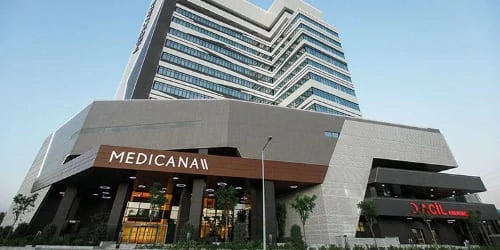
Medikana Ataşehir Clinic has excellent oncologists Professor Mutlu Demiray and Türkan Öztürk Topcu. Both doctors are experienced specialists in their field (more than 15 years of practice) and are members of the American Society of Oncology (ASCO) and the European Society of Oncology (ESMO).
University Hospital Cologne
Read about the hospital →

The medical committee for the treatment of gastric cancer is chaired by some of the country’s best experts on the disease: professor Thomas Zander and professor Jürgen Wolf. The committee meets weekly to discuss each case and collectively find the best treatment plan.
Liv Vadistanbul Clinic
Read about the clinic →
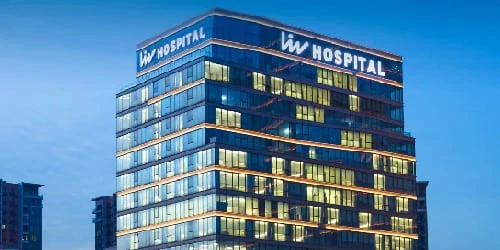
Among the specialists who treat gastric cancer at Liv Vadistanbul Clinic are Dr Eylem Karatay and professor Emre Sivrikoz. The Liv Vadistanbul Clinic is sought after for its endoscopic surgery and state-of-the-art cancer treatment protocols.
Navarra University Hospital
Read about the clinic →

The radiopharmaceutical laboratory at the Uniclinica Navarra is the only one in Spain that synthesises the drugs needed to accurately diagnose GI tumours. The leading specialists of the department are Dr Pablo Álvarez Ballesteros and Alicia Alvarellos Pérez.
Fuda Clinic
Read about the clinic →

The leading advantage of the Fuda Clinic is the availability of advanced cancer treatments (cryoablation, CyberKnife, HIFU, etc.). Gastric cancer treatment is handled by renowned Chinese specialists Dr Phoong Sik Lin and Dr Wang Feng.
SoonChunHyang Hospital
Read about the hospital →
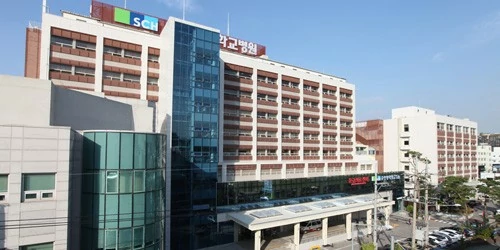
South Korea boasts one of the highest survival rates for gastric cancer patients. Here, patients are seen by experienced experts such as professor Dae-Sik Hong and Kim Hyun Jung.
Summary
Gastric cancer is a disease in which malignant cells form in the mucosa of this organ. The average five-year survival rate for this type of oncology does not exceed 32%. Such results are because the disease is predominantly diagnosed at stages 3 and 4, when the chances of cure are insignificant.
For patients with gastric oncology, various treatment options are available. Some methods are standard and others are undergoing clinical trials, particularly targeted therapies. Surgery is considered the gold standard for dealing with the disease. It is often combined with chemical or radiation therapy.
Patients with gastric cancer for treatment most often choose clinics in Turkey, Germany, Spain, Israel and Korea. Among them, it is worth highlighting the following hospitals: Liv, Memorial, Medistate, Ichilov, Samsung, Teknon, Cologne and Sheba.
The choice of effective means and methods of gastric cancer treatment depends on the stage of the disease. The earlier the patient consults a doctor, the better the chances of getting rid of the disease completely. Mediglobus specialists will help you find the right doctor and clinic for the diagnosis and treatment of gastric cancer.

Sources:
- 1. Cancer Research UK
- 2. World Journal of Gastroenterology
- 3. American Cancer Society
- 4. Disease-Specific Survival of AJCC 8th Stage II Gastric Cancer Patients After D2 Gastrectomy
- 5. The survival of stage III gastric cancer patients is affected by the number of lymph nodes removed
- 6. Molecular Targets for Gastric Cancer Treatment and Future Perspectives from a Clinical and Translational Point of View
- 7. The impact of age on prognosis in patients with gastric cancer: experience in a tertiary care centre