


Robot-assisted surgery is used more and more frequently in medicine, and thoracic surgery is no exception. According to the U.S. Department of Health and Human Services, the number of lung surgeries performed using this method increased 10-fold between 2009 and 2013 alone. In 2024, more than 60% of lobectomies in America were performed with the help of the da Vinci robot. So, what are the features and advantages of this operation? Learn from our article.
What is da Vinci robotic lung surgery for cancer?

Robotic surgery, robot-assisted surgery, da Vinci robotic surgery — these are all names used to describe this surgical technique. It involves the use of a medical robot — a sophisticated machine with which a specially trained surgeon performs all the necessary manipulations. Lung surgery is just one of the areas in which da Vinci surgery is used, along with the treatment of prostate, GI diseases, thyroid gland, etc.
Robotic surgery uses advanced computer technology to allow the surgeon to operate in the chest area using a 3D-HD camera and tiny rotating instruments. They move just like a human hand but with greater range and precision.
The American Lung Association (ALA) recommends robot-assisted surgery (RATS) along with video-assisted thoracoscopic surgery (VATS) as one option for minimally invasive lung cancer surgery. These surgeries differ from traditional interventions in that the surgeon makes minimal incisions to remove the tumour.
In the surgical treatment of lung cancer, robotic surgery is the most advanced method with many advantages. It balances achieving the clean resection margins required for complete cancer treatment while minimising the risks and discomfort of surgery.
Three main types of surgery are used to treat lung cancer, each of which can be performed robotically. They differ depending on the amount of tissue removed by the surgeon:
A machine called the da Vinci robot is used to perform the robotic intervention. The most recent model in this series is called Da Vinci 5. It was released in 2024 and has already been installed in a number of clinics in Turkey, Europe, the USA, etc. Many other centres use the Da Vinci Xi unit.
 Wedge resection – removal of the tumour along with a small area of lung tissue surrounding it.
Segmentectomy – removal of the segment of the lung where the tumour is located.
Lobectomy – removal of an entire lung lobe.
The degree of aggressiveness of the surgery depends on the size of the tumour and at what stage the disease was diagnosed – the earlier it is detected, the less extensive the intervention will be. However, according to statistics, most cases of lung cancer are still diagnosed at an advanced stage.
For a long time, the international community considered lobectomy to be the ‘gold standard’ treatment for lung oncology. However, advances in surgery, particularly with the da Vinci robot, are increasingly allowing segmentectomy to be used instead while maintaining a good prognosis. In addition, segmentectomy is considered a more difficult operation to perform, requiring a certain level of training on the part of the surgeon. Robotic surgery offers a better opportunity to perform this type of intervention than VATS.
In addition, RATS has a significant advantage over other treatment methods in that it can be administered to patients who are contraindicated to standard methods of surgery for one reason or another: obesity, advanced age, past thoracic surgeries, atypical cases, etc.
Where to treat lung cancer abroad?
Lung cancer is a dangerous disease. The earlier the treatment starts, the better prognosis. International medical platform MediGlobus can help you sign up for a consultation with the best foreign oncologist in the shortest time. Push the button below to ask for our help.
What are the indications for robotic lung surgery?
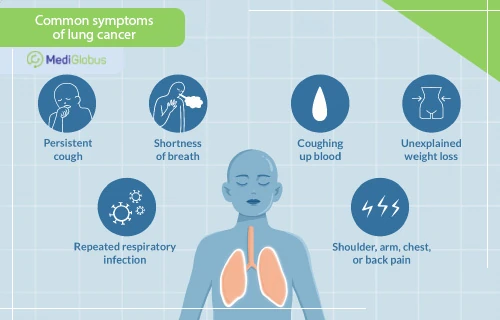
The most common indication for robotic lung surgery is cancer. In particular, such intervention is prescribed at stages 1 and 2 of the disease. However, it can also be used to treat benign lung masses, as well as a number of diseases of other chest organs (thymus, oesophagus, heart).
In some cases, surgery may be performed after a course of chemotherapy or radiation therapy, the key aim of which is to shrink the tumour to an operable size.
The location of the tumour is also an important factor in deciding on treatment. A person may be a candidate for this type of surgery if their tumour is located close to the outside of the lungs and is not attached to blood vessels.
In general, many factors influence the decision on the type of treatment for lung cancer, and thoracic robotic surgery is determined on a case-by-case basis.
 Read:
Read: How is lung surgery with a surgical robot for cancer?
The main difference in robotic lung surgery is the use of the da Vinci robot. It consists of two parts – a console at which the doctor sits, and mechanical ‘arms’ which he remotely controls. In addition to the lead surgeon, who specialises in using the da Vinci robot, there will also be a whole team of specialists in the operating room: an assisting surgeon who will stay with the patient during the operation and help the lead surgeon; an anaesthetist who will make sure the operation starts and ends comfortably; and several surgical nurses who also specialise in working with modern robotic technology.
The surgery begins by putting the patient under general anaesthesia. After the patient falls asleep, a special ‘breathing tube’ is inserted into their airway, which will allow each lung to be separately inflated during the surgery. The patient is then placed on their side and incisions are started.
Usually, to perform robotic lung surgery, the surgeon only needs to make 4 incisions between the ribs, no more than 2,5 cm long each; although one of them, through which the lung tissue will be removed, is slightly larger.
Through one of these incisions, a 3D-HD camera is inserted into the chest cavity, giving the surgeon a 360-degree view of the surgical field.
Through the remaining incisions, the doctor inserts robotic instruments that will be used to perform the necessary manipulations. Sometimes the anaesthetist injects a special fluid called ICG into the lung, which helps the surgeon see the anatomy of the lung more clearly. The increased view and moving instruments allow the doctor to make precise, controlled movements to remove lung tissue without having to make large incisions, open up the chest or spread the ribs.
The robot responds in real-time to the surgeon’s hand movements, removing the affected portion of the lung and, if necessary, lymph nodes. Lymph node resection is very important in cancer diagnosis because it helps the doctor accurately determine the stage of the disease. Often lung cancer spreads to nearby lymph nodes, and sometimes PET scans do not pick up metastasis.
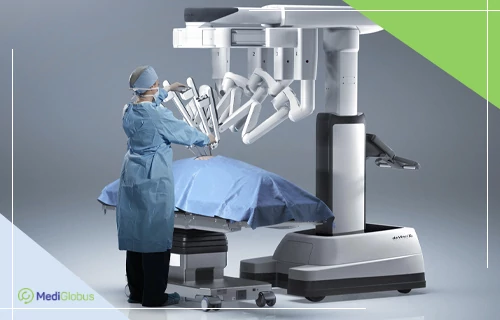
On average, robotic lung cancer surgery takes 2-3 hours.
At the end of the operation, the surgeon will insert a tube through one of the small incisions to drain excess fluid or air from the chest cavity. On average, it will be removed after 4 days and the patient can go home.
The initial recovery after surgery takes an average of 2-3 weeks. This means that at the end of this period, the patient usually regains their normal energy levels, can breathe freely and engage in household activities.
According to Professor Bernard Park, one of the founders of robotic surgery and a leading thoracic surgeon at Memorial Sloan-Kettering Hospital (USA), the FDA is in the process of considering a single-port option for robotic lobectomy. This means that instead of four incisions, the intervention would be performed through only one. For the patient, this will be associated with faster and less painful recovery.
What are the advantages of da Vinci surgery compared to classical surgery?
For patients, minimally invasive lung surgery using the da Vinci robot is associated with a shorter recovery period and hospital stay. Patients experience less blood loss, and through the absence of the need for large incisions and rib spreading, the recovery period is associated with less pain.
For surgeons, da Vinci lung surgery also brings a number of advantages. The robotic instruments are precise and manoeuvrable. The camera also allows the surgeon to get a clear view of the chest during surgery and access hard-to-reach parts of the chest. Some specific interventions, such as segmentectomy or lymphadenectomy, are easier to perform robotically.
If we compare da Vinci robot-assisted lung cancer surgery with the two alternative methods of surgery – open intervention and VATS – the following differences should be noted first of all.
| Comparison criteria | Robot-assisted thoracic surgery | Video-assisted thoracoscopic surgery | Open lung surgery |
|---|---|---|---|
| Duration of surgery | 2-3 hours | 2-3 hours | 2-6 hours |
| Features of the operation | Provides the surgeon with a better view and greater accuracy of movement | Predominantly performed through only 1 port (incision) | In a small percentage of cases, the doctor has to replace the minimally invasive approach to surgery with an open intervention |
| Recovery time | 2-3 weeks | 4-6 weeks | up to 3 months |
| Risk of complications and side effects | Serious complications in 3-4% of cases, slightly lower risk of minor complications than VATS | Serious complications in 3-4% of cases | Severe complications develop in approximately 18,8% of patients |
| Cost of surgery | +++ | ++ | ++++ |
Effectiveness of da Vinci robot treatment for lung cancer
The outcome of treating a particular patient for da Vinci surgery depends on many factors, including the specific diagnosis and overall health. However, in general, this method of surgery shows comparable short- and long-term results and outperforms VATS in achieving some goals.
One important factor affecting the prognosis of lung cancer treatment is the feasibility of lymphadenectomy. Adequate lymph node excision allows proper staging of the cancer and selection of ideal postoperative therapy, which affects overall survival.
A large study by Cerfolio et al. analysed the results of more than 1,339 operations for non-small cell lung cancer in specialised robotic surgery centres and found the following 5-year survival results:
Stage 1A – 83%;
Stage 1B – 77%;
Stage 2A – 68%;
Stage 2B – 70%;
Stage 3A – 62%;
Stage 3B – 31%.
Potential risks and side effects of lung cancer surgery
Any surgical procedure carries risks, and robot-assisted surgery for lung cancer is no exception. These include:
Pain;
Infection;
Bleeding;
Blood clots;
Abnormal heartbeat;
Air leakage from the lungs.
The medical teams at experienced cancer centres that specialise in robotic lung surgery are aware of the possibility of these complications and will do everything possible to diagnose and prevent them early. This is why it is so important that the patient spends some time under close medical supervision after the operation – doctors need to make sure that no further problems arise after discharge.
One of the primary factors influencing the outcome of the surgery is the surgeon’s experience in performing the particular procedure. MediGlobus coordinating doctors cooperate with the leading specialists from over 260 clinics. We can help you find the expert capable of providing the best help with your particular case. For a free consultation, push the button below and fill the form.
The story of a patient who underwent robotic lung surgery
Sharon Smith underwent lung surgery in 2016, and shares her story:

‘I hadn’t been to my family doctor in years, and one day I decided it was time to check my health. My doctor ordered a whole set of tests, including a chest X-ray. On it, the doctors found a shadow. I was soon diagnosed with cancer – an early-stage low-grade endocrine tumour of the left upper lobe. Needless to say, I was very scared. No one wants to hear a diagnosis like that. Both my husband and I had previous experience with this insidious disease – we were both widowed after cancer took the lives of our first spouses. We knew what to expect.
At that point, I was unable to see my primary oncologist and was referred to another specialist. I was already preparing to undergo surgery when my first doctor contacted me. He said: ‘Sharon, I want to refer you to another surgeon at another clinic. I want to recommend you undergo robotic surgery.’
When I spoke to the second surgeon, it was such a relief – compared to the first surgery I was offered, I would have to deal with significantly less pain, a shorter hospital stay, and an overall easier rehabilitation. No risk of nerve damage, no chemotherapy, no radiotherapy. This news was a huge relief. The doctor showed me a video of how the surgery is performed and it was something incredible. All the incisions were so small and the surgeon’s movements so precise!
Everything went just fine. When I was discharged from the hospital, my doctor said: ‘Sharon, I’m sending you home to live a long and happy life’.
Where is robotic lung surgery available?




Summary
Treatment of lung cancer at stages 1, 2 and sometimes even 3 is possible with the da Vinci robot. This is a special equipment that the doctor uses during surgery in order to perform surgical manipulations by remotely controlling the instruments.
This approach to treatment allows the surgeon to achieve a better view of the operated area and better control of movements.
All operations performed with the da Vinci robot are minimally invasive. This means that there are no large incisions involved. Patients experience less blood loss and the rehabilitation period is easier and shorter.
The effectiveness of lung cancer treatment with the da Vinci robot is high. Compared to video-assisted thoracoscopic surgery, the surgeon has a better chance of successfully removing lymph nodes for later laboratory analysis of cancer cells. This improves the chances of correctly determining the stage of the disease and tailoring a personalised treatment.
Robotic thoracic surgery is available in a few medical centres in the world. First of all, the MediGlobus medical platform recommends the Acibadem Clinic in Turkey, the Quirónsalud Clinic Torrevieja in Spain, the Asan Clinic in South Korea and the Soroka Clinic in Israel.
SIGN UP FOR TREAMENT OF LUNG CANCER ABROAD
To sign up for lung cancer treatment abroad, push the button below and fill in the form. Our coordinating doctor will call you back in 30 minutes. They will present all the necessary information and help you organise the trip.
Sources:
- 1. American Lung Association
- 2. Medical News Today
- 3. Journal of Thoracic Disease: Robotic lung resection: a narrative review of the current role on primary lung cancer treatment
- 4. Journal of Thoracic Disease: Robotic surgery, video-assisted thoracic surgery, and open surgery for early stage lung cancer: comparison of costs and outcomes at a single institute
- 5. Video-Assisted Thoracic Surgery: Techniques for robotic lung resection
- 6. Clinics in Surgery: Superior Technology of Lung Cancer Surgery: Robotic Surgery
- 7. Journal of Social Reseaarch: Comparing Robotic-Assisted Thoracoscopic Surgery (RATS) vs Video-Assisted Thoracoscopic Surgery (VATS) Approaches for Non-Small Cell Lung Cancer (NSCLC): a Systematic Review and Meta-Analysis
- 8. Thoracic Cancer: Risk factors for surgical complications after anatomic lung resections in the era of VATS and ERAS
- 9. Interview with doctor Bernard Park
- 10. Interview with cancer survivor Sheryl Smith