


The statistics on the prevalence of neurological disorders are frightening. More than 1 billion people worldwide suffer from Alzheimer’s, Parkinson’s, chronic pain and tremor. Fifty million people have been diagnosed with epilepsy. These diseases are treated with medication or complex neurosurgery. In this article, MediGlobus will tell you about a new cheap, safe and accessible neurology treatment – transcranial magnetic stimulation.
WHAT IS TRANSCRANIAL MAGNETIC STIMULATION (TMS)?
Transcranial magnetic stimulation is a non-invasive method of activating and inhibiting areas in the cerebral cortex using magnetic impulses. The TMS method is used when drug treatment of the disease is ineffective. Transcranial magnetic stimulation is used to treat:
 Essential tremor;
Depression;
Autism spectrum disorder;
Aphasia (speech disorder);
Attention deficit disorder;
Post-traumatic stress disorder;
Multiple sclerosis;
Chronic pain.
HOW IS TRANSCRANIAL MAGNETIC STIMULATION PERFORMED?
The structure of the human brain is unique. For this reason, the patient undergoes an MRI scan before the procedure. The doctor will make a brain map for each patient. This map will help the doctor apply magnetic pulses to the right areas.

The principle of TMS is simple: the system creates a strong magnetic field. It penetrates through the bones of the skull and soft tissues directly into the brain. Under its influence, groups of neurons switch on. The method artificially makes them work. The more often a group of neurons is activated at the same time, the closer the connections between them are formed. After several stimulations, this group of neurons turns into a network. The presence of a neural network ensures the performance of important functions: movement, speech, and attention.
In this way, the TMS method restores the broken connections between the neurons of the brain and the lost ability returns to the person. With inhibition, the opposite process occurs. Increased activity in the area is reduced because fewer neurons are involved.
The depth of stimulation can vary from 2 to 4 cm below the surface of the cortex. The number of sessions the doctor determines individually for each patient. Treatment with TMS can take from 1 month. One session lasts from 3 to 20 minutes.
WHAT ARE THE ADVANTAGES OF TMS OVER OTHER METHODS?
Transcranial electrical stimulation (TES) | TES works on the same principle as TMS. The cerebral cortex is stimulated using a weak electric field. Unlike TMS, it cannot affect the deep structures of the brain. |
Deep brain stimulation | The main difference is that TMS does not require the intervention of a surgeon, while DBS is a surgical procedure. An electrode is implanted in the patient’s brain that delivers electrical shocks to stimulate specific areas of the brain. |
The vagus nerve stimulation (VNS) method | The procedure requires surgery. As a result, the patient is fitted with a stimulator that delivers electrical impulses to the vagus nerve. These impulses suppress epileptic activity. The VNS method causes fewer side effects than taking medication. |
Theta-Burst Stimulation (TBS) | The theta-burst stimulation (TBS) is an improved method of VNS. It replicates the natural activity of the brain. Stimulation occurs in short bursts of high frequency once every 5 seconds. |
 Read:
Read: WHAT ARE THE DIFFERENT TYPES OF TMS?
Rhythmic transcranial magnetic stimulation
In rhythmic TMS, several pulses of different frequencies are delivered to the patient’s brain. High-frequency TMS activates neurons and low-frequency TMS inhibits their activity. To restore movement function, pulses of both frequencies are needed in different areas of the brain.
Navigational transcranial magnetic stimulation
This is a combined MRI machine that creates a 3D image of the brain and the stimulator. Clinics in Turkey, Israel, Spain and Germany are equipped with the nTMS system. It allows the doctor to see a real-time map of the brain and it greatly improves the accuracy of the stimulation. Forbes magazine called this technology “an important step towards personalised medicine”.
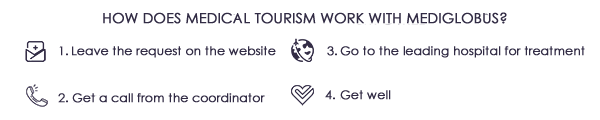
To make an appointment for a TMS procedure, please leave a request with a MediGlobus coordinating physician. We will book you into a clinic and help you with organising your medical travel.
SAFETY OF TRANSCRANIAL MAGNETIC STIMULATION
The National Institute of Health has recognised transcranial magnetic stimulation as safe. It can be given to children from 3 years of age and pregnant women.
Among the side effects of the treatment, patients most commonly complain of headache, dizziness and tingling of the skin. In 2% of cases, high-frequency TMS leads to seizure activity in the brain. In contrast, low-frequency stimulation, which is used to treat epilepsy, reduces the strength and number of seizures.
Transcranial magnetic stimulation is contraindicated in people who have metal implants, a pacemaker or a hearing implant. The procedure is used with great caution in patients with brain tumours, epilepsy and head injuries.
EFFICACY OF TRANSCRANIAL MAGNETIC STIMULATION
Clinical trials of the procedure are ongoing to compare its effectiveness with medication. Doctors recognise that TMS helps patients with serious neurological disorders whose well-being is not improved by medication.
After transcranial magnetic stimulation, patients do not complain of unpleasant side effects in the form of drowsiness and lethargy; it does not harm the liver. The only disadvantage of the method is the short-term effect.
The result of transcranial magnetic stimulation lasts from 1 to 6 months. Patients note a significant improvement in well-being, a decrease in the manifestation of symptoms and a general improvement in the quality of life. If necessary, the procedure can be repeated.

COST OF TRANSCRANIAL MAGNETIC STIMULATION
Transcranial magnetic stimulation is an inexpensive procedure. It costs 2-4 times less than other alternative procedures. For example, a full course of TMS treatment can cost $10,000, while a deep brain stimulation surgery can cost $40,000; and a course of electroconvulsive therapy can cost from $20,000. The number of sessions is prescribed individually depending on the severity of the neurological disorder. Approximate prices of transcranial magnetic stimulation in different countries:
| Country | Cost |
|---|---|
 Spain Spain | from €200 |
 Israel Israel | from $250 |
 Germany Germany | from €220 |
 Turkey Turkey | from $120 |
WHICH CLINICS PERFORM TMS
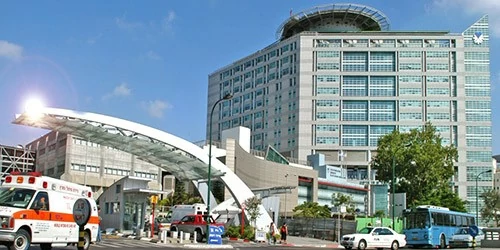
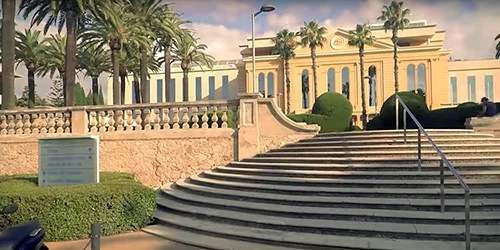
The procedure received official FDA approval in 2018 for the treatment of depression and obsessive-compulsive disorder. In Israel, it is possible to treat Parkinson’s, Alzheimer’s, tremors and epilepsy with this method. During the treatment, doctors monitor weekly progress and report it to the patient. This motivates people to strive for recovery. Transcranial magnetic stimulation can be performed at:


Summary
Transcranial Magnetic Stimulation is used to treat several neurological diseases, specifically: Parkinson’s disease, depression, ADHD, epilepsy, multiple sclerosis, chronic pain, etc.
TMS affects the brain using magnetic fields, changing the activity of nerve networks and thus affecting the symptoms of the disease. The number of sessions the doctor determines individually for each patient. Treatment with TMS can take from 1 month.
Some of the most common side effects of TMS include headache, dizziness and tingling of the skin.
Transcranial magnetic stimulation is a relatively inexpensive procedure, with costs starting at €200 abroad; however, the effects of this treatment are not permanent.
The international platform MediGlobus recommends Ichilov Clinic (Israel), Teknon Clinic (Spain), American Hospital in Istanbul (Turkey), and Ludwig-Maximilians University Hospital (Germany) for TMS.
Sources:
- 1. Transcranial Direct Current Stimulation (tDCS): A Beginner’s Guide for Design and Implementation
- 2. Repetitive Transcranial Magnetic Stimulation (rTMS) Systems – Class II Special Controls Guidance for Industry and FDA Staff
- 3. Combining non-invasive transcranial brain stimulation with neuroimaging and electrophysiology: Current approaches and future perspectives
- 4. Effect of Transcranial Brain Stimulation for the Treatment of Alzheimer Disease: A Review
- 5. Brain-Behavior Relations: Transcranial Magnetic Stimulation: A Review
- 6. Transcranial brain stimulation: potential and limitations
- 7. A systematic review on reporting and assessment of adverse effects associated with transcranial direct current stimulation
- 8. Safety of Transcranial Direct Current Stimulation: Evidence Based Update 2016
- 9. Efficacy and acceptability of transcranial direct current stimulation (tDCS) for major depressive disorder: An individual patient data meta-analysis
- 10. Efficacy of Transcranial Direct Current Stimulation to Improve Insight in Patients With Schizophrenia: A Systematic Review and Meta-analysis of Randomized Controlled Trials