


According to the World Cancer Research Fund International, lip cancer is one of the most common oral cancers. In terms of prevalence, the disease ranks 16th among all types of cancer, 11th among men and 18th among women.
In this article, specialists from the international medical platform MediGlobus will discuss how lip cancer is treated abroad, what the chances of a full recovery are, and which clinics medical tourists can approach for the best offers on treatment.
What is lip cancer?
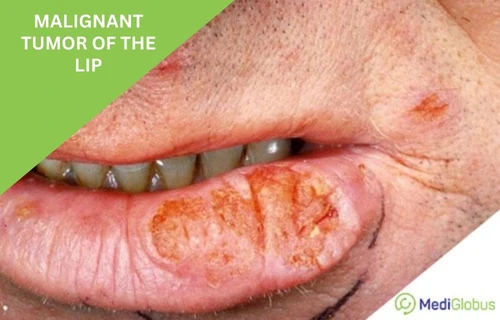
Lip cancer is a malignant tumour that forms from the epithelial tissues of the red border of the lips. In 90% of cases, the cancer appears on the lower lip. More than 75% of cases occur in middle-aged and elderly men.
The main causes of lip cancer are considered to be: prolonged smoking, trauma to the epithelial layer of the lips, frequent exposure to high temperatures, the influence of chemical carcinogens, viral infections and inflammatory processes.
This pathology always occurs against the background of other diseases of the lips — papillomas, cracks, leukoplakia and dyskeratosis.
How does lip cancer start?
The first signs of lip cancer may go unnoticed by the patient. First, the lymph nodes on the chin enlarge and become mobile. Then a lump forms on the lip, with small sores on its surface. There is slight itching in the area of the growth.
Many patients initially ignore these symptoms, as they are similar to a ‘cold sore’. Over time, the tumour grows in size and destroys the surrounding tissue. A secondary tumour may join it. The patient’s nutrition is disrupted, causing exhaustion and general weakness. In the later stages of lip tumours, the metastases turn into large, disintegrating infiltrates that affect the jaw bones.
How to identify lip cancer?
Timely and accurate diagnosis is the key to successful treatment of lip cancer. In foreign medical centres, diagnosing lip cancer is not difficult.
Oncological check-up | |
|
|
| Get a free consultation | |
Here, a comprehensive examination is carried out, which makes it possible to detect lip cancer at an early stage and select the right treatment programme. The main tests carried out to diagnose lip cancer in foreign clinics are:
- X-ray of the jaw and ultrasound examination of the affected lip (examinations that allow the pathology to be detected, its size and spread to be determined, and, in the later stages, the depth of tumour invasion into the jaw bones).
- Biopsy (collection of tumour cells for histological examination; if cancer is suspected to have spread to the lymph nodes, a biopsy is performed).
- Orthopantomography (X-ray examination that allows pathological changes in the facial skull to be detected).
- PET-CT (diagnostic test used to determine the stage of the disease, evaluate the effectiveness of cancer treatment, and detect recurrence of the disease during follow-up).
- Chest X-ray.
- General clinical and laboratory tests.
 Read:
Read: Methods of treating lip cancer
The effectiveness of lip cancer treatment abroad exceeds 90%. The main methods used to eliminate this disease are: radiation therapy, cryotherapy, surgical treatment, photodynamic therapy, and chemotherapy. A combination of these methods shows the best results and helps to eliminate the primary focus and metastases.
| Radiation therapy | Radiation therapy is one of the main methods of treating lip cancer. It involves the use of ionising radiation to destroy cancer cells and metastatic foci. The tumour is removed using close-focus X-ray machines, which have high irradiation accuracy. During radiation therapy, healthy tissues are not damaged, and the cosmetic defect after such treatment is insignificant (a small, rounded scar remains). |
| Surgery | Surgical treatment is used when radiation or cryotherapy cannot be applied (late stages of the disease: tumour growth in the jawbone and floor of the mouth), as well as when non-invasive methods of cancer treatment have not yielded positive results. The operation involves partial or complete removal of the jaw. After surgical removal of lip cancer, plastic surgery is performed at the patient’s request to replace defects in appearance and restore normal body functions. |
| Cryotherapy | Cryotherapy is the destruction of cancer cells using liquid nitrogen. This method is used in the early stages of lip cancer. As a rule, a single application gives good results and does not leave any noticeable cosmetic defects. |
| Chemotherapy | Chemotherapy is not the main method of treating lip cancer. It is used in combination with other methods (e.g., surgery). Chemotherapy can reduce the size of the tumour before surgery and eliminate metastases. It is effective in stage 1 lip cancer. This type of cancer therapy is also used as palliative treatment for stage 4 cancer. It slows down tumour growth, destroys individual metastases and reduces the symptoms of the disease. For chemotherapy abroad, drugs are used that have minimal side effects and are easier for patients to tolerate. These include bleomycin, platinum and fluorouracil. |
| Photodynamic therapy | Photodynamic therapy is a method of treating limited superficial lip cancer using a laser. A photosensitising drug is first injected into the tumour, which promotes the rapid destruction of cancer cells. |

What is the prognosis for lip cancer in foreign clinics?
The prognosis for lip cancer treatment abroad depends on several factors: the stage of the disease, the patient’s age, the presence of concomitant pathologies, and the sensitivity of cancer cells to radiation.
According to statistics from the American Cancer Society, if the cancer is localised, the 5-year survival rate is 94%; if surrounding tissues are affected, it is 63%; if metastases have formed in distant organs, it is 38%.
Recommended clinics for lip cancer treatment abroad

Lip cancer treatment is carried out in all foreign medical centres that have oncology departments or centres. Foreign specialists use gentle methods to treat this disease. Preference is given to non-invasive or minimally invasive techniques.
In the case of surgical treatment of lip tumours (surgical removal of malignant neoplasms and affected structures), reconstruction and restoration of lost lip volume and other tissues are performed, which allows the undesirable aesthetic result to be reduced to zero.
For the treatment of lip cancer, foreign patients most often travel to countries such as Israel, Turkey, Germany, Spain and South Korea. The leading clinics that provide services in the field of therapy for this type of cancer are:
- Sourasky Medical Centre ‘Ichilov’ (Israel, Tel Aviv);
- Assuta Medical Centre (Israel, Tel Aviv);
- Koç University Hospital (Turkey, Istanbul);
- Liv Clinic (Turkey, Istanbul);
- Memorial Hospital Network (Turkey, Istanbul, Antalya);
- Rechts der Isar Clinic (Germany, Munich);
- Ludwig Maximilian University Clinic (Germany, Munich);
- Nuremberg Clinic (Germany, Nuremberg);
- Samsung Medical Centre (South Korea, Seoul);
- Anam Clinic at Korea University (South Korea, Seoul);
- Teknon Clinic (Spain, Barcelona);
- University Clinic of Navarra (Spain, Pamplona).
Summary
- Lip cancer is a malignant tumour of the lip. It forms from the epithelial tissues of the red border. More than 75% of cases occur in men over the age of 40. Cancer of the lower lip is more common.
- The first signs of lip cancer are not noticeable to the patient. First, the lymph nodes on the chin enlarge and become mobile. A lump with ulcers forms on the lip. This growth is itchy.
- The main methods used to treat this disease are: radiation therapy, cryotherapy, surgical treatment, photodynamic therapy, and chemotherapy. A combination of these methods shows the best results and helps to eliminate the primary focus and metastases.
- Foreign patients travel to Israel, Turkey, Germany, Spain, and South Korea for lip cancer treatment.
To learn more about lip cancer treatment abroad, leave your request on the website. Our specialists will answer all your questions and help you organise your trip to a foreign clinic.