


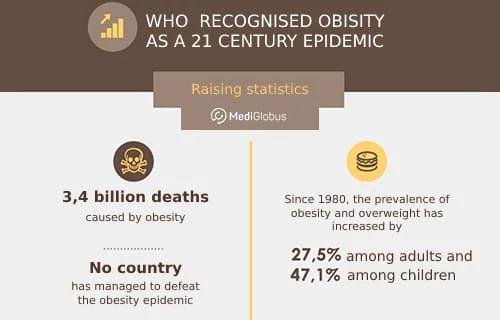
World Health Organization recognized obesity as a global problem. Statistics in 2020 showed that over 2 billion people are overweight or obese. That’s about 30% of the world’s population. Overweight people are at high risk of developing diabetes, cardiovascular disease and joint diseases. The American Society of Clinical Oncology notes that people with obesity are most often diagnosed with the most deadly cancers. For this reason, obesity should be treated and lead a healthy life afterwards. MediGlobus coordination doctors receive many requests for bariatric surgery. In this article, we have listed 16 questions that patients most often ask us. We hope they will help you get answers and make an informed decision about the need for surgery.
Reading time – 28 minutes

Listen to the article:
1. WHAT IS BARIATRIC SURGERY AND WHY DO YOU NEED IT?
Bariatrics is an operation that is performed to remove excess weight and prevent it from being added again. Surgeons do this by reducing the size of the patient’s stomach or small intestine. After the operation, the person needs less food to feel saturated. After the operation, the patient’s hormonal background changes, which also helps weight loss. By following a diet and a healthy lifestyle, this will help the patient maintain a stable weight.
In 2016, the American Diabetological Association (ADA) and the International Diabetological Federation (IDF) included bariatric surgery in their list of type 2 diabetes treatments.
Conducting bariatrics helps the patient not only to lose weight but also to reduce the risk of arthritis, arthrosis, heart attack, cancer and other diseases. The study, which was published in the New England Journal of Medicine, showed that life expectancy of a patient increases after a stomach bypass, and the risk of death from diseases is reduced by 40%.
2. HOW DO I KNOW THAT I NEED BARIATRIC SURGERY?
To understand the need to visit the clinic for yourself, it is necessary to calculate the body mass index (BMI). The BMI measures the weight-to-height ratio. This can be done in three simple steps:
 Learn your weight in kilograms;
Learn your height in meters and raise it to the square;
Divide your weight by the height in the square.
The result of 20-25 means that the weight is normal.
A result of 25 to 30 means that there is excess weight. This situation does not require an operation. A person can lose excess weight themselves.
A result of 30 to 35 means that there is 1st-degree obesity. In this case, it is also possible to lose weight without surgery.
The result of 35 to 40 means type 2 obesity. Bariatric treatment of diabetes mellitus is possible while the BMI is between 30 and 40.
A result of 40 or more means class 3 obesity. In this case, bariatric surgery on the stomach is recommended.
These results are a signal to see a doctor. It is up to the doctor to decide if the operation is necessary, based on the patient’s health condition, individual indications and contraindications for bariatrics.
3. WHAT KIND OF DIAGNOSIS DO YOU NEED TO GET BEFORE BARIATRIC SURGERY?
Before surgery, the patient should consultwith a nutritionist, psychologist and bariatric surgeon. This is necessary to weigh the benefits and risks of the surgery, as well as to ensure the moral readiness of the person for the consequences of the surgery. A full medical examination and blood tests are a mandatory step before weight loss surgery. The patient can also be prescribed:
urine test;
echocardiogram;
chest ultrasound;
Gall bladder ultrasound.
4. HOW DO YOU PREPARE FOR BARIATRIC SURGERY?
6 weeks before surgery, you should stop smoking, or quit it for good. This reduces the risk of post-operative complications.
3 months before surgery, you should stop taking steroids and immunosuppressants. Within 2 weeks you should stop taking medications that affect blood clotting.
For 2-3 months before surgery, you need to increase physical activity and switch to the right diet. Eliminate caffeine drinks a month before the operation. Weight loss and reduced blood sugar increase the chances of successful surgery.
On the day of surgery, the patient should take with them to the clinic documents, pyjamas, personal hygiene products, medicines for daily intake, a book or a player.

Before the operation, you can make an appointment for individual counselling with a psychologist. With them you can talk about your fears, attitude to the body and appearance, the importance of the operation in your life. You can also visit support groups. There, you can talk to people who have faced the same difficulties and were able to solve them.
5. WHAT BARIATRIC SURGERY METHODS ARE AVAILABLE TO PATIENTS?
The American Society of Metabolic and Bariatric Surgery (ASMBS) has approved 4 methods for performing bariatric surgeries: Roux-en-Y Gastric Bypass (RYGB), Laparoscopic Sleeve Gastrectomy (LSG), adjustable gastric band (AGB), Biliopancreatic Diversion with Duodenal Switch (BPD / DS).

During a bypass, the stomach is divided into 2 unequal parts. The small stomach is attached to the small intestine. In this way, the person has a smaller appetite.
Sleeve Gastrectomy is considered the gold standard in bariatrics. It involves removing 80% of the stomach. The operation is performed laparoscopically, that is, through small incisions.
With a gastric band, a ring is put on the top of the stomach. It narrows the gap between the parts of the organ and limits the passage of food. Since the upper part of the stomach is smaller and contains receptors that report saturation, a person needs less food.
Biliopancreatic diversion requires removal of part of the stomach and small intestine. The intervention is recommended in the severe stages of obesity.
 Read:
Read: 6. WHICH BARIATRIC SURGERY METHOD IS THE SAFEST?
Stomach bandaging is the easiest and safest method in bariatrics. It does not require the removal of parts of organs. After this surgery, patients recover the fastest. Complications after the intervention are usually due to the displacement of the device, which is easy to correct. However, after bandaging, patients slowly lose weight. Usually, they manage to lose no more than 50% of their original body weight.
Laparoscopic surgery or surgery with the Da Vinci robot are the safer alternatives to open bariatric surgery.
7. WHAT BARIATRIC SURGERY METHOD WOULD BE APPROPRIATE FOR ME?
An experienced bariatric surgeon chooses the method that will be most effective for a given degree of obesity and taking into account the risks to the patient. The safest stomach banding method is effective for patients with slight obesity. The riskiest method of a biliopancreatic bypass is prescribed when the person has too much excess fat and it is dangerous for his or her life.
The International Federation of Obesity Surgery and Metabolic Diseases (IFSO) reports that most patients have a gastric bypass. After this surgery, patients quickly lose weight, but they need to stay in the hospital longer under medical supervision. After the operation, vitamin deficiency is common, especially in patients who are not on a diet.
8. WHAT IS THE RECOVERY FROM BARIATRIC SURGERY LIKE?
After the surgery, the patient can spend 3 to 7 days in the hospital. The time of inpatient observation depends on the bariatric method. Within 2-3 years after discharge, the patient will need to see a doctor. During these checkups, the doctor notes the progress after bariatric surgery and can adjust the plan of nutrition, physical activity, taking supplements or medication.
At first, after surgery, the patient may be prescribed medication to prevent gastric or gallstone ulcers. The doctor will also offer medication to help reduce the severity of side effects.
In the first 3-5 weeks after surgery, the dietician prescribes a special diet. for the patient. It contains liquid and soft food, as well as supplements of Ca, Fe and vitamins D, B12. In the future, the patient can eat solid food. During this period, the person should drink at least 2 litres of water per day. However, caffeine intake should be avoided during the first month after surgery.

After a heavy weight loss, a person may have saggy skin. It can be partially removed through exercise. To eliminate this deficiency, plastic surgery can be performed after consultation with a bariatric surgeon. Abdominoplasty is not recommended to be done earlier than a year after the operation.
9. WHAT’S THE BEFORE AND AFTER OF THE BARIATRIC SURGERY?
A surgeon can answer the question of how much weight the patient will lose after bariatric surgery. Each method is different on this indicator. A gastric bypass can give the biggest result – about 30%. After sleeve gastroplasty, you can expect to lose a quarter of the weight, and belt gastroplasty results in 20% weight loss.

Apart from the type of operation, the speed of weight loss is influenced by the way a person adheres to the recommendations of a nutritionist. According to observations of the National Institute of Health, patients lose 4-5 kilograms every month after the surgery.
Experts from the American Society of Metabolic and Bariatric Surgery (ASMBS) note that a person loses up to 60% of their weight in the first 6 months after surgery and 75% of their weight in the first year. These results can be achieved if you exercise regularly and eat healthy food.
The rate of bariatric weight loss slows down over time. Some patients may gain weight again within 5-10 years, but it will still be much less than before surgery.
10. WHAT COMPLICATIONS AND RISKS CAN THERE BE AFTER BARIATRIC SURGERY?
Bariatric surgery has many advantages that improve the quality of human life. At the same time, serious side effects and complications are possible after this intervention.
During the first 6 months after bariatrics, patients complain about side effects:
nausea and vomiting;
heartburn;
meteorism;
diarrhoea or constipation;
vitamin deficiency.
Among the complications of the operation may be observed:
the obstruction of food;
internal bleeding;
infections;
hernias;
gallstones;
stomach ulcers.
Proper preparation for surgery can reduce the risk of development and the severity of side effects and complications. 3 months before surgery, the person should quit smoking and start a healthy lifestyle to lose some weight.
In some popular sources, you can read false information about the consequences after bariatric surgery. The American Society for Metabolic and Bariatric Surgery (ASMBS) refutes the most popular myth about the procedure: that after bariatric surgery there is a high chance of death. That’s not true. ASMBS Bariatric Centers of Excellence data show that the risk of dying within a month after the intervention is 0,13%. At the same time, 2.8 million people die each year from obesity. The likelihood of dying from obesity is ten times higher than after surgery.
11. HOW EFFECTIVE IS BARIATRIC SURGERY?
Bariatric efficiency statistics according to the New England Journal of Medicine:
Decrease in mortality by 56% from coronary heart disease.
Decrease in mortality by 92% from diabetes mellitus.
Decrease in mortality by 60% from cancer.
On average, after bariatrics, patients lose between 40% and 75% of their original body weight.
If the doctor’s recommendations are followed, the weight of patients 10 years after bariatric surgery remains 25% less than before surgery.
Obesity weight loss reduces the risk of diabetes by 12%.
Sleep breathing rate is normalized in 85% of patients.

12. WHAT DIET AND LIFESTYLE ARE RECOMMENDED AFTER BARIATRIC SURGERY?
One surgery is not enough to make you feel better for a long time. To maintain the result of the operation, the patient needs to move a lot and stay on a diet. Surgery with good follow-up care and moderate lifestyle changes can produce remarkable long-term health results.

After bariatrics, vitamin and mineral supplements. must be present in the diet. They will have to be taken for the rest of their life. High-protein foods should be a priority. Protein helps maintain muscle mass and a healthy metabolism. It is found in meat, eggs, dairy products, tofu, beans and lentils.
The patient should limit the consumption of sugar and carbohydrates. This means they should not pamper themselves with cookies, juices, cakes and other sweets. The consumption of pasta, cereal and white bread should also be reduced. The choice of diet should be agreed with your doctor or personal nutritionist.
The patient needs to eliminate alcohol after bariatric surgery. This is because the stomach becomes more sensitive to it, the intoxication comes faster and lasts longer. All of this can lead to an accelerated formation of alcohol dependency.
After bariatrics, the dosage of medication in some patients may decrease. For example, people with diabetes need less insulin. Doctors strongly recommend not using non-steroidal anti-inflammatory drugs after bariatric surgery, as they may cause ulceration or stomach irritation. The patient should always consult a doctor before taking or cancelling medication.
Active physical exercise will be an integral part of the patient’s daily routine. You can start with simple and short exercises, 25 minutes a day. As your muscles strengthen, you should increase the intensity and duration of the exercise. A person can run, walk, swim, use fitness machines. Surgeons often recommend that you include cardio training in your daily routine. Patients may go to the fitness centre or perform a personal sports program, which will be drawn up by an experienced trainer, taking into account the capabilities of the body.

Regular consultations with a psychologist will help a person get used to a new way of life. The psychotherapist will help to cope with negative emotions and stress that a person may experience after surgery. Work with a specialist is especially important when there is a “weight plateau” – a person suddenly notices that his weight does not change. During this period there is a high risk of returning to old habits. With the psychologist, you can work out the motivation for a healthy lifestyle. Working with a specialist helps patients after bariatrics to save their marriage.
The patient must understand that bariatric repetition is often impossible. If a person returns to their original weight, they will no longer be able to lose the same percentage of body weight. Awareness of this fact can be an additional motivation to comply with the doctor’s instructions.
13. WHAT’S THE COST OF BARIATRIC SURGERY?
The price of bariatric surgery depends on the method, location, class of the clinic, experience of the doctor. It is formed on an individual basis. The average price for surgical treatment of obesity in European clinics is €6,000. The cheapest procedures are in Turkey, Poland, Korea or the Czech Republic. The price of bariatrics in clinics of Germany, Spain, Israel will be 50% higher.
| Country | Cost |
|---|---|
| Turkey | from $3,400 |
| Germany | from €9,000 |
| Spain | from €8,000 |
| Korea | from $6,000 |
| Israel | from $9,700 |
| Poland | from €5,000 |
| Czech Republic | from €5,200 |
For individual prices for bariatric surgery, please check with our coordinating physicians.
14. WHAT KIND OF CLINICS ARE THERE FOR BARIATRIC SURGERY?
The American Society of Metabolic and Bariatric Surgery (ASMBS) recommends patients to undergo bariatric procedures in clinics that are JCI accredited or specialized centres. With the help of MediGlobus, you can choose a suitable clinic in 23 countries worldwide.
KCM Clinic (Poland)
The KCM Clinic is a multidisciplinary centre of excellence in medicine with a highly developed bariatric department. The Clinic actively cooperates with the American centre Sanford Health, where Polish surgeons undergo practical training and learn new methods of bariatric surgery. In 2018, GCR recognized KCM as “The Best Bariatric Surgery Clinic in the World”. The main advantage of GCR Clinic KCM is the availability of 3D laparoscopic bariatric surgery. Small incisions, visual navigation and full visibility greatly enhance the success of the operation.
Metabolik Cerrahi Center (Turkey)
The Metabolik Cerrahi Clinic is a specialized centre that is certified by the Centre of Excellence for Bariatric and Metabolic Surgery. Patients can enrol in the Clinic for the treatment of type 1 and type 2 diabetes in obesity. The clinic has good control of hormones and blood sugar in patients after surgery.
Soon Chun Hyang Hospital (Korea)
The Center has received JCI international accreditation and is recognized by the South Korean Ministry of Health and Social Welfare. Obesity surgery can be performed in Soon Chun Hyang with the help of the Da Vinci robot. The clinic is known for its very strict selection of practising doctors. This strategy ensures a low risk of postoperative complications.
Liv Clinics Network (Turkey)
It is a multi-profile centre that has been certified by Joint Commission International (JCI) and TÜV (European ISO standard document). In 2016, Liv Hospital received the Centre of Excellence Award for Excellence in Metabolic and Bariatric Surgery. Over 500 bariatric surgeries are performed there every year. Patients are happy with the results of their surgeries: they lose more than half their weight in six months and after 12 months they lose 70% of the weight.
Hospital of St. Zdislava (Czech Republic)
The main specialization of the Czech St. Zdislava’s Clinic is minimally invasive bariatric surgery. Here you can access safe bariatric methods using Da Vinci robotic technologies. Patients can undergo laparoscopic gastroplasty – a procedure after which a person is discharged from the hospital after 3 days with minimal risk of complications. The clinic has successfully operated on patients weighing up to 200 kilos.
15. WHICH DOCTOR TO CHOOSE FOR BARIATRIC SURGERY?
Dr Grzegorz Kowalski is the Head of the Department of Bariatric Surgery at the Polish KCM Clinic. He is considered one of the most experienced bariatric surgeons in Europe. He has more than 1,000 open and more than 9,000 laparoscopic surgeries in the field of obesity surgery.
Dr Kowalski had internships in clinics in the USA, Germany and France. His achievements include recognition of his competence by such respected organizations as Johnson & Johnson, Covidien and Olympus.
Dr Thomas Carus heads the visceral surgery department at the German clinic Asklepios Barmbek. He has been recognized by Focus and LeadingMedicine as one of the best specialists in bariatric surgery.
Doctor Igor Simonik practices in the Czech hospital of St. Zdyslava. During 18 years of work, he has performed more than 2,500 bariatric surgeries. He has an international license for performing robotic bariatric surgeries.
Dr Halil Coşkun specializes in bariatric, metabolic and robotic surgery. He practices at Liv Clinic in Turkey. He had an internship at the Cleveland Clinic in the United States. He is a member of leading organizations in obesity surgery IFSO, SAGES, TOSS, ELCD.
Dr Alper Çelik is a renowned surgeon at the Turkish clinic Metabolik Cerrahi. He has extensive experience in performing biliopancreatic diversion. He performed the operations together with the former IFSO chairman Nicola Scorpinaro. He created a national database on obesity.
16. HOW TO QUICKLY AND SAFELY ENROLL FOR BARIATRIC SURGERY IN A FOREIGN CLINIC?
You can get rid of unnecessary stress by choosing a clinic, doctor and appointment for surgery. Trust the organization of the medical trip to professionals! The MediGlobus team knows the leading specialized bariatric surgery centres and the best bariatric surgeons. We will find a convenient option for you in terms of price and location, provide 24-hour support and get a quick response from the clinic. Leave your application on our website.
Resume
Bariatric surgery is a surgery that helps patients lose weight and treat obesity. It is performed to reduce the risk of diabetes, heart disease, joint disease and cancer.
The intervention is recommended for people with a body mass index of 35 and above.
Before bariatrics, you should take a blood test, have a consultation with a nutritionist, surgeon and psychologist. The patient may be prescribed an additional diagnosis to ensure that the operation will not cause any harm.
Preparation for bariatric surgery starts 3 months in advance. The person must go on a diet and start active exercise to lose weight. This will increase the chances of successful surgery. You should also stop smoking and eliminate caffeine from the menu.
Bariatric surgery is performed by 4 methods: Roux-en-Y Gastric Bypass (RYGB), Laparoscopic Sleeve Gastrectomy (LSG), adjustable gastric band (AGB), Biliopancreatic Diversion with Duodenal Switch (BPD / DS).
The gastric band is the safest but least effective method of bariatrics. Laparoscopic and robotic surgery is also considered safer in comparison to open surgery.
The type of operation is prescribed by the doctor based on individual body characteristics and risks.
Recovery from the operation may take 3 to 5 weeks. At this time, the patient takes medicines to help the stomach and to remove side effects. The patient needs a special diet with liquid and soft food.
Patients lose 4-5 kilos every month immediately after the surgery. Within 6 months, between 50% and 60% of body weight is lost. During the first year, the patient loses up to 75% of the previous weight. These results can be achieved if you exercise regularly and eat healthy food.
Frequent side effects and complications after bariatrics include diarrhoea/constipation, nausea, vomiting, vitamin deficiency and heartburn. In rare cases, infection and internal bleeding may occur.
Mortality in obese patients after bariatrics is reduced by 40%. The risk of death from cancer, diabetes mellitus and heart disease is reduced. Over 75% of patients report improved quality of life after surgery.
After the operation, a person will have to take vitamin and mineral supplements. The diet should contain protein food, and the amount of sugar and carbohydrates should be reduced. Regular exercise for 30 to 60 minutes a day is important.
The average price for surgical treatment of obesity in European clinics is €6,000.
Bariatric surgery can be performed at KCM Clinic, Soon Chun Hyang Hospital, Liv Clinic Network, St. Zdislava Hospital, and Cerrahi Metabolic Clinic.
Dr Grzegorz Kowalski is considered one of the leading specialists in bariatrics. Prof. Alper Çelik, Dr Thomas Carus, Dr Igor Simonik, Dr Halil Coşkun have extensive practical experience.
MediGlobus will help with simplifying registration in a foreign clinic and organizing the medical trip.
Do you still have any questions about the surgery? Do you want to know more about the clinic or the doctor? Or have you already decided to undergo bariatric surgery abroad? Leave your application and our coordination physicians will help you!

Sources:
- 1. University of Pittsburgh Medical Center (UPMC)
- 2. International Federation for the Surgery of Obesity and Metabolic Disorders (IFSO)
- 3. National Institute of Diabetes and Digestive and Kidney Diseases (NIDDK)
- 4. American Society for Metabolic & Bariatric Surgery
- 5.World Health Organization (WHO)
- 6. The New England Journal of Medicine
- 7. National Institutes of Health (NIH)