


1. Athlete Sarah Reinertsen’s story |
2. Supermodel Kelly Knox’s story |
3. “Cyborg drummer” Jason Barnes’s story |
4. Actress Angel Giuffria’s story |
5. Bionic Pop Artist Victoria Modesta’s story |
The loss of a limb not only harms functionality but also can cause severe psychological trauma. A person loses control over their movements, which inevitably affects their daily and professional life. However, thanks to the development of technology, modern prostheses have become real saviours, able to compensate almost completely for the lost functions and give a person back the opportunity to lead a full life.
The stories of people who have overcome hardships after losing an arm or leg are shining examples of how willpower and advanced technology can change lives for the better. These people have not only coped with physical limitations but have also achieved impressive success in various fields. Let’s dive into their inspiring stories, which demonstrate that even in such a difficult situation, one can find the strength and encouragement to continue living a full and successful life.
From amputation to victories – Sarah Reinertsen’s story in the world of sport
Born on 22 May 1975 in the USA, Sarah Reinertsen became a famous Paralympic triathlete and track and field athlete. Since childhood, she had a bone growth disorder known as hip dysplasia and had to have her leg amputated above the knee at the age of 7.
At the age of 11, Sarah began running. At her first international competition at the age of 13, she broke the world record in the women’s 100 metres with an above-knee amputation.
Sarah Reinertsen was a member of the US National Disabled Athletics and Paratriathlon teams and competed in the Paralympic Games. She was a three-time ITU Paratriathlon World Champion in 2003, 2007 and 2009, and was runner-up in 2011. Sarah was the first female amputee to compete at the Ironman World Championships in Hawaii. She completed the 3.8km swim, 180km bike race and 42.2km run in 15 hours. Sarah has also competed in marathons in New York, Los Angeles, New Zealand, London and Boston. In 2011, she became the first woman with a leg amputation to take part in the Great Wall of China Marathon.
Sarah’s athletic achievements have been recognised with awards including “Best Female Athlete with a Disability by the United States Olympic Committee”, “New York Road Runners Club and Achilles Road Runners Club Female Athlete of the Year” and many others.

What is a bionic prosthesis?
A bionic prosthesis is an artificial limb designed using advanced technology and bionic components. A prosthesis is designed to replace a lost or damaged limb. It can replicate the function of a natural limb, allowing a person to move more fully and regain daily activity.
In addition to her athletic feats, Sarah is a public speaker for Ossur and the Challenged Athletes Foundation. Her story has been the subject of extensive media coverage. Sarah Reinertsen has been on the covers of Runner’s World, Triathlete, Max Sports & Fitness, Competitor, The Body Issue, and Ironman magazines. She has also starred in adverts for well-known brands such as Lincoln and Nike and has published a book about her life and career, In a Single Bound: Losing My Leg, Finding Myself and Training for Life.
Sarah Reinertsen continues to participate in triathlons and races around the world. She inspires others through her example and activities in support of athletes with disabilities.
 Read:
Read: The power of self-expression – Kelly Knox’s story of breaking stereotypes in the fashion industry

Kelly Knox was born without a left forearm, which didn’t stop her from becoming one of the UK’s most influential models and disability rights campaigners.
The starting point for her career was winning the BBC Three reality show Britain’s Missing Top Model. The grand prize was a photo shoot with top fashion photographer Rankin and an article in Marie Claire magazine. In addition, she managed to sign contracts with several modelling agencies afterwards.
Today, Kelly actively participates in global catwalk shows, including London and New York Fashion Weeks. She shoots advertising campaigns for brands such as VO5, Samsung, Yperlab, Primark and Asda. Her photos have been published in the prestigious magazines Marie Claire UK, Diva, Marie Claire China, Fabulous, British Vogue, Link and many more. In August 2023, Kelly Knox signed a contract with the Base Models agency.
Kelly has also made a name for herself in the television industry. She has appeared in How to Look Good Naked and I’m Spazticus and has appeared on various television programmes such as Celebrity Ready Steady Cook, This Morning and BBC Breakfast.
In addition to her successful modelling career, Kelly is active in charity work. In 2008, she organised a charity celebrity shoe auction to raise funds to help landmine victims. She also works with the Raleigh organisation and is an ambassador for Reach Charity, helping children with upper limb amputees.
Kelly Knox has been recognised three times as one of the 100 most influential people with a disability by the Shaw Trust and is listed in the Power 100. In 2016, she co-founded Diversity Not Disability, a company dedicated to promoting equal opportunities for models with disabilities. She also spoke at the Glasgow conference in 2018, where she shared her experiences and views on the fashion industry.
What is the speciality of a bionic prosthesis?
The working principle of a bionic prosthesis involves the use of advanced technology that integrates with the human nervous system to replicate natural movements. Electrodes embedded in the prosthesis record the electrical signals sent by contracting muscles. Data processing algorithms translate these signals into specific commands for the prosthesis, allowing the user to perform controlled movements. Some more advanced bionic prostheses integrate with the nervous system through implants. These implants are embedded in the tissue surrounding nerve fibres and can directly interact with neurons. This creates a greater bond between the prosthesis and the nervous system, ensuring precise and natural control.
Kelly Knox believes that everyone deserves the right to feel beautiful, happy and fulfilled in their unique body.
“I want to change the way society views disability. To show that disability can be cool, fashionable, beautiful and powerful.”

“The Cyborg Drummer” – the story of Jason Barnes
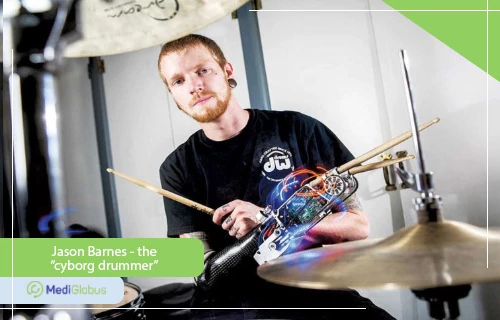
Jason Barnes is not just a talented drummer, but a true hero in the world of music. Since childhood, he dreamed of becoming a professional drummer. However, his music career almost ended after a tragic accident that resulted in the amputation of his arm up to the elbow. Instead of giving up, Jason attached his drumstick to a simple prosthetic and continued to pursue music.
Jason’s fate took a new turn when Professor Gil Weinberg of the Georgia Institute of Technology intervened in his life. His specially designed bionic prosthesis allowed Jason to use two drumsticks attached to the prosthesis at the same time. Jason controls one of them independently with the help of sensors that pick up muscle impulses. The second drumstick works autonomously. It is controlled by a special programme and can “hear” the musical rhythm.
What can a bionic prosthesis do?
Modern bionic prostheses allow users to reproduce a wide range of actions – holding objects of different shapes and sizes, driving, playing sports and many others. Integration with the nervous system and myoelectric control allows the prosthesis movements to be controlled with high precision. Moreover, the latest models of bionic prostheses utilise innovative technologies that enable the transmission of tactile sensations. This additional enhancement greatly increases the level of control and interaction with the environment.
Professor Weinberg didn’t stop there and in 2017 created an even more advanced prosthesis that allows each finger to be controlled separately. This advanced bionic prosthetic opened new horizons for Jason, allowing him to play the piano as well.
In 2024, Jason turned 34 years old. He took his drumming skills to a new level and became a kind of “musical cyborg”. He is recognised as the fastest drummer, being able to beat out the rhythm at a speed of 20 bps.
Jason is now working with leading manufacturers of bionic prostheses and is actively involved in the creation of “smart” prostheses for people with disabilities.
Playing without limits – the story of Angel Giuffria, who conquered the film world

Angel Giuffria is an American actress known for her roles in the big-budget TV series “Goliath”, “Through the Snow”, “Impulse” and films including the blockbusters “The Hunger Games” with Jennifer Lawrence and “Payback” with Ben Affleck. She is also involved in community activities and advocates for equal opportunities for people with disabilities.
Angel Giuffria has become a shining example of willpower and determination despite her physical limitations. Born without a left arm, she began wearing a prosthetic at 4 months old. Since childhood, Angel dreamed of a career as an actress. However, she was self-conscious about her appearance and believed that the prosthesis would be a barrier to achieving her dream.
However, despite everything, Angel chased her dream. At the age of 18, she started her modelling career and shot for local photographers. After going to university, in her spare time, she worked part-time on film sets as an extra.
Everything changed in 2011. During the filming of the film “Green Lantern” director Martin Campbell noticed Angel Giuffria and chose her among 60 candidates for a supporting role. He was the first to support her and made it clear that the absence of an arm is not a barrier to creativity.
After receiving a bachelor’s degree in psychology, Angel seriously pursued an acting career. She found an agent and insisted on using the BeBionic bionic prosthesis, which became part of her unique look. Since that decision, she has starred in several successful films and TV series.
Angel’s goal in the entertainment industry is to defeat stereotypes and prove that differences in appearance are not only acceptable but inspiring. Her confidence and talent allow her to play a variety of roles despite her physical features.
What are the benefits of bionic prosthetics?
Apart from the fact that bionic prostheses allow you to reproduce movements as close to natural movements as possible, they have numerous other advantages. Some models are equipped with additional features such as smartphone connectivity, in-built touchscreen monitors, torches, clocks, GPS, USB, Bluetooth and others, which significantly expand the capabilities of the prosthesis. They also provide increased safety during use. Thanks to the presence of sensors and transducers, the prosthesis prevents incorrect movements or the risk of falling. In addition, bionic prostheses are made of lightweight but durable materials, which makes them as comfortable to wear as possible. A variety of designs allows you to choose the best option for your individual preferences and lifestyle.
The art of self-expression – Victoria Modesta and her success story
Victoria Modesta is known today as a successful and in-demand model, singer and creative artist. She was born with a dislocated left hip due to a medical error. The girl spent most of her childhood in hospitals and underwent 15 surgeries. However, this did not save her left leg. In 2007, at the age of 19, the decision was made to amputate it to avoid serious health problems in the future. This step was a turning point in her life, opening the door to new opportunities.
Victoria has been involved in music since the age of 6 and has achieved a lot of success. However, her real fame was brought to her by the extravagant image she created with the help of prosthetics. In 2009, she began a collaboration with producer Nick Hodges. Together they created the track “Jane Bond”, which entered the Music Week playlist. A year later, Victoria took part in the Evo Music Rooms show in the UK, and made it into the top six performers. She then released the single “Only You” and signed to Channel 4 as part of the Born Risky campaign.
Victoria Modesta declared herself the world’s first “bionic pop artist”. As part of the project, she released the music video “Prototype”, which has amassed over 6 million views on YouTube, and 16 million on Facebook and won the Silver Lion Award at the Cannes Film Festival.

Prosthetics have become an integral part of Victoria’s image. She chose unique designs such as the “stereo leg”, a prosthetic made of crystals and a shiny black spike. These stylish elements became not only a means of maintaining her mobility but also an important part of her self-expression. She took part in Milan and London Fashion Week shows, became the face of Samsung and Vodafone brands, and was on the cover of Bizarre and Skin Two magazines. In addition, the girl’s success story was published on the pages of i-D Magazine, Upworthy, Forbes and Elle Magazine USA.
Victoria Modesta epitomises the idea that beauty has no standards, and that talent and willpower can transform any circumstance. “I chose my way to express myself and I hope people understand me. None of us should follow some made-up rules. The more your life is like a film, the more interesting and vivid it will be.”
Summary
 A bionic prosthesis is an artificial limb created using advanced technology and bionic components. Its main purpose is to replenish the function of a lost or damaged limb and restore daily activity.
Bionic prostheses are based on the integration of advanced technologies with the human nervous system. Electrodes embedded in the prosthesis record electrical signals from the muscles, and data processing algorithms translate them into commands, providing precise control.
Modern bionic prostheses have versatile functions and allow users to perform various actions necessary for daily and professional activities.
Даже потеряв конечность, люди продолжают жить полноценной и вдохновляющEven after losing a limb, people continue to live fulfilling and inspiring lives, demonstrating incredible fortitude and determination. The story of Sarah Reinertsen, a successful amputee athlete, emphasises that physical limitations are no barrier to achieving outstanding performance in sport. Kelly Knox, who became the most influential model without an arm, and Jason Barnes, who excelled in the world of music, demonstrate that talent and determination can overcome any physical barrier. Actress Angel Giuffria and singer Victoria Modesta are prime examples of how people with amputations can become famous and successful.
If you are interested in modern prosthetics, contact a MediGlobus coordinator. We can help you find the right clinic according to your preferences, organise an appointment with an experienced doctor and provide all the support you need. Click on the button below and fill out the form for a free consultation.