



1. What are endoprostheses? |
2. Types of endoprostheses |
3. How to choose an endoprosthesis? |
4. Manufacturers of joint prostheses |
5. Endoprosthetic clinics |
6. Cost of endoprosthetics |
Joint endoprosthetics offer a great improvement in the quality of life and mobility restoration. According to the National Library of Medicine, more than 3,1 million hip replacements and 2,5 million knee replacements are performed annually in Europe. In the United States, approximately 4,0 million adults are living with knee endoprostheses, representing around 4,2% of the population over the age of 50 years. These facts confirm the great importance of endoprosthetics in modern medicine and its important role in improving the quality of life of patients, as well as prolonging their lifetime activity. In this article, we will review the different types of joint endoprostheses, their distinctive features and selection criteria to help readers gain a comprehensive understanding of this topic.

Listen to the article:
What are endoprostheses and who needs them?
Endoprostheses are artificial joints that are used to replace damaged or diseased joints. They are designed to improve mobility and reduce pain in patients with joint disease or damage.
The need for endoprosthetics occurs when a joint becomes unsuitable for normal function. The decision to undergo surgery is made when other treatments fail. Surgery is performed for:

 osteoarthritis;
rheumatoid arthritis;
ankylosing spondylitis;
joint tumours;
congenital pathologies;
traumatic injuries.
To ensure the success of the surgery and to reduce the risk of complications, careful patient assessment is required. If there is a high risk of postoperative side effects, surgery may be contraindicated or postponed. The main contraindications are infectious diseases in the acute stage, neuromuscular and mental dysfunction, serious cardiovascular pathologies, decompensated diabetes mellitus, acute respiratory system disorders, severe osteoporosis, in which bone density and the ability to support the new joint are reduced, as well as smoking and alcohol consumption.
Abroad, orthopaedic surgeons take into account all factors that have a negative impact on the success of the procedure and the patient’s health. They use a multidisciplinary approach and comprehensive body diagnostics to choose the most effective and safe method of joint replacement. This ensures optimal results and prevents possible complications. Contact MediGlobus specialists to choose a clinic for joint diagnosis and treatment.
What types of endoprostheses are available?
A wide range of hip, knee, shoulder, ankle, elbow, wrist and hand joints, as well as foot joints, are used to treat orthopaedic diseases.
Total prostheses are designed to completely replace a damaged joint. They consist of artificial materials that replace the joint pads and head.
Partial endoprostheses are used when the damage to the joint is not severe enough to require total replacement. They replace only the tissue affected by the disease, leaving the rest of the joint structures intact. It is a less invasive procedure than a full joint replacement.
Endoprostheses are also categorised by design. Fixed Bearing prostheses have one moving component and are recommended for patients with weak ligaments and tendons. If a person is overweight, this prosthesis will wear out faster.
Mobile Bearing prostheses have two moving components. Their design is as close as possible to a natural joint. Since this type of endoprosthesis allows greater freedom of movement, it is suitable for people with high mobility.
Endoprostheses are made of different materials – metal, plastic, and ceramics. This determines the functionality of the joint, the duration of use and the cost of the prosthesis.
The most common types of hip joint endoprostheses:
Metal+plastic. The advantage is the relatively low cost. However, since plastic wears out rather quickly, this type of prosthesis is not suitable for people with an active lifestyle.
Ceramic+plastic. Compared to the previous option, a prosthesis made of ceramic and plastic has a higher degree of wear resistance. These materials are recommended for patients with low physical activity.
Ceramic+ceramic. Such prostheses have a longer service life and freedom of movement. They are suitable for active people. The price of ceramic+ceramic endoprosthesis is slightly higher than the previous options.
Metal+metal. These endoprostheses are considered the most reliable, and able to serve for many years. However, when the material wears out, metal particles can accumulate in the body. In addition, the price of metal-on-metal hip replacements is significantly higher than other materials.
Methods of implant placement also vary. Prosthesis implantation uses a special polymer cement that glues the implant to the bone. This method is widely used and guarantees a secure fixation, especially in cases where the bone is not dense enough. The cementless prosthesis interacts directly with the bone tissue and integrates into it. It provides stability and long-term fixation due to its design and surface properties, allowing the bone to grow around the prosthesis.
The final choice of prosthesis type and fitting method depends on the condition of the joints and the individual characteristics of the patient.
What to look for when choosing an endoprosthesis?
The following aspects are worth considering when selecting an endoprosthesis:
Compliance with the individual needs and anatomical features of the patient.
Durability and functionality of the prosthesis.
Quality and reliability of the manufacturer.
Cost of the prosthesis.
By considering these factors, you can choose the endoprosthesis that is best for your particular situation. Contact the experts at MediGlobus for more information and advice.
Joint replacement manufacturers – who to choose?
When it comes to choosing an endoprosthesis manufacturer, several leading companies have earned the trust of the medical community.
Prosthetic joints from Zimmer Biomet
This is one of the leading manufacturers of joint prostheses that has earned the trust of the medical community. The company has been developing prosthetic joints since 1927. It has manufacturing facilities in 40 countries, allowing it to provide high-quality prostheses worldwide.
In 2020, Zimmer Biomet won gold at the Edison Awards in the Advanced Surgical Instruments category, and in 2021, it was honoured at the Healthcare Asia Medtech Awards for its ROSA robotic knee endoprosthesis unit.

The company’s developers actively cooperate with doctors and research centres to continuously improve their products and apply the latest medical advances. They offer a wide range of prostheses for various joints, including hip, knee, shoulder and ankle. The prostheses are made of improved materials, with special surfaces and designs that promote a precise fit, natural function and long life. For example, the Oxford partial knee endoprosthesis has demonstrated more than 10-year survival rates in 94% of patients (according to the UK national registry).
Zimmer Biomet specialises not only in creating artificial implants but also develops cell therapy products designed to repair damaged cartilage in joints. Their innovative DeNovoNT technology is an effective treatment for grade I-II osteoarthritis, promoting cartilage regeneration and restoring functionality.
If you are interested in the price of Zimmer hip, knee or other joint endoprosthetics, please contact the experts at MediGlobus for more information on this subject.
DePuy Synthes Endoprostheses
DePuy Synthes is a division of Johnson & Johnson. The company was founded in 1895 and according to its website, it was “the world’s first orthopaedic manufacturing company.” It offers prosthetic replacements for hip, knee and shoulder joints, as well as products for the use of facial and skull reconstruction.
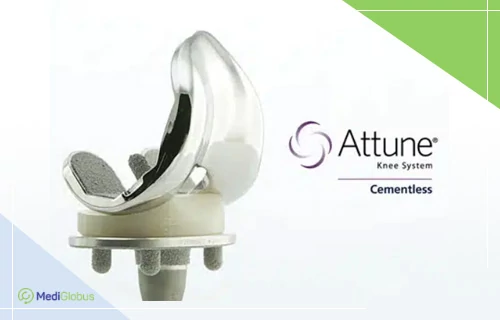
The company has an impeccable reputation in the field of orthopaedic prostheses. With its years of experience and innovative approaches, it is committed to providing quality and effective joint replacement solutions. A huge number of patients from all over the world place their trust in DePuy Synthes prostheses. Since 2013, approximately 1,8 million knee replacement surgeries have been performed using ATTUNE Knee System endoprostheses. In addition, more than 400,000 people worldwide have had hip replacements with the latest ACTIS system.
Interesting fact: DePuy Synthes also manufactures metal plates and screws that are used to correct knee joint problems in dogs.
You can ask MediGlobus specialists about Depuy hip prosthetics, its price and other questions. We will provide comprehensive information and help you choose the best solution.
Endoprostheses from Smith+Nephew
Smith+Nephew is a British manufacturer of joint prostheses. Its roots can be traced back to a small pharmacy in the town of Hull, England, founded by Thomas James Smith in the mid-19th century. After Smith died in 1896, his nephew Horatio Nelson Smith took over the company. According to information on the Smith+Nephew website, in 1914, the younger Smith met with representatives of the French president and negotiated a contract to supply surgical and field dressings for soldiers fighting in the war. The company has since grown and restructured in 1998 to focus on wound care, endoscopy and orthopaedics.

In 2001, Smith+Nephew became one of the top 100 companies traded on the London Stock Exchange. Today, it has annual sales of $5,2 billion. It develops systems for knee, hip and shoulder replacements, as well as instruments and technologies used in the repair of soft tissue injuries. The manufacturer has a well-respected reputation and continues to evolve with innovative orthopaedic solutions. By choosing a Smith & Nephew endoprosthesis, patients are guaranteed a long-lasting prosthesis and comfortable mobility.
If you are interested in a Smith & Nephew hip prosthesis, its price and features, or if you would like information about other Smith & Nephew hip prostheses, please contact MediGlobu specialists.
Stryker Endoprosthesis

The company was founded in 1941 by orthopaedic physician Homer Stryker when he discovered that most medical devices were not meeting the needs of his patients. Stryker specialises in hip, knee, ankle, wrist, wrist and shoulder implants. They also offer solutions for oral and maxillofacial surgery, spine technology and manufacture surgical instruments. Stryker is known for its progressive approach to developing new products and innovative solutions. The manufacturer is committed to improving surgical outcomes and patient satisfaction by offering a wide range of products and technologies for various fields of orthopaedics and surgery.
With years of experience and a constant drive for innovation, Stryker continues to be one of the leading manufacturers of orthopaedic implants and medical devices. To date, more than 1 million endoprosthetic surgeries have been performed worldwide using Stryker technology. Their products help restore motion and improve patients’ quality of life, and their innovative designs are helping to improve treatments and surgical procedures.
 Read:
Read: Wright Medical Group implants
Wright Medical Group was founded in the middle of the 20th century. Today, it is part of the Stryker group. The organisation has a reputation for innovation and reliability in orthopaedic products. It offers solutions for various areas of orthopaedics, helping patients regain functionality and quality of life. Wright Medical Group manufactures prosthetics, implants and technologies to treat injuries and diseases of the foot, ankle, hand, elbow, shoulder and wrist.
Wright Medical Group continually strives to innovate and improve their products to meet the needs of patients and physicians. They are actively developing new technologies and treatments.
Aesculap Artificial Joints
Founded in 1867 in Tuttlingen, Germany, Aesculap is a respected manufacturer of surgical instruments and medical devices. Throughout its history, it has established itself as a trusted supplier to the healthcare industry. The organisation specialises in the development and manufacture of a wide range of surgical instruments, implants and equipment. They offer prosthetic devices for various medical fields including orthopaedics, neurosurgery, cardiac surgery, and others. The company is constantly working to develop innovations and technologies to provide the best care for patients. Aesculap endoprostheses are characterised by durability and high-quality performance.
Mathys Endoprostheses
The company, founded in 1946, is a world leader in orthopaedic prostheses. In 2021, it became part of the American company Enovis. The main area of specialisation is the development, production and distribution of implants for joint replacement. The range includes prostheses for hip, knee, shoulder and sports orthopaedics. The company is based in Bettlach, Switzerland, with manufacturing sites in Switzerland and Germany and subsidiaries in 10 countries. Mathys actively researches and develops new technologies aimed at improving the safety and quality of surgical procedures and the health and comfort of patients.
Where are joint replacement surgeries performed?
The leading endoprosthetic clinics are located in Turkey, Israel, South Korea, Germany, Czech Republic, Lithuania, Poland and Spain. They apply modern and safe methods and use high-quality prostheses from world manufacturers.
The most popular medical centres for endoprosthetics:
Liv Hospital (Turkey);
Medistate Hospital (Turkey);
OST Munich Orthopaedic Centre (Germany);
Motol Medical Centre (Czech Republic);
Souraski Medical Centre (Israel);
Rambam Medical Centre (Israel);
Severance Hospital (South Korea);
Teknon Clinic (Spain);
KCM Clinic (Poland);
Kardiolita Centre (Lithuania).
How much does endoprosthetics cost?
The price of surgery to replace a diseased joint with an artificial one depends largely on the complexity of the pathology, the type of prosthesis and the method of surgery. In addition, the cost of treatment differs from country to country.
Cost of joint replacement in 2023:
| Country | Cost |
|---|---|
| Turkey | оfromт $7,000 |
| Israel | from $17,000 |
| South Korea | from $13,000 |
| Czech Republic | from €10,000 |
| Country | Cost |
|---|---|
| Poland | from €5,800 |
| Lithuania | from €8,000 |
| Spain | from €16,900 |
| Germany | from €16,800 |
Summary
Joint endoprosthetics is a surgical procedure to replace a damaged or worn-out joint with an artificial implant. It is performed to eliminate pain, restore joint functionality and improve patients’ quality of life.
Endoprosthetics are recommended when a joint suffers from severe damage, arthritis, osteoarthritis or other conditions that cause chronic pain, restriction of movement and a significant deterioration in the patient’s quality of life. This decision is made when conservative treatments fail.
Prostheses can be fixed or mobile. They are made of metal, plastic, ceramic and a combination of these.
Zimmer Biomet, DePuy Synthes, Smith+Nephew, Stryker and others are among the main companies manufacturing joint endoprostheses. These companies have an impeccable reputation and a long history in the field of orthopaedics. They provide high-quality products based on advanced research and innovation. One of the main advantages of these companies is their wide range of products, which includes prostheses for various joints, instruments and technologies that enable surgeons to perform precise and successful operations.
Joint endoprosthetics using modern technology are performed in Turkey, Israel, South Korea, Germany, the Czech Republic, Lithuania, Poland and Spain.
The cost of endoprosthetics depends on the type of prosthesis, the complexity of joint damage, the patient’s condition and the country. The approximate price in Turkey is from $7,000, in Israel – from $17,000, in South Korea – from $13,000, in European countries – from €5,800 to €16,800.
To book an appointment with an orthopaedic surgeon and start your joint treatment at one of the world’s leading clinics, click on the button below and wait for a call from a MediGlobus coordinator.