
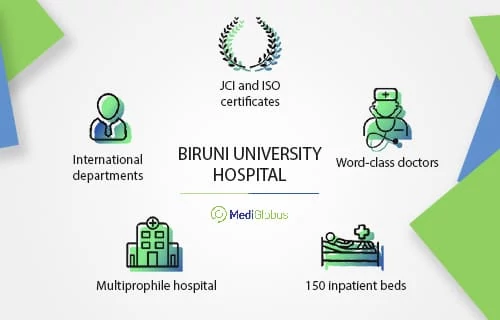



Biruni University Hospital is a world-class modern Turkish medical centre located in Istanbul. The hospital is housed in a ten-storey building with 500 employees, more than 100 of whom are highly specialised doctors. There are 150 inpatient beds. The hospital has the following departments:
- Medical tourism
- Clinics
- Turkey
- Biruni University Hospital
Biruni University Hospital
Istanbul, Turkey
Clinic Review

- Cardiology
- Cardiovascular surgery
- Gastroenterology
- Neurology
- Neurosurgery
- Oncology
- Ophthalmology
- Orthopedics and traumatology
- Surgery
Features of the Clinic
Neurosurgery at the Biruni Clinic
The neurosurgical department has all the equipment it needs to diagnose diseases (including early diagnostics) and to carry out operations. Specialists select an individual therapy programme for each patient, which increases the chances of a successful surgical outcome. The main areas of neurosurgery that the local doctors work with are:
- vascular;
- functional;
- oncological;
- pediatric.
Minimally invasive surgery using the da Vinci robot helps doctors to successfully perform complex spinal cord and brain surgeries. After these operations, mortality and the occurrence of severe neurological disorders are reduced to zero.
| Deep Brain Stimulation DBS |
| Brain MRI |
| Consultation with a neurosurgeon |
| Stimulator insertion surgery |
| Quality of life recommendations |
State-of-the-art preoperative diagnostics at Biruni Hospital
At the Biruni clinic, depending on the patient’s illness, doctors can run several sophisticated tests:
- Doppler Ultrasound is a method of diagnosing blood vessels, which is used to determine the speed of blood flow and the presence of obstructions in the circulatory system.
- Discography is a modern examination of the spine for chronic pain syndrome. In discography, a contrast agent is injected into the intervertebral disc, followed by a targeted CT scan.
- Magnetic resonance imaging – used to detect pathological processes in organs, MRI can detect tumours, injuries, bleeding, neurodegenerative diseases.
- An electroencephalogram is an examination used to assess the electrical activity of the brain in cases of epilepsy, head injuries and suspected tumours.
- Brainstem evoked potential studies – used to detect damage to the nervous system in hearing, vision, movement and a range of neurological disorders.
What diseases are most often treated here by foreign patients in the neurosurgery department?
- epilepsy;
- scoliosis;
- intervertebral hernia;
- spinal injuries;
- tumours of the spinal cord and brain;
- peripheral nerve injuries;
- post-operative complications;
- etc.
When carrying out neurosurgery, specialists choose the most appropriate procedure options for each case. This is where doctors turn to these types of interventions:
- percutaneous minimally invasive surgery;
- stereotactic surgery;
- endoscopic surgery;
- microsurgery;
- open surgery.
| Transnasal resection of a pituitary adenoma |
| Consultation with a specialist |
| Comprehensive examination |
| A minimally invasive operation to remove a pituitary adenoma |
| Rehabilitation |
Orthopaedics at the Biruni Clinic
The medical centre offers effective treatment for orthopaedic diseases, which includes both non-invasive and surgical therapies. Endoscopic instruments are successfully used here and open surgery is performed. In addition, the doctors of the department specialise in sports surgery, reconstructive surgery, traumatology and paediatric orthopaedics and spinal surgery. The orthopaedists at the Biruni Clinic most often treat scoliosis, tendon injuries, joint injuries, movement disorders and congenital bone deformities.
Rehabilitation at Biruni Medical Centre
Patients who need rehabilitation can undergo it according to modern standards in the physiotherapy and rehabilitation department of Biruni Hospital. The doctors use a multidisciplinary approach to draw up a treatment programme – this helps to ensure that rehabilitation is tailored to all the patient’s needs in the shortest possible time. The clinic provides quality rehabilitation treatment for neurological and orthopaedic diseases, sports injuries and congenital pathologies. The doctors at the Biruni Clinic use effective modern techniques that have proven themselves worldwide:
- Infrared treatment – accelerates the metabolic process in the area affected by the beam, thus increasing local resistance to pathological processes;
- Cryotherapy – reduces muscle spasticity and has anti-inflammatory and pain-relieving effects;
- Electrostimulation – used to restore organ functions by affecting nerve and muscle tissues;
- Ultrasound therapy – stimulates blood and lymph circulation and speeds up tissue regeneration;
- Hilterap (high-density laser) – a rehabilitation method that is used in cases of degenerative joint diseases and injuries of various types;
- ESWT (shock wave therapy) – used for severe chronic diseases of the musculoskeletal system;
- Ozone therapy – is used to strengthen the body’s defence functions and normalise metabolism;
- etc.
Child psychology at Biruni University Hospital
For young patients with developmental delays, difficulties in adapting to society and other psychological problems, the specialists at the medical centre apply a special approach. Each child receives the care and productive therapy from the ward’s staff, which quickly improves their ability to perceive the world around them.
Cost of diagnosis and treatment at Biruni University Hospital
| Procedure | Cost |
| Specialist consultation | from $150 |
| Magnetic Resonance Imaging (MRI) | from $700 |
| Biopsy | from $1,700 |
| Computed Tomography (CT) | from $400 |
| Coronarography | from $800 |
| Lab tests | from $250 |
| Procedure | Cost |
| Robotic Prostatectomy | from $14,000 |
| Coronary Artery Bypass surgery | from $9,000 |
| Cochlear implant surgery | from $12,000 |
| Knee replacement | from $14,000 |
| A kidney transplant from a related donor | from $18,000 |
| Chemotherapy | from $1,500 |
Certificates
Doctors
Location of the Clinic