Moshe Soroka Medical Centre is one of Israel’s leading general hospitals, treating over 500,000 outpatients and more than 200,000 inpatients from all over the world each year. Some 48,000 CT and MRI diagnostic procedures, 32,000 surgeries and approximately 15,000 births are performed here.
- Medical tourism
- Clinics
- Israel
- Soroka Medical Center
Soroka Medical Center
Beersheba, Israel
Clinic Review

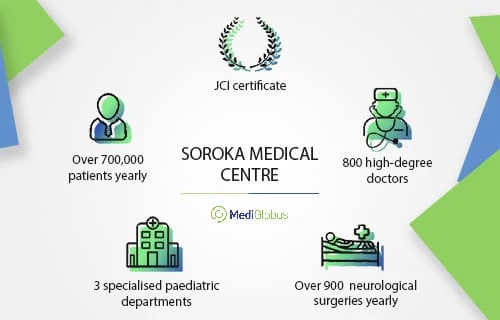
In 2008, the hospital was certified by the Joint Commission for International Accreditation of Healthcare Institutions (JCI). The quality of the hospital’s services is checked every 3 years. In 2012 and 2015, Soroka Medical Center was reaccredited by the JCI.
What does it mean to have this certificate? Confirmation of the highest quality of health care services provided, namely:
- Availability of new generation equipment that ensures accurate diagnosis and effective treatment of patients;
- Successful surgeries using advanced techniques;
- The use of innovative medicines during treatment;
- Minimising the likelihood of medical errors.
Soroka Hospital consists of 40 specialised departments, including one of Israel’s largest paediatrics departments with over 40,000 patients treated and diagnosed each year. It is divided into 3 departments:
Dalet – a general pediatric department that treats patients from 0 to 18 years of age with all types of diseases of varying degrees of severity. It has been awarded “Expert in Pediatrics” status by the Israel Medical Association for the successful treatment of pediatric diseases and its research activities.
The Aleph department treats infectious diseases and respiratory tract illnesses. The leading paediatricians of this clinic cooperate with Columbia University, allowing them to improve treatment methods for small patients.
Beth department specialises in lung disease treatment. The professionalism of doctors at the Soroka Medical Centre and the use of the latest methods make it possible to effectively deal with even the most advanced cases of paediatric illnesses.
Israel’s Soroka Hospital began accepting patients for treatment in 1960. In 1974, the clinic opened a medical school and Ben-Gurion University became a full partner of Soroka Medical Center in the scientific and practical fields.
The university status gives patients access to innovative cancer therapies, the safest surgical techniques and advanced treatments for infectious diseases. The clinic now employs 4,500 staff, 800 of whom are senior doctors.
Features of the Clinic
The clinic provides advanced treatment for all types of stage 1-4 cancer through a combination of chemotherapy, radiotherapy and surgery.
The most frequent visitors to Soroka Hospital are patients with leukaemia. 30% of patients in the paediatric oncology unit are admitted with this diagnosis. 15-20% of children struggle with malignant growths in the brain – medulloblastoma or astrocytoma.
10-15% of young patients at the Soroka Medical Centre are battling lymphoma. The doctors here also effectively treat cancer of the sympathetic nervous system (neuroblastoma) and bone cancer (sarcoma).
Leading Israeli oncologists use MRI and CT scans to accurately diagnose the disease.
MRI is a safe diagnostic method, as it is carried out with a state-of-the-art electromagnetic scanner without the use of X-rays. The best oncologists in Israel use MRI to determine the size, shape and location of a tumour to within 1 mm. It also allows for detailed examination of soft tissues, joints and vessels.

The hospital has an advanced CT scanner that minimises radiation exposure to the patient’s body. CT scans are only administered to children if an MRI scan cannot be used to make an accurate diagnosis.
For the treatment of cancer in children, oncologists at the Soroka Clinic in Israel prescribe:
| Tumour resection | The specialists at the Soroka hospital perform organ-preserving surgeries to remove malignant growths. The procedure is carried out in high-tech surgical units, which increases the success and safety of the operation. |
| Chemotherapy | Intravenous or medicament introduction of special medications into the organism of the cancer patient, which stops the development of cancerous cells. |
| Radiation therapy | Radiation therapy at the Soroka Medical Centre – conducted with the help of advanced linear accelerators, minimises the impact of radiation on healthy tissues and organs of children. High-dose radiation is aimed directly at the tumour and destroys it from the inside. |
| Immunotherapy | Involves treating cancer with drugs that act on the patient’s immune system and allow it to fight cancer effectively, destroying the pathological cells and preventing a recurrence. |
| Autologousm BMT | An autologous bone marrow transplant is used to restore the child’s immune system after aggressive chemotherapy. A small amount of healthy bone marrow is taken from the patient before treatment, frozen and successfully transplanted back after the chemotherapy has ended. |
Treatment for neurosurgical diseases in Israel at Soroka Hospital
The Soroka Medical Centre treats diseases of the brain, spinal cord, and central and peripheral nervous system in patients from all over the world. More than 900 neurosurgical operations and 1,500 procedures are performed here each year.
The clinic’s specialists are among Israel’s leaders in the treatment of malignant and benign tumours of the central nervous system, brain cancer, congenital pathologies and trauma.
The neurosurgery department at Soroka Hospital is equipped with an intraoperative MRI unit that allows to:
- Carry out surgical removal of neoplasms as safely as possible, as it makes it possible to observe the brain during the operation;
- Minimise post-operative complications and speed up the patient’s recovery process, as the unit enables the surgeon to open the skull at the right size in the right place with an accuracy of 2 mm;
- Avoid trauma to vital brain centres near the tumour by tracing their exact location;
- The leading Israeli neurosurgeons at the Soroka Clinic can detect brain haemorrhages in time and take timely action, not only in the area that is under the surgeon’s direct supervision but also in more distant areas of the brain;
- Prevent recurrences, because only with the intraoperative MRI unit can specialists examine the operated area in detail and make sure that the malignant neoplasm is completely removed.
Certificates
Doctors
Location of the Clinic