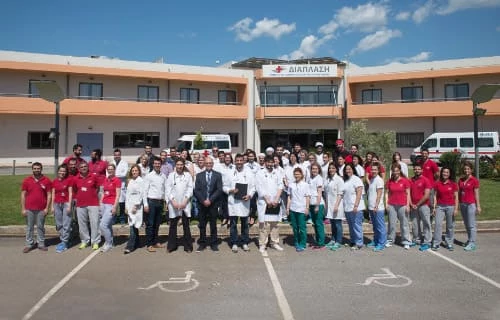
The Diaplasis Rehabilitation and Recovery Center is the leading rehabilitation clinic in Greece. It aims to help patients from all over the world to regain their health after injuries of the musculoskeletal system, heart surgery, diseases of the nervous system. 90% of Diaplasis patients manage to restore their body functions and get back to their normal lives.
- Medical tourism
- Clinics
- Greece
- The Diaplasis Rehabilitation and Recovery Center
The Diaplasis Rehabilitation and Recovery Center
Greece, Kalamata
Clinic Review

The hospital provides medical services according to ISO 9001 quality standards worldwide and is monitored by the Greek National Health Organization EOPYY.
In all developed countries of the world, patients after heart attacks, strokes, craniocerebral injuries, complex fractures, and major surgeries are referred to a rehabilitation centre. This is necessary since full home recovery is impossible after such injuries. Only specialists can restore patients’ ability to move, coordinate movements, speak, and take care of themselves.
The Dialysis Clinic employs rehabilitation therapists, physical therapists, speech therapists, and occupational therapists with more than 15 years of experience. They collectively prescribe the most suitable rehabilitation scheme, which takes into account all the individual characteristics of the patient (condition at the time of arrival at the hospital, the presence of chronic diseases, etc).
A personalized treatment plan and continuous improvement of rehabilitation methods allow for the most effective recovery of patients: 85% of patients regained their health in 2015, 87% in 2016 and 90% in 2017.
The Diaplasis Rehabilitation Center in Greece is visited by patients with:
- Diseases and injuries of the musculoskeletal system: joint repair, fractures, amputations, disc hernias, lumbago, cervical syndrome, sports injuries, military injuries, brachial plexus injuries;
- Diseases and injuries of the nervous system: craniocerebral injuries, degenerative diseases of the CNS, ataxia, paraplegia, neurosurgery, diseases and injuries of the spinal cord, multiple sclerosis, neuritis, Parkinson’s disease, tumours of the nervous system;
- Diseases of the cardiovascular system: heart surgery, heart attacks;
- Diseases of the respiratory system: chronic respiratory failure, cystic fibrosis, asthma;
- Autoimmune disorders: disorders of higher brain functions, sex drive disorders, ankylosing spondylitis, lupus erythematosus, rheumatoid arthritis;
- Congenital diseases of the musculoskeletal and nervous system: spinal hernia; cerebral palsy; myopathy;
- Age-related diseases: idiopathic scoliosis, obstetric paralysis, spina bifida in children and movement disorders in the elderly.
Features of the Clinic
Diagnosis of patients at Diaplasis Rehabilitation Center
Diaplasis clinic in Greece has 6 diagnostic departments, which allow for a comprehensive examination of the patient to accurately determine the degree of impairment and prescribe the most effective scheme of rehabilitation.
Radiological Diagnostic Laboratory – performs accurate radiological examinations using the latest X-ray machines.
Cardiology Laboratory – allows a detailed examination of a patient’s heart after cardiac surgery, heart attacks.
Motion and Walking Analysis Laboratory allows to detect deviations of walking from the norm in case of cerebral palsy, central nervous system injuries, myopathy, stroke, arthroplasty, patients with prostheses, sports injuries, and also in children from 6 years old with balance problems.
Electromyography Laboratory – makes it possible to evaluate the functional state of muscle tissues, nerves and neuromuscular transmission, examining the biopotential of the muscles at rest and in tension.
Urodynamics Research Laboratory – allows studying disorders of lower urinary tract functions like incontinence, urinary tract obstruction, infravesical obstruction, urinary disorders in children.
Spirometry Laboratory for determining the type of functional insufficiency of the respiratory tract, locating the pathological process, the nature of the damage.
Robotic methods of rehabilitation at Diaplasis Clinic
Patients at the Diaplasis Rehabilitation Center in Greece have access to an advanced robotic system for restoring walking function, the Lokomat.
This is a unique automated device with orthoses that helps return the ability to walk to patients after stroke, spinal cord injuries, multiple sclerosis, craniocerebral injuries.
With the Lokomat, Diaplasis specialists teach patients how to walk properly using repetition and goal-oriented teaching methods. This approach to rehabilitation allows for shorter treatment times and a quick return to the patient’s usual way of life.
The advantages of the Lokomat robotic system:

- the patient performs a longer and more intense functional workout compared to training on a conventional treadmill;
- the device provides a physiological walking pattern with individually adjusted orthotics and a weight support system;
- the Lokomat is suitable for rehabilitating children, as it has children’s robotic orthoses;
- the system allows the patient’s progress to be measured, which helps to adjust the type and duration of exercise, and the patient sees their results in real-time, which is additional motivation.
The Lokomat is a support system for hip joints and two robotic lower limbs. Rehabilitation procedures with this device are performed on a special track with a connected body weight support system. Doctors control the Lokomat system via a computer.
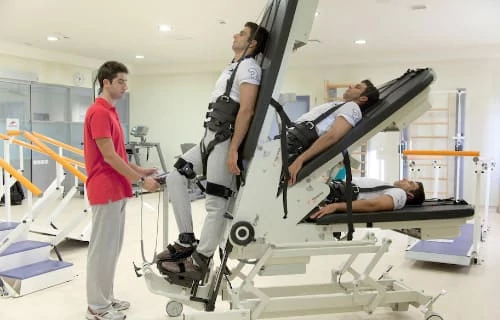
Also available at the Diaplasis Rehabilitation Center is the Erigo robotic platform with an automated orthopaedic device for lower limb movement and mobilization of neurological patients. This device allows accelerating the early rehabilitation of patients after stroke, craniocerebral injuries, spinal cord injuries, multiple sclerosis, Parkinson’s disease.
Erigo provides intensive motor therapy and cyclic exercise for the lower extremities. The system helps recovery of the cardiovascular and respiratory systems, as well as the musculoskeletal system.
| Rehabilitation after accidents |
| 14-day course |
| Erigo, Lokomat exercises |
| Regular occupational therapy |
| Educating relatives about caring for the patient |
Certificates
Doctors
Location of the Clinic